How to Bill Mixed Goods and Services in One GST Invoice
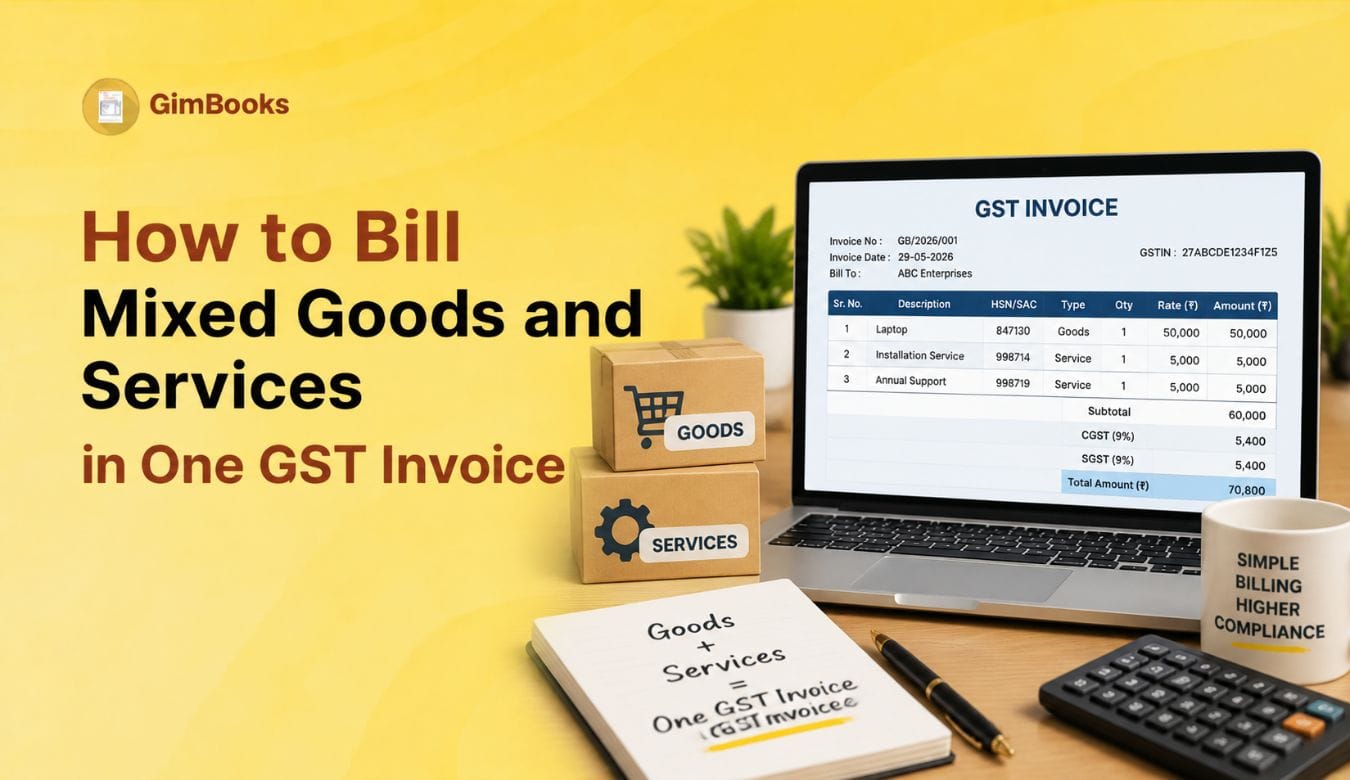
A repair business replaces a spare part and charges labour. An IT company supplies hardware along with installation. An agency supplies printed material as well as design services. A consultant may provide a product, subscription or other taxable item along with professional services.
In all these situations, one practical GST question comes up:
Can goods and services be billed together on the same GST invoice?
Yes, goods and services can generally appear on the same GST invoice. But putting them on one invoice does not automatically mean they become a mixed supply under GST.
The correct GST treatment depends on whether the items are:
- Independent supplies
- A composite supply, or
- A mixed supply
This distinction determines whether you should apply separate GST rates, the rate of the principal supply, or the highest applicable GST rate.
If you first want to understand the basic structure and mandatory information required in a GST bill, read our GST Invoice Guide: GST Components, Invoice Format and Rules.
This guide focuses specifically on how to bill goods and services in one GST invoice, how to use HSN and SAC codes, and what agencies, consultants, repair businesses, freelancers and other MSMEs should check before issuing the bill.
Can Goods and Services Be Included in the Same GST Invoice?
Yes. A GST tax invoice can contain supplies of goods, services or both. Therefore, you do not necessarily need to create one invoice for the goods and another invoice for the service merely because the transaction contains both.
Businesses should also ensure that the invoice contains all required GST details before issuing it. Following a proper GST invoice mandatory fields checklist helps verify important fields such as HSN/SAC, GST rate, taxable value, invoice number and place of supply.
For example, suppose a computer repair business bills a customer for:
Both items may be shown on the same invoice where the transaction and applicable GST treatment permit it.
However, before calculating GST, you need to answer a more important question:
Are these two independent supplies, or are they one bundled supply for GST purposes?
That determines how GST should be charged.
One Invoice Does Not Automatically Mean Mixed Supply
This is one of the most important points for businesses to understand.
The everyday phrase “mixed goods and services invoice” should not be confused with the legal GST term “mixed supply.”
You can have goods and services on the same invoice without the transaction becoming a mixed supply.
For GST purposes, a transaction containing several items can generally fall into one of these three situations:
So, do not select the highest GST rate merely because a bill contains both a product and a service.
First identify the nature of the transaction.
Scenario 1: Independent Goods and Services on the Same Invoice
Suppose a repair shop sells a replacement part and separately charges for repair labour.
If the goods and services are treated as independent supplies based on the nature of the transaction, they can be separately identified on the invoice.
For example:
The product line should carry the appropriate HSN code, while the service line should carry the appropriate SAC/accounting code.
GST can then be calculated according to the applicable treatment of each independent supply.
This is usually the clearest way to invoice when the goods and services genuinely retain their separate identities.
Practical Example
Imagine an electronics repair business charges:
- Replacement component: ₹8,000
- Repair service: ₹2,000
If these are independent supplies, the invoice can show both as separate line items, with the appropriate HSN/SAC and GST treatment against each line.
You do not have to label the whole ₹10,000 transaction as a mixed supply simply because one line is goods and the other is a service.
Incorrectly mapping GST rates or classifications can create reconciliation and ITC problems later. See our guide to 10 Common GST Invoice Errors and How to Avoid Them for other mistakes businesses should check before issuing an invoice.
Scenario 2: Composite Supply of Goods and Services
A composite supply consists of two or more taxable supplies of goods or services, or both, that are naturally bundled and supplied together in the ordinary course of business, with one being the principal supply.
The principal supply is essentially the predominant element of the transaction.
A common example is goods supplied along with packing, transportation and insurance where those elements form a natural bundle and the goods are the principal supply.
GST Rate for Composite Supply
Under Section 8 of the CGST Act, a composite supply is treated as the supply of its principal supply.
That means the GST treatment of the principal supply generally determines the treatment of the entire composite supply.
Example: Equipment With Installation
Suppose a business sells specialised equipment and installation is naturally connected with the supply.
Before creating separate GST calculations merely because the invoice contains a product and installation service, the supplier should examine whether the transaction constitutes a composite supply and identify its principal supply.
If the equipment is the principal supply, the composite supply is treated accordingly.
The exact result can depend on the contract and facts, so businesses should not classify a bundle merely by looking at the invoice layout.
Scenario 3: Mixed Supply Under GST
A mixed supply has a specific meaning under GST.
It generally involves two or more individual supplies of goods or services, or any combination of them:
- supplied together;
- for a single price;
- capable of being supplied separately; and
- not qualifying as a composite supply.
For example, imagine several unrelated taxable products or services are deliberately combined into a promotional package and sold for one consolidated price even though they are not naturally bundled.
That can potentially be a mixed supply.
Which GST Rate Applies to a Mixed Supply?
Under Section 8 of the CGST Act, a mixed supply is treated as the supply that attracts the highest rate of tax among the components.
This is why incorrectly classifying a transaction as mixed supply can materially change the GST charged.
Composite Supply vs Mixed Supply vs Independent Supplies
Use this quick comparison before creating the invoice:
The most important lesson is simple:
One invoice does not decide the GST classification. The actual nature of the supply does.
How to Bill Goods and Services in One GST Invoice
Once you have determined that the goods and services can be separately shown, creating the invoice becomes straightforward.
Step 1: Enter Supplier and Customer Details
Start with the normal GST invoice information, including:
- Supplier name and address
- Supplier GSTIN
- Invoice number
- Invoice date
- Customer name and address
- Customer GSTIN, where applicable
- Place of supply, where required
Make sure the GSTIN and state information are correct before calculating tax.
For a complete field-by-field review, use the GST Invoice Mandatory Fields: Rule 46 Audit Checklist.
Step 2: Add the Goods as Separate Invoice Items
Enter each product supplied.
For goods, maintain details such as:
- Product description
- HSN code
- Quantity
- Unit
- Rate
- Taxable value
- Applicable GST rate and amount
Avoid using a vague description such as “materials” when a clearer product description can be provided.
If you use GimBooks, you can maintain item information such as the product name, HSN code, GST rate, selling price and unit in your product master. Follow this step-by-step guide to adding products in GimBooks to set up your product information correctly.
Step 3: Add Services as Separate Invoice Items
Add the service supplied as another line item.
For services, enter the appropriate:
- Service description
- SAC/accounting code
- Taxable value
- GST rate
- GST amount
For example:
Installation and configuration service — Relevant SAC
This makes the nature of the charge clearer to both the customer and your accounts team.
Step 4: Use HSN for Goods and SAC for Services
A common question is:
Can HSN and SAC appear on the same GST invoice?
Yes. When an invoice contains goods and services, the relevant classification can be shown against the respective line items.
Use:
- HSN for goods
- SAC/accounting code for services
Do not assign the product's HSN code to a separately classified service merely because both appear on one bill.
Likewise, do not use a service SAC for a separately supplied product.
Correct product and service masters in your billing software can make this much easier because the appropriate classification and tax information can be populated when an item is selected.
Example of a GST Invoice With Goods and Services
Consider an IT support business supplying a networking device and separately providing configuration services.
Sample Combined GST Invoice
Supplier: ABC Tech ServicesCustomer: XYZ EnterprisesInvoice No.: ATS/2026-27/104Place of Supply: As applicable to the transaction
Taxable value: ₹20,000GST: Calculated according to the applicable classification and place-of-supply rulesInvoice total: Taxable value + applicable GST
This structure keeps the product and service visible separately while still giving the customer one invoice.
If the transaction instead qualifies as a composite or mixed supply, the GST treatment needs to follow the relevant rules for that classification.
Should Labour and Parts Be Shown Separately?
This question is especially important for repair and maintenance businesses.
Suppose you repair a machine, appliance, computer or other equipment and use replacement parts during the work.
Do not assume that every such transaction has exactly the same GST treatment.
The classification depends on the nature of the contract and supply.
Where parts and labour constitute separate supplies, they may need to be classified according to their respective GST treatment. But if the transaction is naturally bundled, composite-supply rules may need to be considered.
Businesses dealing with repairs, maintenance and installation should therefore review:
- What exactly the customer has contracted to buy
- Whether the goods are separately identifiable
- Whether labour/service charges are separately identifiable
- Whether one supply is ancillary to another
- Whether the supplies are naturally bundled
- Whether a single consolidated package price is being charged
This analysis is more reliable than simply deciding based on how many lines appear on the invoice.
How to Decide Between HSN and SAC on the Same Bill
Use a simple item-level rule.
Selling a product?Check the appropriate HSN classification.
Charging separately for a service?Check the appropriate SAC/service classification.
Supplying a bundled transaction?First determine whether it is an independent, composite or mixed supply before deciding the GST treatment.
This prevents a common billing mistake: copying the same GST classification across every invoice line merely because the customer is receiving one bill.
CGST + SGST or IGST on a Combined Invoice?
After classifying the supplies, check the place of supply and location of the supplier.
Broadly:
- An intra-State supply generally attracts CGST + SGST/UTGST
- An inter-State supply generally attracts IGST
However, place-of-supply rules for goods and services are not always identical.
For goods involving movement, installation or Bill-to/Ship-to transactions, see our Place of Supply Audit Checklist for Goods Invoices.
For consultants, agencies, freelancers and other service providers, use the Place of Supply Audit Checklist for Service Invoices before deciding whether IGST or CGST + SGST should be charged.
Place of supply errors are one of the common reasons for incorrect GST calculations. Businesses can also review place of supply errors in GST billing to understand common mistakes and their corrections.
This becomes particularly important when a commercial transaction includes both a physical product and a service.
Do not decide IGST versus CGST/SGST merely from the customer's mailing address.
If you are unsure why the tax type on an invoice is incorrect, our guide on Place of Supply Errors in GST Billing explains common causes and corrections.
GST Invoice Details You Should Check
Rule 46 of the CGST Rules prescribes particulars required on a tax invoice.
Depending on the transaction, these include details such as:
- Supplier name, address and GSTIN
- Unique invoice number
- Invoice date
- Recipient details
- HSN/accounting code
- Description of goods or services
- Quantity and unit for goods
- Total value
- Taxable value
- GST rate
- GST amount
- Place of supply for inter-State transactions
- Delivery address where applicable
- Reverse-charge indication where applicable
Use our GST Invoice Mandatory Fields Audit Checklist as a pre-invoice review whenever your business handles invoices with several products, services or GST rates.
What About E-Invoicing?
Businesses covered by India's e-invoicing requirements should ensure that the information submitted for IRN generation matches the final transaction and applicable GST classification.
For larger businesses, there is another important compliance control.
From 1 April 2025, taxpayers with Aggregate Annual Turnover of ₹10 crore and above are subject to the applicable 30-day e-invoice reporting restriction on the Invoice Registration Portal.
If your business falls under this requirement, invoice creation and IRN generation should not be left until month-end.
Businesses can use our guide to avoiding the 30-day e-invoice reporting deadline to build the reporting deadline into their billing workflow.
Businesses new to electronic invoicing can also read our older step-by-step guide to creating your first e-invoice on mobile to understand the basic invoice creation flow.
Common Mistakes When Billing Goods and Services Together
1. Treating Every Combined Invoice as Mixed Supply
This is probably the biggest mistake.
Multiple items on one invoice do not automatically constitute mixed supply.
First determine whether the supplies are independent, composite or mixed.
2. Applying the Highest GST Rate Automatically
The highest-rate rule applies to a mixed supply under Section 8. It is not a general rule for every invoice containing multiple goods and services.
3. Using Only HSN When a Separate Service Is Billed
If a separately classified service appears on the invoice, check the appropriate SAC/service classification instead of copying the product's HSN.
4. Using Only SAC for Products
The reverse mistake also happens. A service-led business may add hardware, components or other goods and leave the service classification against every line.
Maintain separate product and service masters where appropriate.
5. Selecting GST Based Only on the Customer's Address
GST type depends on the applicable place-of-supply provisions and supplier location, not merely the address printed at the top of the invoice.
This is one of several issues covered in our guide to common GST invoice errors businesses should avoid.
6. Creating Artificial Bundles
Combining unrelated goods and services into one package price without considering mixed-supply treatment can create unexpected GST consequences.
7. Splitting a Naturally Bundled Supply Only to Obtain a Lower GST Rate
Separately displaying components on an invoice does not necessarily turn a genuine composite supply into independent supplies.
GST classification follows the substance of the transaction.
Practical Checklist Before Issuing a Combined GST Invoice
Before sending an invoice containing both goods and services, check:
- Are the goods and services genuinely independent?
- If not, are they naturally bundled?
- Is there an identifiable principal supply?
- Is everything being sold for one consolidated price?
- Could the components normally be sold separately?
- Have you used the correct HSN for goods?
- Have you used the correct SAC for services?
- Are the GST rates current and correctly mapped?
- Is the place of supply correct?
- Is CGST + SGST/UTGST or IGST being applied correctly?
- Does the customer GSTIN match the correct state?
- Does the invoice contain all required GST particulars?
- If e-invoicing applies, will the invoice be reported within the applicable reporting timeline?
Completing these checks before issuing the invoice is much easier than correcting tax classification later.
How GimBooks Helps Businesses Bill Goods and Services
For agencies, consultants, repair businesses, freelancers and service-led MSMEs, product-and-service billing can become difficult when invoice information is maintained manually.
GimBooks helps businesses maintain a structured GST billing workflow, including GST invoices, products, customer records and payment tracking.
Businesses can use GimBooks to manage:
- GST invoices
- Product and HSN information
- GST calculations
- Quotations
- Customer records
- Invoice and payment tracking
- Outstanding amounts
- Billing records
- GST-related business reports
If you are starting with digital GST billing, first read our complete GST invoice format and rules guide.
You can then set up your products, HSN codes and GST rates in GimBooks so that frequently used item information does not need to be entered manually every time you create an invoice.
Businesses can also improve their billing workflow by understanding how GST billing software helps businesses manage invoices, tax calculations and customer records more efficiently.
For businesses that regularly sell products along with installation, repairs, consulting or other services, maintaining accurate item information can reduce repetitive data entry and billing mistakes.
FAQs
Can goods and services be billed on the same GST invoice?
Yes. A GST invoice can contain goods and services together. The GST treatment depends on whether they are independent supplies, a composite supply or a mixed supply.
Can HSN and SAC be mentioned on the same invoice?
Yes. Where separately classified goods and services appear on the same invoice, the relevant HSN can be used for goods and the relevant SAC/accounting code for services.
Does putting goods and services on one invoice make it a mixed supply?
No. A single invoice containing multiple items does not automatically create a mixed supply. Mixed supply has a specific definition under GST.
Which GST rate applies when goods and services are billed together?
It depends on the transaction. Independent supplies generally retain their applicable treatment; a composite supply follows the principal supply; and a mixed supply is treated according to the component attracting the highest GST rate.
Can parts and labour be shown separately on one GST invoice?
They can be shown separately where the underlying transaction supports treatment as separate supplies. Repair and maintenance businesses should examine the contract and actual nature of the supply instead of assuming that every parts-and-labour transaction receives identical GST treatment.
What Is the Difference Between Composite Supply and Mixed Supply?
A composite supply consists of supplies that are naturally bundled in the ordinary course of business and includes a principal supply.
A mixed supply consists of individual supplies sold together for a single price but which do not constitute a composite supply.
Do I Need Separate Invoices for a Product and Installation Service?
Not merely because one component is goods and another is a service. They may appear on the same invoice.
However, you should determine whether the transaction represents independent supplies or a composite/mixed supply before applying GST.
Which Code Should I Use for Installation Charges: HSN or SAC?
A separately classified installation service generally requires the appropriate service classification/SAC. If installation forms part of a composite supply, the GST treatment should be determined after identifying the principal supply.
Can Different GST Rates Appear on One Invoice?
Yes. An invoice can contain separately classified taxable supplies attracting different applicable GST rates where they are treated as independent supplies.
However, do not apply separate rates merely to split a transaction that legally constitutes a composite or mixed supply.
What Is the Safest Way to Create a GST Invoice Containing Products and Services?
Classify the transaction first, maintain accurate HSN/SAC and GST-rate information, verify the customer's GSTIN and place of supply, calculate the appropriate tax, and review the invoice before issuing it or generating an IRN where e-invoicing applies.
Conclusion
You can bill goods and services on the same GST invoice.
The key is not whether they appear on one bill. The key is understanding the nature of the supplies.
If the goods and services are independent, they can generally be separately classified with their relevant HSN/SAC and GST treatment.
If they form a composite supply, the GST treatment follows the principal supply.
If they form a mixed supply, Section 8 generally requires the bundle to be treated according to the supply attracting the highest GST rate.
Finally, verify the HSN/SAC, GST rate, customer GSTIN and place of supply before issuing the invoice. You can use the GimBooks GST Invoice Mandatory Fields Checklist as a final invoice review.
For businesses that regularly invoice products and services together, maintaining correct product, service, tax and customer information in billing software can make invoicing faster and reduce avoidable GST errors.