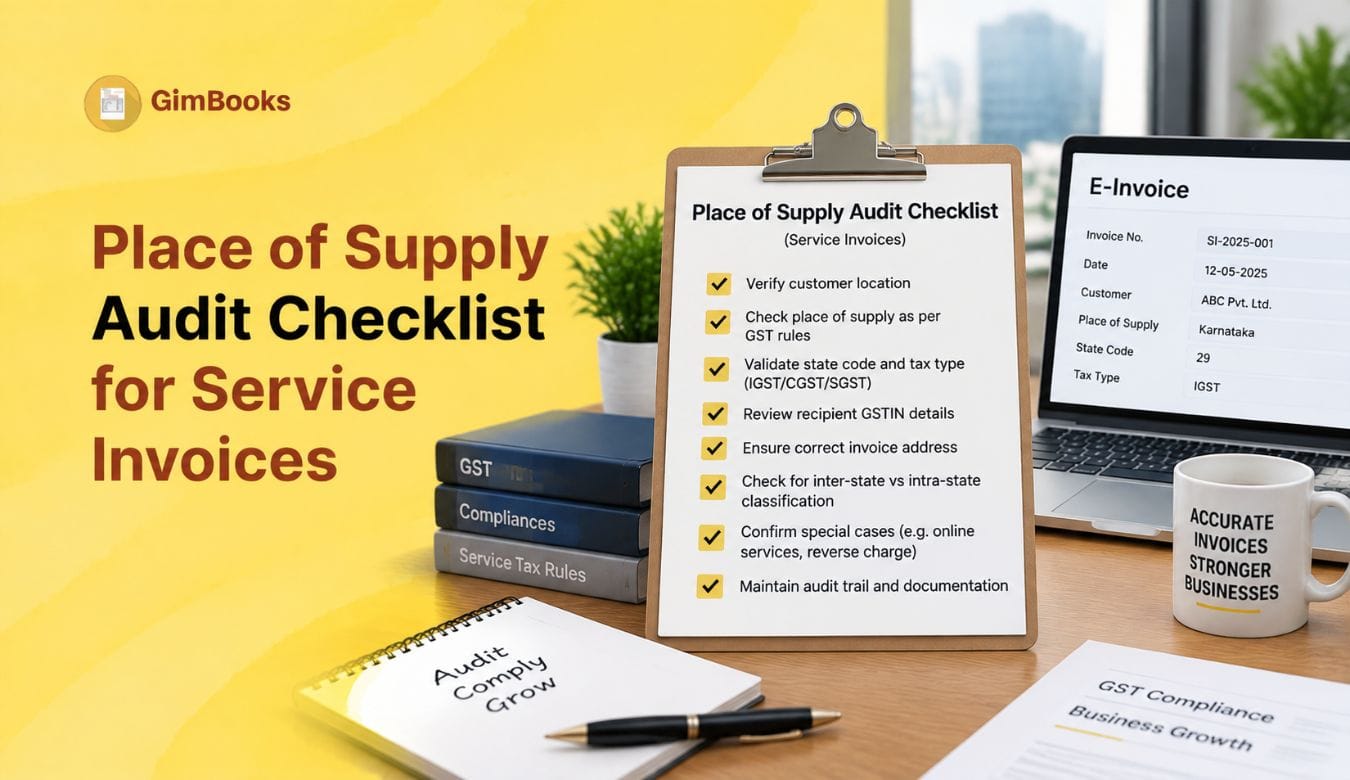
Place of Supply Audit Checklist for Service Invoices
Place of supply is a critical field in GST service invoices because it decides whether the invoice should charge IGST or CGST and SGST.
For service providers, consultants, agencies, freelancers, transporters, software companies, event businesses and accountants, place of supply errors can lead to wrong tax charging, return mismatches, customer ITC issues and invoice corrections.
Unlike goods invoices, service invoices often depend on the recipient’s registration status, billing address, performance location, property location, event location or cross-border rules. That is why billing teams should not automatically select the customer’s state without checking the applicable service rule.
This guide provides a practical place of supply audit checklist for service invoices so businesses can reduce GST billing errors before issuing invoices and filing returns.
For most domestic B2B service invoices, the place of supply is the location of the registered recipient. If the supplier location and place of supply are in different states or union territories, IGST is charged. If both are in the same state or union territory, CGST and SGST are generally charged.
For B2C services and special service categories such as immovable property, events, training, goods transport, passenger transport, telecom, banking, insurance and online services, specific place-of-supply rules should be checked before issuing the invoice.
Key Takeaways
- Place of supply decides whether a service invoice should charge IGST or CGST and SGST.
- For most services supplied to a registered person in India, place of supply is the location of that registered person.
- For most services supplied to an unregistered person, place of supply depends on address on record; if no address is available, it may be the supplier’s location.
- Some services follow special rules based on property location, event location, performance location, transport location or records maintained by the supplier.
- Rule 46 requires place of supply along with the state name in interstate tax invoices.
- Service providers should separately check supplier location, customer GSTIN, billing address, place of performance and contract terms.
- Wrong place of supply can lead to wrong tax type, GSTR-1 errors and customer ITC issues.
- Export and import of services require separate review under cross-border place-of-supply rules.
- GimBooks can help service businesses create GST invoices, maintain customer records and manage billing reports in one place.
What Is Place of Supply for Services?
Place of supply is the location used under GST law to decide whether a service transaction is interstate or intrastate.
For service invoices, place of supply is mainly determined under:
- Section 12 of the IGST Act, where both supplier and recipient are in India;
- Section 13 of the IGST Act, where either the supplier or recipient is outside India.
This blog mainly focuses on domestic service invoices, but it also explains when cross-border services need separate review.
Why Place of Supply Matters in Service Invoices
Place of supply affects:
- IGST vs CGST/SGST selection;
- GST return reporting;
- customer Input Tax Credit;
- state-wise tax allocation;
- invoice validity;
- e-invoice data, where applicable;
- export or import treatment;
- reverse-charge review;
- customer billing accuracy;
- audit and reconciliation.
A service invoice can have the correct GST rate but still be wrong if the place of supply is incorrect.
IGST vs CGST and SGST for Service Invoices
Example
A marketing agency registered in Maharashtra provides services to a registered client in Karnataka.
- Supplier location: Maharashtra
- Recipient location: Karnataka
- Place of supply: Karnataka
- Tax type: IGST
If the same agency provides services to a registered client in Maharashtra:
- Supplier location: Maharashtra
- Recipient location: Maharashtra
- Place of supply: Maharashtra
- Tax type: CGST + SGST
General Place of Supply Rule for Domestic Services
For most domestic services where both supplier and recipient are in India:
This general rule applies only where the service is not covered by a special place-of-supply rule.
Common services where the general rule often applies
- consulting services;
- marketing services;
- accounting services;
- business support services;
- software implementation services;
- IT support services;
- design services;
- agency retainers;
- professional services;
- management services.
Special Place of Supply Rules for Service Invoices
Some services do not follow the general recipient-location rule. The billing team should identify these before issuing the invoice.
1. Services Related to Immovable Property
For services directly related to immovable property, the place of supply is generally the location of the property.
This can include:
- architect services;
- interior design;
- construction coordination;
- property consultancy;
- real estate agent services;
- hotel accommodation;
- renting of immovable property;
- property valuation;
- site supervision.
Example
An architect registered in Delhi designs a property located in Gujarat.
Do not use the client’s billing address if the service is directly related to a specific property.
2. Restaurant, Catering, Beauty, Fitness and Personal Services
For restaurant, catering, personal grooming, fitness, beauty treatment, health services and similar services, the place of supply is generally where the service is actually performed.
Example
A catering service registered in Maharashtra provides catering at an event venue in Goa.
3. Training and Performance Appraisal Services
For training and performance appraisal:
Example
A training company in Karnataka provides employee training to a registered company in Tamil Nadu at a venue in Karnataka.
If the recipient is registered in Tamil Nadu, the place of supply is Tamil Nadu.
4. Admission to Events
For admission to cultural, artistic, sporting, scientific, educational, entertainment or amusement events, the place of supply is generally where the event is actually held.
Example
A business sells tickets for a business conference held in Mumbai.
5. Event Organisation Services
For organising events, conferences, exhibitions, fairs or similar events:
If the event is held in multiple states and a consolidated amount is charged, allocation may be needed based on contract or prescribed method.
6. Goods Transportation Services
For transportation of goods, including mail or courier:
Example
A transporter in Gujarat transports goods for a registered business in Rajasthan.
For dispatch and e-way bill workflows, read: GimBooks e-way bill software
7. Passenger Transportation Services
For passenger transportation:
8. Services on Board a Conveyance
For services provided on board a vessel, aircraft, train or motor vehicle, the place of supply is the first scheduled point of departure of that conveyance for the journey.
9. Telecommunication Services
Telecom services have separate rules depending on whether the service is fixed-line, post-paid mobile, prepaid voucher, internet-based or supplied through another mode.
Billing teams should avoid applying the standard recipient-location rule without checking the telecom-specific provisions.
10. Banking and Financial Services
For banking and other financial services, including stock broking, the place of supply is generally the location of the recipient on the records of the supplier. If the recipient’s location is not on record, the place of supply may be the supplier’s location.
11. Insurance Services
For insurance services:
12. Advertisement Services to Government Bodies
For advertisement services supplied to the Central Government, State Government, statutory body or local authority and meant for identified states or union territories, the place of supply may be allocated across the relevant states or union territories based on the contract or applicable basis.
13. OIDAR and Online Services
Online Information and Database Access or Retrieval services have specific rules, especially for cross-border and unregistered-recipient cases.
If your business provides digital subscriptions, online databases, SaaS access, online courses, cloud-hosted products or similar online services, review OIDAR treatment separately before invoicing.
Place of Supply Audit Checklist for Service Invoices
Use this checklist before issuing a service invoice.
A. Supplier Details
- Correct supplier GSTIN selected.
- Correct branch or registered location selected.
- Supplier state code checked.
- Invoice series belongs to the correct GSTIN.
- Service provider’s location is identified correctly.
- SEZ or export-related treatment checked, where applicable.
B. Recipient Details
- Customer legal name is correct.
- Customer GSTIN is captured where registered.
- Customer registration status is checked.
- Billing address is updated.
- Address on record is available for unregistered recipient.
- Recipient state and state code are correct.
- Customer master data is updated before invoicing.
C. Service-Type Review
- General service rule checked.
- Immovable-property rule checked.
- Event or admission rule checked.
- Training rule checked.
- Goods transport rule checked.
- Passenger transport rule checked.
- Telecom, banking, insurance or advertisement rule checked.
- Online or OIDAR service treatment checked.
- Export or import service treatment checked where one party is outside India.
D. Place of Supply
- Correct place-of-supply rule selected.
- Location of registered recipient verified.
- Service performance location checked.
- Property location checked where applicable.
- Event location checked where applicable.
- Goods handover location checked for unregistered transport customers.
- Multi-state service allocation reviewed where applicable.
- Place of supply state name shown for interstate invoices.
E. Tax Type
- Supplier location compared with place of supply.
- IGST selected where supplier location and place of supply are in different states or union territories.
- CGST and SGST selected where both are in the same state.
- Reverse charge checked where applicable.
- Export or zero-rated treatment reviewed where applicable.
- Invoice total recalculated after tax selection.
F. Invoice and Return Review
- GST rate is correct for the service.
- SAC code reviewed.
- Description of service is clear.
- Place of supply matches GSTR-1 treatment.
- Customer ITC impact checked.
- E-invoice data matches final invoice, where applicable.
- Supporting contract or work order reviewed.
- Correction process identified for past errors.
For invoice field-level compliance, read: GST Invoice Mandatory Fields Audit Checklist
Place of Supply Audit Matrix for Service Invoices
Common Place of Supply Errors in Service Invoices
1. Using Supplier Location for Every Invoice
Many service businesses wrongly charge CGST and SGST just because they are registered in the same state where their office is located.
For B2B services, the recipient’s registered location often decides the place of supply unless a special rule applies.
2. Ignoring Customer GSTIN State
If the customer is registered in another state and the service follows the general B2B rule, IGST may apply.
3. Using Event Venue for All Event Services
Admission to an event and organisation of an event may follow different rules. Check whether the recipient is registered.
4. Treating Property-Related Services Like General Consulting
Services directly related to immovable property usually follow the property-location rule.
5. Not Collecting Address for Unregistered Customers
For unregistered recipients, address on record can decide place of supply. Without address, the supplier’s location may apply.
6. Wrong Tax Type for Interstate Clients
If place of supply is outside the supplier’s state and the invoice charges CGST/SGST, customer ITC and GSTR-1 reporting may be affected.
7. Not Reviewing Export Services Separately
Cross-border services have separate rules. Do not assume that foreign billing automatically means export of service.
8. Not Showing Place of Supply on Interstate Invoice
For interstate supply, the invoice should show place of supply along with the state name.
9. Confusing Services With Goods Rules
Goods and services follow different place-of-supply rules. A dispatch or delivery address that matters for goods may not decide place of supply for services.
For goods-specific review, read: Place of Supply Audit Checklist for Goods Invoices
Practical Example 1: Marketing Agency Billing an Interstate Client
A marketing agency registered in Maharashtra provides services to a registered client in Delhi.
Since the client is registered in Delhi and the general B2B rule applies, the invoice should charge IGST.
Practical Example 2: Consultant Billing Same-State Client
A consultant registered in Karnataka provides advisory services to a registered client in Karnataka.
Practical Example 3: Interior Designer for Out-of-State Property
An interior designer registered in Delhi provides design services for a property located in Rajasthan.
Even if the client’s billing office is in Delhi, the property-specific place-of-supply rule must be checked.
Practical Example 4: Training for Registered Company
A training company registered in Tamil Nadu conducts a workshop in Chennai for a registered recipient located in Maharashtra.
Because the recipient is registered, the recipient location applies.
Practical Example 5: Catering Service at Event Venue
A catering business registered in Gujarat provides catering at a wedding venue in Rajasthan.
Practical Example 6: Goods Transport Service to Registered Client
A transporter registered in Haryana transports goods for a registered client in Punjab.
Place of Supply vs Billing Address vs Service Location
These fields are related but not always the same.
A good service invoice audit checks all these fields instead of relying on only one.
Monthly Place of Supply Audit Report for Services
Use this format before filing GSTR-1.
Pre-Filing Audit Process for Service Invoices
Step 1: Export sales invoice report
Export all service invoices for the return period.
Step 2: Group by service type
Separate:
- general professional services;
- property-related services;
- training;
- events;
- transport;
- telecom;
- insurance;
- banking or financial services;
- online services;
- export or import services.
Step 3: Compare supplier state and place of supply
Flag invoices where tax type does not match the supplier location and place of supply.
Step 4: Review interstate invoices
Check whether IGST has been charged where place of supply is outside the supplier state.
Step 5: Review intrastate invoices
Check whether CGST and SGST have been charged where supplier location and place of supply are in the same state.
Step 6: Review high-risk service categories
Prioritise property, events, training, transport, online services and cross-border invoices.
Step 7: Correct before return filing
Take corrective action through revised invoice treatment, debit note, credit note or return-level correction based on professional advice.
Create Accurate Service Invoices With GimBooks
Place of supply errors usually happen when service businesses manually create invoices, copy old customer addresses or select tax type without checking the service category.
GimBooks helps service providers create structured GST invoices and manage billing records in one place.
With GimBooks, you can:
- create GST-compliant service invoices;
- maintain customer and supplier records;
- add service descriptions and SAC details;
- manage tax calculations;
- create quotations and proforma invoices;
- track payments and outstanding amounts;
- access billing records from mobile and web;
- generate reports for invoice review.
Explore GimBooks GST billing software to manage service invoices, tax details and billing workflows more efficiently.
For businesses using editable formats, you can also review the GST invoice format page before moving to a more structured billing system.
Learn more about place of supply for service invoice
What is place of supply for service invoice?
Place of supply for a service invoice is the GST location used to decide whether the invoice should charge IGST or CGST and SGST.
What is the place of supply for B2B services?
For most domestic B2B services, the place of supply is the location of the registered recipient, unless the service falls under a special rule.
How do I decide IGST or CGST SGST on services?
Compare the supplier location with the place of supply. If they are in different states or union territories, IGST generally applies. If they are in the same state or union territory, CGST and SGST generally apply.
Is place of supply mandatory on a service invoice?
For interstate supplies, the tax invoice should include place of supply along with the state name.
Can place of supply be different from service location?
Yes. For some services, such as training to a registered person, place of supply can be the recipient’s registered location even if the service is performed elsewhere.
Frequently Asked Questions
What is the general place of supply rule for services under GST?
For most services supplied to a registered person, place of supply is the location of the registered recipient. For unregistered recipients, it depends on address on record or supplier location.
What is place of supply for consulting services?
For most consulting services supplied to a registered recipient, place of supply is the registered recipient’s location.
What is place of supply for services related to property?
For services directly related to immovable property, place of supply is generally the location of the property.
What is place of supply for training services?
For training services supplied to a registered person, place of supply is the recipient’s location. For unregistered persons, it is the place where the service is actually performed.
What is place of supply for event services?
For admission to events, place of supply is the event location. For event organisation services, the rule depends on whether the recipient is registered or unregistered.
What is place of supply for goods transport services?
For goods transport services supplied to a registered person, place of supply is the registered recipient’s location. For unregistered persons, it is the location where goods are handed over for transportation.
What happens if place of supply is wrong in service invoice?
Wrong place of supply can lead to wrong GST type, GSTR-1 mismatch, customer ITC issues and invoice correction requirements.
Can a service invoice have IGST even if the work is done in the supplier’s state?
Yes. If the place of supply is another state, IGST may apply even if the work is performed in the supplier’s state.
Does customer billing address decide place of supply?
Not always. Customer billing address is important, but special rules may depend on registered recipient location, property location, event location or service performance location.
Can billing software reduce place of supply errors?
Billing software can help by maintaining structured customer records, GSTINs, billing details, invoice data and tax calculations. Businesses should still review special service categories manually.
Conclusion
Place of supply is one of the most important checks in a GST service invoice. It decides whether IGST or CGST and SGST should be charged and affects return reporting, customer ITC and audit accuracy.
The safest process is to:
- identify the service type;
- confirm customer registration status;
- verify customer GSTIN and address;
- check whether a special place-of-supply rule applies;
- compare supplier location with place of supply;
- select the correct tax type;
- review invoice data before filing GSTR-1.
Using GimBooks GST billing software can help service businesses create GST-compliant invoices, maintain customer records and manage billing reports in a more organised workflow.
Create accurate service invoices and reduce GST place-of-supply errors with GimBooks.