
Place of Supply Errors in GST Billing: Fixes for Traders and Service Providers
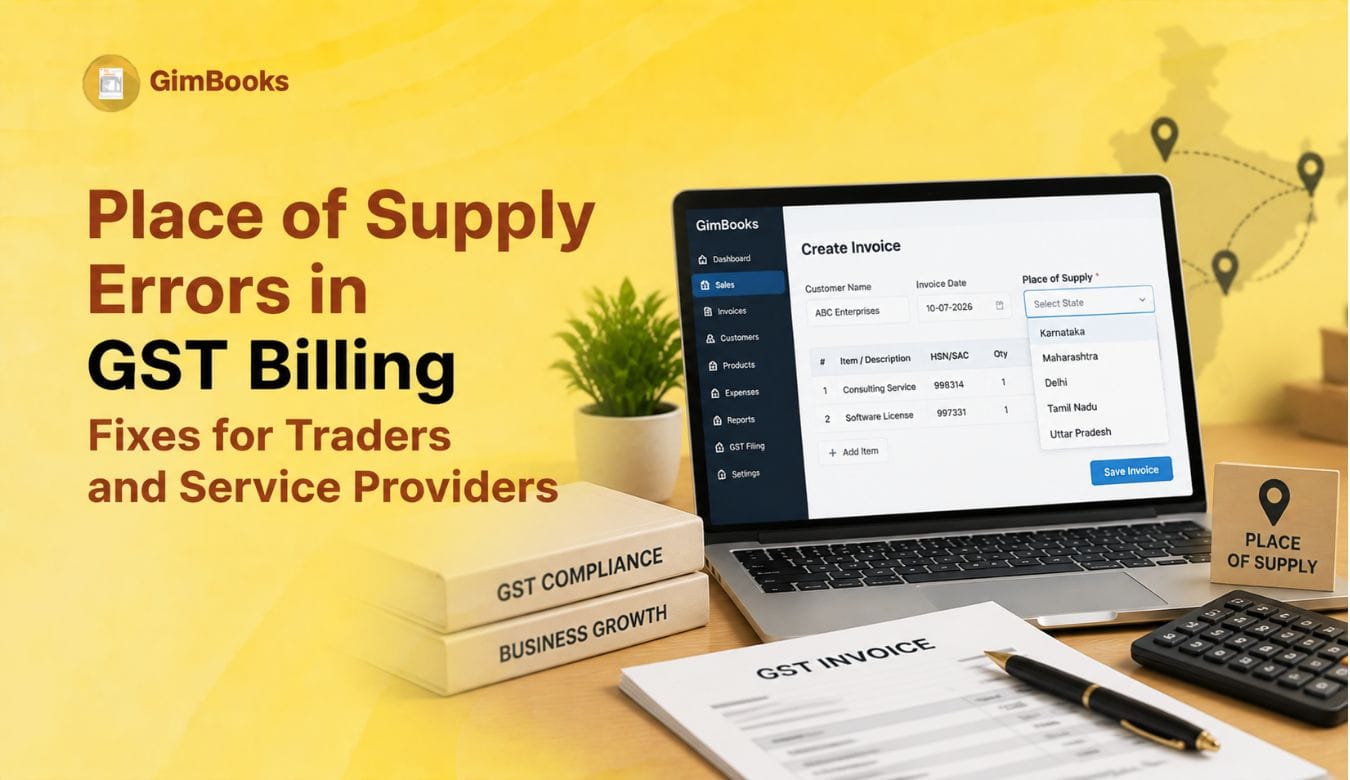
A customer is in another state, but your invoice shows CGST and SGST. Or you charged IGST because the goods were delivered outside your state, only to discover that a Bill-to/Ship-to rule changes the actual place of supply.
These are common place of supply errors in GST billing, and they matter because the place of supply helps determine whether a transaction should be treated as an intra-State or inter-State supply.
For an intra-State supply, CGST plus SGST/UTGST generally applies. For an inter-State supply, IGST generally applies. The legal determination depends on the location of the supplier and the applicable place-of-supply provisions rather than simply where the customer happens to be located.
A wrong place of supply can therefore result in:
incorrect IGST, CGST or SGST on the invoice; incorrect GSTR-1 reporting; reconciliation issues; incorrect customer records; and complications when the tax has already been paid under the wrong head.
This guide explains how traders, retailers, wholesalers, freelancers, consultants and other service providers can identify, correct and prevent these errors.
What Is Place of Supply in GST Billing?
The place of supply under GST identifies the state or location to which a supply is attributed for GST purposes.
It must be considered together with the location of the supplier to determine whether the transaction is intra-State or inter-State.
For example:
CBIC explains that when the location of the supplier and place of supply are in the same state, the supply is generally intra-State and CGST plus SGST applies.
However, determining the place of supply itself can become more complicated in cases such as Bill-to/Ship-to transactions, installation of goods, property-related services, events, transportation and customers with multiple GST registrations.
That is where most GST billing place of supply errors begin.
For a deeper pre-invoice verification process for goods, see GimBooks' Place of Supply Audit Checklist for Goods Invoices. For service transactions, use the Place of Supply Audit Checklist for Service Invoices.
Why Does a Wrong Place of Supply Cause a GST Error?
Place of supply is not simply another address field on an invoice.
It affects the tax head itself.
Suppose a trader in Maharashtra sells goods in a transaction where the correct place of supply is Gujarat.
If Maharashtra is accidentally selected as the place of supply, the billing system may treat the transaction as intra-State and charge CGST plus Maharashtra SGST.
But if Gujarat is the correct place of supply, the transaction would generally need to be treated as inter-State and IGST charged instead.
The total GST percentage may remain the same, but the tax has been accounted for under the wrong heads.
GST law specifically provides mechanisms for situations where IGST was paid instead of CGST/SGST or CGST/SGST was paid instead of IGST.
Common Place of Supply Errors in GST Invoices
1. Selecting the Customer's State Without Checking the Actual Supply
A common assumption is:
Customer state = place of supply.
That may work for many routine transactions, but it is not a universal rule.
For goods, factors such as movement, delivery, installation and Bill-to/Ship-to arrangements can change the result.
For services, the general B2B rule commonly uses the registered recipient's location, but specific services have their own place-of-supply provisions. Zoho's GST guidance, for example, distinguishes general recipient-location rules from special cases under Sections 10–13 of the IGST framework.
Fix: Determine whether the transaction is for goods or services first. Then apply the relevant place-of-supply rule before choosing IGST or CGST plus SGST.
2. Using the Ship-to State as the Place of Supply in Every Transaction
This creates frequent errors for traders, distributors and e-commerce sellers.
Imagine this transaction:
A supplier in Maharashtra sells goods to a registered buyer in Delhi. The Delhi buyer instructs the Maharashtra supplier to deliver the goods directly to another person in Karnataka.
The delivery address is Karnataka, but in a qualifying Bill-to/Ship-to transaction under Section 10(1)(b), the place of supply can be the location of the third person directing the supply—in this example, Delhi.
GimBooks' Bill-to/Ship-to guidance illustrates the same Maharashtra → Delhi buyer → Karnataka consignee structure, where the place of supply is Delhi and IGST applies.
Fix: Do not automatically copy the Ship-to state into the place-of-supply field. Review who placed the order, who is being invoiced, who receives the goods and whether the Bill-to/Ship-to provisions apply.
You can also refer to GimBooks' Bill-to/Ship-to e-Invoice checklist for complex transactions.
3. Charging CGST and SGST on an Inter-State Invoice
This is one of the most common interstate invoice errors.
Example:
Supplier: Karnataka Correct place of supply: Telangana GST treatment selected: CGST + Karnataka SGST
Because the location of supplier and place of supply are in different states, IGST would generally be the appropriate tax for the transaction.
Correction: Change the place of supply and tax treatment before filing whenever possible. If the incorrect tax has already been paid, additional corrective steps may be required, which we cover below.
4. Charging IGST on an Intra-State Transaction
The opposite error also occurs.
Example:
Supplier: Gujarat Correct place of supply: Gujarat Tax charged: IGST
If both the location of supplier and the applicable place of supply are Gujarat, the transaction would ordinarily be intra-State and CGST plus Gujarat SGST should apply.
This is a classic IGST CGST SGST mistake caused by an incorrect place-of-supply selection.
5. Choosing Place of Supply From the Customer's Head Office Instead of the GSTIN Being Billed
Businesses often have GST registrations in several states.
Suppose a company has:
Head office: Maharashtra, Karnataka GSTIN Tamil Nadu GSTIN, Delhi GSTIN
If you are invoicing its Karnataka GST registration, automatically using the Maharashtra head-office location can create the wrong place of supply and tax treatment.
Fix: Maintain state-wise customer masters and confirm which GSTIN is receiving the particular supply before generating the invoice.
The GSTIN's state code is also a useful validation point, but it should not replace application of the actual place-of-supply rule.
6. Confusing Billing Address, Delivery Address and Place of Supply
These fields may be identical in a simple transaction, but they do not mean the same thing.
Rule 46 requires the place of supply along with the state name for inter-State supplies, and delivery details may also need to be captured where applicable.
For a broader invoice check, use GimBooks' GST Invoice Mandatory Fields checklist.
Place of Supply Errors for Service Providers
Place-of-supply mistakes are particularly common in service invoices because the place where the work is performed is not always the place of supply.
Consider consultants, agencies, freelancers, software companies, architects, transport providers and event businesses.
General B2B Services
For many services supplied to a registered person, the general place-of-supply rule uses the location of the recipient.
Example:
Consultant location: Maharashtra Registered client: Karnataka GSTIN Applicable place of supply: Karnataka General tax treatment: IGST
But special categories can override the general rule.
Property-Related Services
Services directly related to immovable property can depend on where the property is located.
A consultant or contractor should therefore not automatically use the customer's registered office state without checking whether the specific service is covered by the immovable-property rule.
CBIC guidance confirms that property-related services can have location-specific place-of-supply treatment.
Event, Restaurant, Transport and Other Special Services
Several categories of service have specialised place-of-supply provisions.
The appropriate field might depend on factors such as:
recipient registration status; location of performance; event location; place of embarkation; property location; or other conditions specified under the IGST Act.
That is why service businesses should avoid hardcoding the customer's billing state as the place of supply for every invoice.
How to Fix a Place of Supply Error in a GST Invoice
The correct procedure depends mainly on when you discover the mistake.
Scenario 1: Error Found Before Filing GSTR-1
This is normally the simplest situation.
Verify the customer's GSTIN, applicable place-of-supply rule and correct state. Then correct the invoice record and recalculate IGST or CGST plus SGST as applicable before filing.
The GST Portal allows invoice data in draft GSTR-1 to be modified or deleted before the return is filed.
If the transaction falls under e-invoicing and an IRN has already been generated, do not simply alter the locally stored invoice PDF. Follow the applicable e-invoice correction/cancellation process for the transaction.
GimBooks users handling applicable electronic invoices can refer to the e-Invoicing software workflow.
Scenario 2: GSTR-1 Filed but GSTR-3B Has Not Been Filed
This is where GSTR-1A becomes particularly useful.
The GST Portal currently allows Form GSTR-1A to be used to:
amend a record already reported in GSTR-1 for the same tax period; add a record missed from that GSTR-1; and feed the corrected information into the corresponding GSTR-3B.
GSTR-1A becomes available after GSTR-1 has been filed or its due date has passed, whichever is later, and it can be filed before GSTR-3B for that tax period. It is optional and can be filed only once for a particular period.
So if you discover a place-of-supply mistake at this stage, correcting the record through GSTR-1A may prevent the error from continuing into the liability reported in GSTR-3B.
Scenario 3: The Error Belongs to an Earlier Filed Period
If the invoice was already reported in a previous GSTR-1 period, the GST Portal provides amendment tables for earlier reported invoices.
For example, Table 9A is used for amendments to previously reported B2B invoices.
There is also a statutory cut-off.
The GST Portal states that invoices from a previous financial year cannot be amended in GSTR-1 after 30 November of the following financial year.
Businesses should therefore review invoice errors well before the annual correction deadline instead of postponing reconciliation until year-end.
Can You Revise GSTR-3B to Fix a Place of Supply Error?
No. A filed GSTR-3B itself cannot be amended. The GST Portal specifically states that amendment of GSTR-3B is not allowed.
If the mistake has already affected tax liability in a filed GSTR-3B, the appropriate adjustment and payment treatment needs to be handled through the available subsequent-period GST mechanisms.
Where tax has already been paid under the wrong head, the specific CGST/IGST provisions discussed below become important.
What If CGST/SGST Was Paid Instead of IGST?
Suppose you treated a transaction as intra-State and paid:
CGST + SGST
but later determine that it was actually an inter-State supply requiring:
IGST.
Section 77 of the CGST Act and Section 19 of the IGST Act provide a mechanism for correcting this type of classification error.
CBIC clarifies that where CGST and SGST were paid on a supply subsequently found to be inter-State, the taxpayer can pay the required IGST and claim refund of the wrongly paid CGST/SGST. Interest is not required on the IGST payable purely because of this intra-State versus inter-State reclassification.
Importantly, CBIC has also clarified that “subsequently held” covers situations where the taxpayer discovers the classification error independently—it does not have to arise only from a tax officer's assessment or investigation.
What If IGST Was Paid Instead of CGST and SGST?
The reverse situation is also covered.
If a transaction was treated as inter-State and IGST was paid, but the supply is subsequently found to be intra-State, the taxpayer may pay the appropriate CGST and SGST/UTGST and claim refund of the IGST wrongly paid.
CBIC guidance similarly states that no interest is payable on the corrected CGST and SGST solely because of this reclassification.
For refund claims under these provisions, Rule 89(1A) provides for electronic filing in Form GST RFD-01, generally within two years from the date tax is paid under the correct head. CBIC Circular 162/18/2021-GST explains this procedure.
Because refund eligibility can depend on how the original transaction was subsequently corrected, businesses dealing with material amounts should have the correction reviewed by their accountant or GST professional.
Place of Supply Error Examples
Example 1: Normal Inter-State Sale of Goods
Seller: Maharashtra Goods delivered to buyer: Gujarat Correct place of supply: Gujarat
Correct treatment:
IGST
Incorrect treatment:
CGST + Maharashtra SGST
The billing team should correct the place of supply from Maharashtra to Gujarat and apply IGST.
Example 2: Intra-State Sale
Seller: Karnataka Applicable place of supply: Karnataka
Correct treatment:
CGST + Karnataka SGST
If IGST was selected because the customer's corporate office happened to be located in another state, the invoice should be reviewed against the GSTIN and actual place-of-supply rule.
Example 3: Bill-to/Ship-to Transaction
Supplier: Maharashtra Bill-to buyer: Delhi Ship-to consignee: Karnataka
Where Section 10(1)(b) applies, the place of supply for the supplier-to-buyer transaction is Delhi rather than automatically Karnataka.
Because supplier Maharashtra and place of supply Delhi are in different states, IGST applies.
Example 4: B2B Consulting Service
Consultant: Maharashtra Registered client GSTIN: Telangana
Under the general B2B service rule, the recipient's registered location would ordinarily determine the place of supply.
Place of supply: Telangana General tax treatment: IGST
Special service-specific rules should still be checked before finalising the invoice.
How Place of Supply Errors Affect GST Reconciliation
A wrong place of supply can create more than a visual invoice error.
It can cause the invoice records and tax ledgers to reflect the wrong GST head. It may also require amendments to outward-supply data and corresponding corrections before the buyer's records and the supplier's GST reporting reconcile correctly.
GSTR-2B is generated using documents reported by suppliers through GSTR-1, GSTR-1A and other applicable statements, which makes accurate supplier-side invoice reporting particularly important for B2B transactions.
Regular reconciliation is therefore preferable to discovering place-of-supply errors only during an annual GST review.
How to Prevent Place of Supply Errors Before Issuing an Invoice
Use this simple invoice-control checklist:
- Confirm whether the supply is for goods or services.
- Verify the supplier GST registration from which the invoice is being raised.
- Confirm the recipient GSTIN and its state.
- Determine the applicable place-of-supply rule rather than relying only on the customer address.
- Check Bill-to and Ship-to details separately.
- Verify whether IGST or CGST plus SGST/UTGST follows from the supplier location and place of supply.
- Check HSN/SAC, GST rate, taxable value and other invoice fields.
- Reconcile invoice records before GSTR-1/GSTR-1A and GSTR-3B filing.
- Review high-risk invoices involving multiple states, branches, installations or special services.
- Correct errors before the statutory amendment window closes.
For a broader invoice review, GimBooks' guide to common GST invoice errors covers GSTIN, HSN/SAC, duplicate invoices, tax rates and other frequent mistakes.
How GimBooks Can Help Reduce GST Billing Errors
Place-of-supply problems become harder to manage when customer details, item records, tax calculations and GST reports are maintained across separate spreadsheets.
GimBooks GST billing software brings GST invoicing, e-invoices, e-way bills, GST filing and business reporting into one platform.
Businesses can maintain structured invoice and party information, create GST invoices, manage HSN/SAC-related item information and work with GST reports without relying on multiple disconnected files. GimBooks also provides invoice and GST reporting capabilities for small businesses, traders and service providers.
If you need a compliant starting layout, you can also use GimBooks' free GST invoice formats, which include fields for GSTIN, HSN/SAC, CGST, SGST, IGST, taxable value and invoice totals.
The important point is that software should support your GST workflow—not replace the need to determine the legally correct place of supply for unusual transactions.
Frequently Asked Questions
1. What happens if the place of supply is wrong on a GST invoice?
A wrong place of supply can result in an incorrect classification between intra-State and inter-State supply and therefore the wrong GST heads being reported. The invoice and GST return records should be corrected using the appropriate mechanism based on whether GSTR-1 and GSTR-3B have already been filed.
2. Can I change the place of supply after filing GSTR-1?
Yes, depending on the stage of filing. For the same tax period, GSTR-1A can be used after GSTR-1 and before GSTR-3B. For earlier periods, applicable GSTR-1 amendment tables can be used, subject to the statutory amendment deadline.
3. Can GSTR-3B be revised after filing?
No. The GST Portal states that a filed GSTR-3B cannot be amended.
4. What should I do if I paid IGST instead of CGST and SGST?
Where a transaction considered inter-State is subsequently found to be intra-State, the applicable CGST and SGST/UTGST should be paid and the wrongly paid IGST may be claimed as a refund in accordance with Section 19 of the IGST Act and the applicable refund rules.
5. What if I paid CGST and SGST instead of IGST?
If an intra-State transaction is subsequently found to be inter-State, the correct IGST should be paid and the wrongly paid CGST and SGST may be eligible for refund under the applicable provisions. CBIC also provides relief from interest on the correct tax purely due to this reclassification.
6. Is place of supply mandatory on a GST invoice?
Rule 46 requires the place of supply along with the name of the state for inter-State supplies.
7. Is the customer's GSTIN state always the place of supply?
No. It may determine the place of supply in many standard B2B service transactions, but special rules apply to various goods and services. Bill-to/Ship-to transactions, installation of goods, immovable-property services and several other cases require separate analysis.
8. What is the deadline for correcting an invoice from a previous financial year in GSTR-1?
The GST Portal currently states that previous-financial-year invoice amendments cannot be made after 30 November of the following financial year.
Conclusion
Place of supply errors in GST billing usually begin with a simple data-entry assumption but can eventually lead to the wrong IGST, CGST or SGST being reported.
The safest workflow is:
Identify the supply → determine the correct place of supply → compare it with the supplier location → select the correct GST head → verify the invoice → reconcile before GST filing.
If an error is identified after filing, act based on the stage of compliance. GSTR-1A can help correct same-period records before GSTR-3B, earlier invoices can be handled through applicable GSTR-1 amendment tables within the permitted time limit, and GST law provides a refund mechanism when tax was paid under the wrong head because an inter-State supply was treated as intra-State or vice versa.
Using organised GST invoicing and reporting processes can reduce these errors substantially—especially for traders and service providers handling customers across multiple states.