
Place of Supply Audit Checklist for Goods Invoices
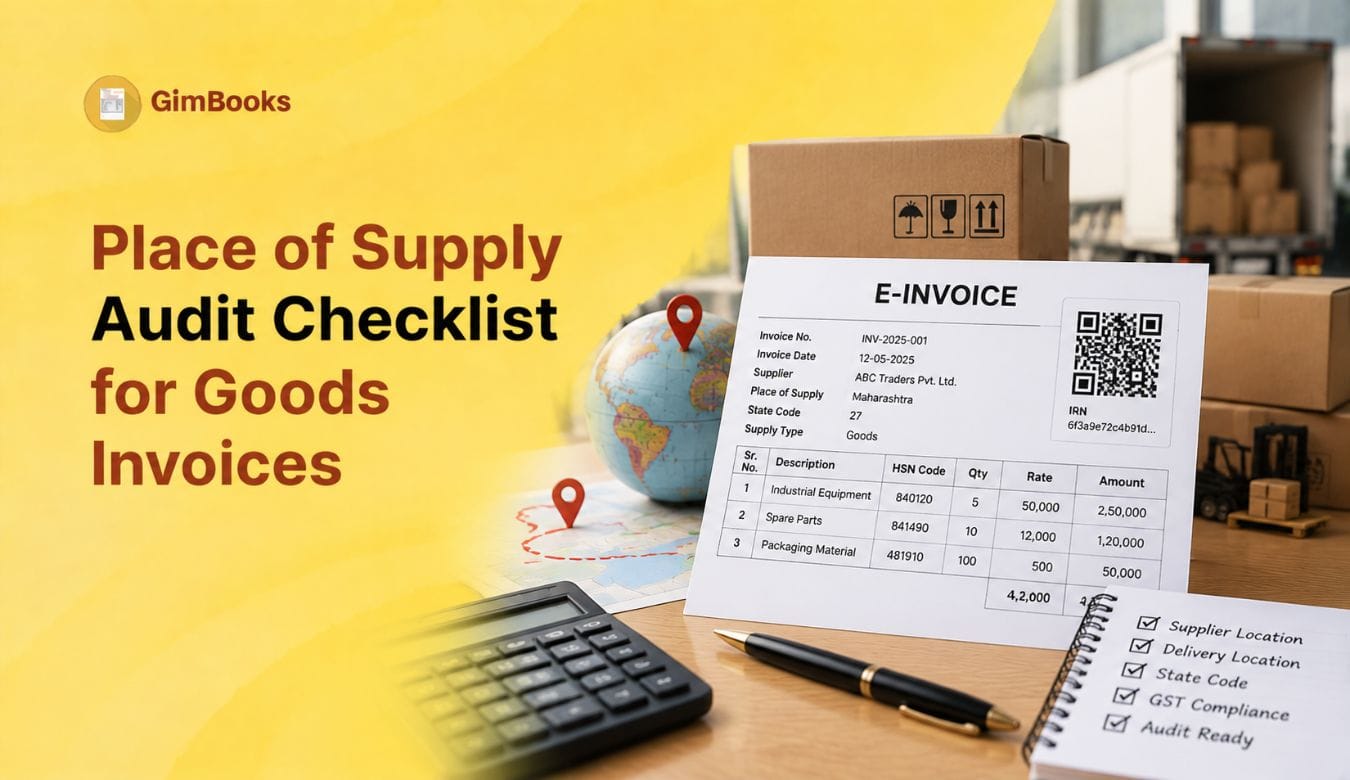
Place of supply is one of the most important fields in a GST goods invoice. It decides whether the invoice should charge IGST or CGST and SGST.
A small mistake in place of supply can affect the tax type, GSTR-1 reporting, customer Input Tax Credit, e-way bill data, branch-transfer records and invoice reconciliation.
For traders, distributors, manufacturers, wholesalers and accountants, place of supply should not be selected automatically from the customer’s billing address. It must be checked based on how and where the goods are delivered.
This guide provides a practical place of supply audit checklist for goods invoices so that billing and accounts teams can reduce GST invoice errors before filing returns.
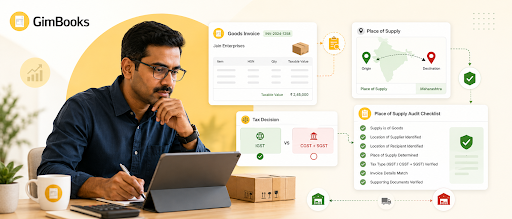
For goods invoices, the place of supply generally depends on where the movement of goods ends for delivery to the recipient. If the supplier location and place of supply are in different states or union territories, IGST is charged. If both are in the same state or union territory, CGST and SGST are generally charged.
In Bill-to/Ship-to transactions, where goods are delivered to another person on the buyer’s instruction, the place of supply may be linked to the buyer who instructed the delivery, not automatically the final delivery location.
Key Takeaways
- Place of supply decides whether the invoice should charge IGST or CGST and SGST.
- For normal movement of goods, the place of supply is usually where the goods are delivered to the recipient.
- For Bill-to/Ship-to transactions, special rules apply where goods are delivered to another person on the instruction of a third person.
- For goods not involving movement, place of supply is generally the location of goods at the time of delivery.
- For goods installed or assembled at site, place of supply is the installation or assembly location.
- For goods supplied on board a conveyance, place of supply is the location where the goods are taken on board.
- Rule 46 requires place of supply, along with the state name, on invoices for interstate supplies.
- Wrong place of supply can cause wrong GST type, GSTR-1 mismatch, e-way bill mismatch and customer ITC issues.
- Billing teams should separately check Bill From, Dispatch From, Bill To and Ship To details before finalising GST invoices.
- GimBooks can help businesses maintain structured GST invoice, customer, item and e-way bill records.
What Is the Place of Supply for Goods?
Place of supply means the location that GST law uses to determine whether a supply is interstate or intrastate.
For goods, place of supply is mainly covered under Section 10 of the IGST Act for supplies within India.
The place of supply for goods depends on the transaction structure, such as:
- whether goods move from one place to another;
- whether goods are delivered to a third party on buyer instruction;
- whether goods are supplied without movement;
- whether goods are installed or assembled at site;
- whether goods are supplied on board a conveyance.
The place of supply should be decided before choosing IGST or CGST/SGST on the invoice.
Why Place of Supply Matters in GST Invoices
Place of supply affects more than one field on the invoice.
It directly impacts:
- GST tax type;
- GST rate application;
- GSTR-1 reporting;
- customer ITC reconciliation;
- e-invoice data;
- e-way bill data;
- state-wise tax reporting;
- branch transfer accounting;
- audit trail;
- invoice validity.
If the place of supply is wrong, the invoice may show the wrong tax type even if the GST rate and value are correct.
IGST vs CGST and SGST: How Place of Supply Decides Tax Type
Example
A supplier in Maharashtra sells goods to a buyer in Maharashtra and delivers the goods in Maharashtra.
- Supplier location: Maharashtra
- Place of supply: Maharashtra
- Tax type: CGST + SGST
If the same supplier delivers goods to a buyer in Gujarat:
- Supplier location: Maharashtra
- Place of supply: Gujarat
- Tax type: IGST
Place of Supply Rules for Goods
1. Goods Involving Movement
Where the supply involves movement of goods, whether by the supplier, recipient or any other person, the place of supply is generally the location where the movement of goods ends for delivery to the recipient.
Example
A supplier in Delhi sends goods to a customer in Rajasthan.
The goods move from Delhi and are delivered in Rajasthan.
2. Bill-to/Ship-to Transactions
A Bill-to/Ship-to transaction happens when the supplier bills one party but delivers goods to another person or location on the instruction of the buyer.
In such cases, where goods are delivered to a recipient or another person on the direction of a third person, that third person is deemed to have received the goods, and the place of supply is the principal place of business of that third person.
Example
- Supplier: Maharashtra
- Buyer / Bill-to party: Delhi
- Ship-to party: Karnataka
The supplier ships goods directly to Karnataka on Delhi buyer’s instruction.
This is one of the most common place-of-supply errors in goods invoices.
Read the detailed guide: E-Invoice for Bill To–Ship To Transactions
3. Goods Not Involving Movement
Where goods do not move from one place to another, the place of supply is generally the location of the goods at the time of delivery to the recipient.
Example
A machine is already located at the buyer’s factory in Gujarat and ownership is transferred there without physical movement.
4. Goods Installed or Assembled at Site
Where goods are installed or assembled at site, the place of supply is the place of installation or assembly.
Example
A supplier sells and installs an industrial machine at the customer’s plant in Tamil Nadu.
This is important for machinery, equipment, plant installations, modular units and similar goods supplied with installation.
5. Goods Supplied on Board a Conveyance
Where goods are supplied on board a conveyance such as a vessel, aircraft, train or motor vehicle, the place of supply is the location where the goods are taken on board.
Example
Goods are supplied on board a train at Mumbai.
Place of Supply Audit Checklist for Goods Invoices
Use this checklist before issuing a GST invoice for goods.
A. Supplier Details
- Correct supplier GSTIN selected.
- Correct branch or business location selected.
- Supplier state code matches GSTIN.
- Bill From location is correct.
- Dispatch From location is separately checked.
- Invoice series belongs to the correct GSTIN or branch.
B. Buyer Details
- Buyer legal name is correct.
- Buyer GSTIN is valid.
- Buyer state matches GSTIN state code.
- Bill To address is correct.
- Customer master data is updated.
- Buyer registration status is checked.
C. Delivery and Ship-to Details
- Ship To location is captured separately.
- Delivery address is complete.
- Delivery state and PIN code are correct.
- Ship-to GSTIN is checked where applicable.
- Bill-to and Ship-to difference is reviewed.
- Delivery location is not blindly used as a place of supply in Bill-to/Ship-to cases.
D. Place of Supply
- Correct place-of-supply rule identified.
- Normal goods movement rule applied where applicable.
- Bill-to/Ship-to rule checked where applicable.
- Installation or assembly rule checked where applicable.
- Goods-without-movement rule checked where applicable.
- On-board supply rule checked where applicable.
- Place of supply state name is shown on interstate invoices.
E. Tax Type
- Supplier location and place of supply compared.
- IGST selected for interstate supply.
- CGST and SGST selected for intrastate supply.
- CGST and SGST are equal where applicable.
- Tax type agrees with GSTR-1 treatment.
- Invoice total is recalculated after tax-type selection.
F. E-Way Bill and E-Invoice Data
- E-way bill delivery details match invoice data.
- Dispatch From and Ship To PIN codes are correct.
- Place of supply agrees with invoice treatment.
- IRN data matches the final invoice.
- Vehicle and transporter details are checked.
- E-way bill distance and PIN code are validated.
For dispatch validation, read: E-Way Bill Distance and PIN Code Validation Checklist
Place of Supply Audit Matrix
Common Place of Supply Errors in Goods Invoices
1. Using Billing Address as Place of Supply Every Time
The billing address is not always the place of supply. Goods may be delivered to another location, shipped to a third party or installed at a different site.
2. Using Ship-to State Automatically in Bill-to/Ship-to Transactions
In Bill-to/Ship-to transactions, the final delivery state is not always the place of supply. The buyer giving the delivery instruction must be reviewed.
3. Selecting IGST Only Because Goods Cross State Border
Movement between states usually creates IGST treatment, but the tax type must still be determined by comparing supplier location and place of supply.
4. Ignoring Installation Location
For goods installed or assembled at site, the place of supply is the installation site.
5. Treating Branch Transfer as Internal Movement Without Checking GSTINs
A branch transfer between different GSTINs is not the same as moving goods within the same registration.
Read: E-Way Bill for Branch Transfers Between GSTINs
6. Not Showing Place of Supply on Interstate Invoice
Rule 46 requires a place of supply along with a state name for interstate supplies.
7. Wrong State Code in Invoice or E-Way Bill
Incorrect state codes can create mismatch between GST invoice, e-invoice and e-way bill records.
8. Not Updating Customer Master Data
If buyer GSTIN, state or ship-to address is wrong in the customer master, the same error will repeat across invoices.
Practical Example 1: Interstate Goods Invoice
A supplier in Uttar Pradesh sells goods to a registered buyer in Haryana. Goods are delivered to the buyer’s Haryana warehouse.
The invoice should charge IGST.
Practical Example 2: Intrastate Goods Invoice
A supplier in Gujarat sells goods to a buyer in Gujarat. Goods are delivered within Gujarat.
The invoice should charge CGST and SGST.
Practical Example 3: Bill-to/Ship-to Supply
A supplier in Maharashtra raises an invoice to a buyer in Delhi and ships goods to the buyer’s customer in Karnataka.
The invoice should not automatically use Karnataka as the place of supply.
Practical Example 4: Installation at Site
A supplier in Rajasthan sells and installs a machine at a customer’s plant in Madhya Pradesh.
The installation site decides the place of supply.
Practical Example 5: Branch Transfer Between GSTINs
A company transfers goods from its Maharashtra GSTIN to its Karnataka GSTIN.
The transfer should be documented correctly and reconciled with e-way bills and inventory records.
Place of Supply vs Dispatch From vs Ship To
These fields are related but not the same.
Example
A company bills from Mumbai, dispatches from Pune, bills a Delhi customer and ships goods to Jaipur on the Delhi customer’s instruction.
In this case:
- Bill From: Mumbai GSTIN
- Dispatch From: Pune warehouse
- Bill To: Delhi customer
- Ship To: Jaipur consignee
- Place of Supply: Delhi, in applicable Bill-to/Ship-to cases
Each field must be entered correctly in invoice, e-invoice and e-way bill workflows.
Audit Process Before Filing GSTR-1
Place of supply should be reviewed before GSTR-1 filing because invoice-level errors can flow into return reporting.
Step 1: Export sales invoice report
Export all goods invoices for the tax period.
Step 2: Filter interstate invoices
Check invoices where supplier state and place of supply are different.
Step 3: Filter intrastate invoices
Check invoices where supplier state and place of supply are the same.
Step 4: Review tax type mismatch
Identify:
- IGST charged for same-state place of supply;
- CGST/SGST charged for different-state place of supply;
- missing place of supply;
- wrong state code;
- unusual Bill-to/Ship-to records.
Step 5: Compare with e-way bill data
Check whether delivery state, PIN code and vehicle movement match the invoice and place-of-supply treatment.
Step 6: Review high-value and repeated customers
Prioritise high-value invoices and customers with multiple ship-to locations.
Step 7: Correct before return filing
Correct invoice, debit note, credit note or return treatment as applicable with your GST advisor.
Monthly Place of Supply Audit Report
Use this format internally:
This report helps detect tax-type and place-of-supply mismatches before filing.
Create Accurate GST Invoices With GimBooks
Place of supply errors usually happen when billing teams manually select tax type, copy customer addresses from old records or use the same delivery address for every invoice.
GimBooks helps businesses create structured GST invoices with organised customer, item, tax and e-way bill data.
With GimBooks, you can manage:
- GST invoices;
- customer and supplier records;
- item and HSN details;
- tax calculation workflows;
- e-way bill generation;
- delivery challans;
- branch and dispatch records;
- inventory and purchase records;
- mobile and web billing;
- reports for better invoice review.
Explore GimBooks GST billing software to manage GST invoices, billing and reports more efficiently.
For transport-linked invoicing, also explore GimBooks e-way bill software.
Place of Supply For Goods Invoice
What is the place of supply for goods invoice?
Place of supply for goods invoice is the GST location used to decide whether the invoice should charge IGST or CGST and SGST. For goods involving movement, it is generally where the movement ends for delivery to the recipient.
How to decide IGST vs CGST SGST in goods invoice?
Compare the supplier location with the place of supply. If both are in the same state, CGST and SGST generally apply. If they are in different states, IGST generally applies.
Is place of supply mandatory on GST invoice?
For interstate supplies, Rule 46 requires place of supply along with the state name to be shown on the tax invoice.
What is the place of supply in the Bill-to/Ship-to case?
In a Bill-to/Ship-to case where goods are delivered to another person on buyer instruction, the place of supply may be the principal place of business of the buyer who instructed the delivery.
Can the place of supply be different from the delivery address?
Yes. In Bill-to/Ship-to transactions, the place of supply can be different from the final Ship-to delivery address.
Frequently Asked Questions
What is the place of supply for goods under GST?
For goods involving movement, the place of supply is generally the location where the movement of goods ends for delivery to the recipient.
What happens if the place of supply is wrong?
A wrong place of supply can result in wrong tax type, incorrect GSTR-1 reporting, customer ITC issues, e-way bill mismatch and possible invoice correction requirements.
Is Ship-to address always the place of supply?
No. The Ship-to address is not always the place of supply. Bill-to/Ship-to and other special cases must be reviewed separately.
What is the place of supply for goods installed at site?
For goods installed or assembled at site, the place of supply is the place where the goods are installed or assembled.
What is the place of supply for goods without movement?
Where the supply does not involve movement of goods, the place of supply is generally the location of goods at the time of delivery to the recipient.
Does e-way bill place decide GST tax type?
No. E-way bill movement details support transport compliance, but the GST tax type should be determined according to place-of-supply rules.
Can customer billing state and place of supply be different?
Yes. They can be different in some transaction structures, especially where goods are shipped to another party or installed at another location.
How do I audit the place of supply before filing GSTR-1?
Export sales invoices, compare supplier state, buyer state, ship-to state, place of supply and tax type, then identify IGST vs CGST/SGST mismatches before filing.
Does branch transfer have a place of supply?
Yes. Branch transfers between separate GSTINs require careful place-of-supply and tax treatment because separate GST registrations can be treated as distinct persons.
Can billing software reduce place of supply errors?
Billing software can reduce errors by maintaining structured customer, item, tax and dispatch data. However, businesses should still review special cases such as Bill-to/Ship-to, branch transfers and installation supplies.
Conclusion
Place of supply is a critical GST invoice field for goods. It determines whether IGST or CGST/SGST should be charged and affects return reporting, ITC reconciliation and transport documentation.
The safest process is to check:
- supplier GSTIN and location;
- buyer GSTIN and billing address;
- actual delivery or Ship-to location;
- transaction type;
- place-of-supply rule;
- correct GST tax type;
- e-way bill and invoice consistency;
- GSTR-1 reporting before filing.
A regular place-of-supply audit can prevent repeated invoice errors, wrong tax charging and downstream reconciliation issues.
Using GimBooks GST billing software can help businesses create structured GST invoices, maintain customer and item records, generate e-way bills and manage invoice reports in one place.
Create accurate GST invoices and reduce place-of-supply errors with GimBooks.