GST Invoice Date vs Supply Date: What Businesses Should Record
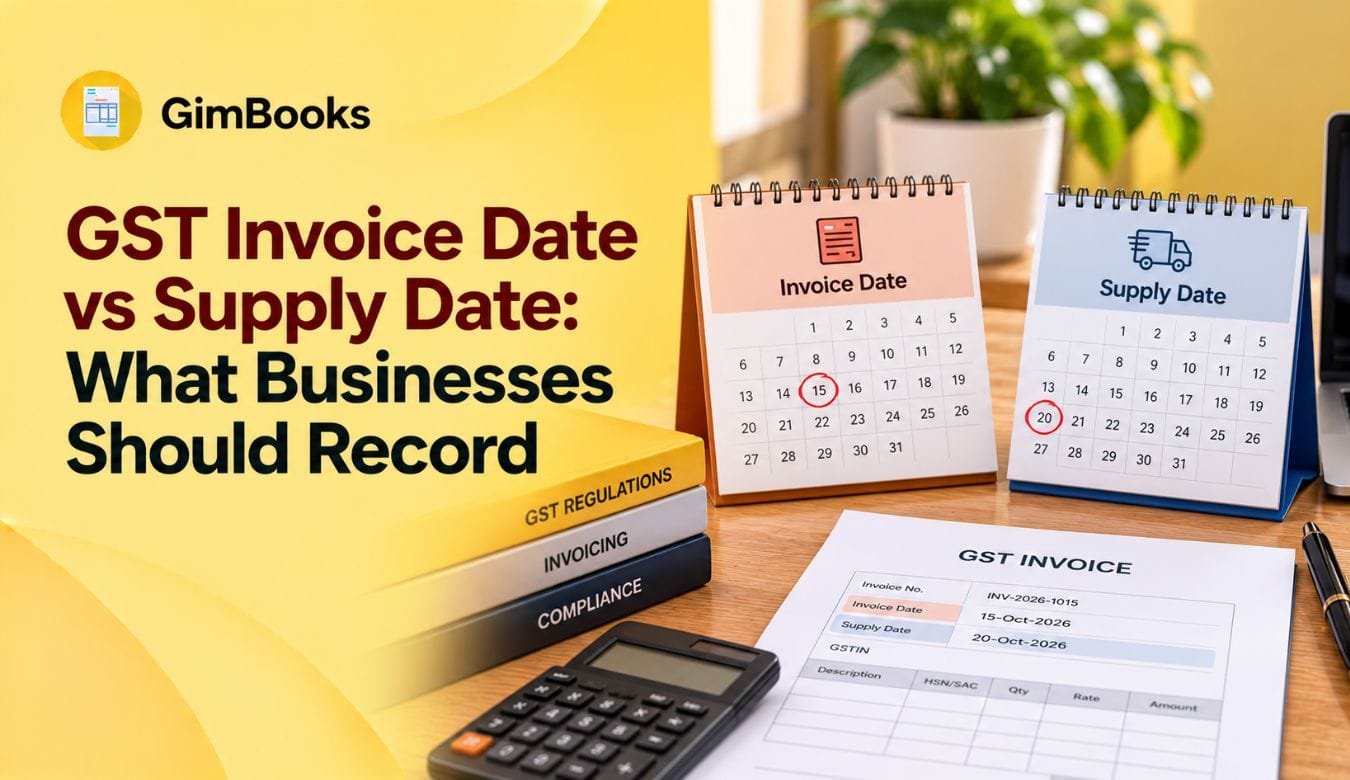
When a business sells goods or provides services, the date printed on the invoice may not always match the date the goods were dispatched, delivered or the services were completed. This difference can create confusion during GST return filing, accounting and invoice reconciliation.
Understanding gst invoice date vs supply date is important because these dates serve different purposes. The invoice date identifies when the tax invoice was issued, while the actual supply date records when the relevant goods or services were supplied. A third concept, the time of supply under GST, determines when the tax liability arises under the applicable provisions.
For retailers, wholesalers, manufacturers, freelancers and service providers, recording these dates correctly helps maintain accurate transaction records and identify GST reporting issues.
This guide explains the difference between GST invoice date and supply date, the relevant GST rules, practical examples and what businesses should record in their billing systems.
What Is the Difference Between GST Invoice Date and Supply Date?
The main difference between GST invoice date and supply date is that the invoice date identifies when the supplier issues the tax invoice, while the actual supply date identifies when the goods or services are supplied.
However, the date of actual supply is not necessarily the legal time of supply for GST purposes.
Under Sections 12 and 13 of the CGST Act, GST time of supply is determined by specific rules that consider the invoice date, payment date, statutory invoicing deadline and other relevant circumstances.
For example, a consulting business may complete a project on 5 August and issue its invoice on 12 August. Both dates should be recorded accurately, but the applicable time of supply must be determined separately.
GST Invoice Date vs Supply Date: Quick Comparison
Important: Businesses should not assume that GST liability always arises on the actual delivery or service-completion date. The applicable time-of-supply rules must be considered.
What Is an Invoice Date Under GST?
The invoice date under GST is the date on which a registered supplier issues a tax invoice for a taxable supply of goods or services.
Rule 46 of the CGST Rules requires the date of issue to appear on a tax invoice.
For example, suppose a supplier issues invoice INV-105 on 18 September 2026. The invoice date is 18 September 2026, even if the goods reach the customer on 21 September.
A proper GST invoice generally includes:
- Invoice number and issue date
- Supplier's name, address and GSTIN
- Customer details and GSTIN, where applicable
- Description of goods or services
- HSN or SAC code
- Taxable value
- Applicable GST rate and amount
- Place of supply, where required
- Other applicable particulars
The invoice date is a mandatory field, whereas a separate actual supply-date field is not universally required on every tax invoice under Rule 46.
For a detailed review of invoice particulars, refer to GimBooks' GST invoice mandatory fields checklist.
Why Is the GST Invoice Date Important?
The GST invoice issue date helps businesses:
- Identify when a tax invoice was formally issued.
- Determine invoice-based GST obligations.
- Maintain invoice numbering and financial-year records.
- Reconcile invoices with GST returns and customer accounts.
- Monitor e-invoice reporting timelines where applicable.
- Investigate invoices issued late or in an incorrect reporting period.
Businesses should record the actual invoice issue date rather than changing it merely to match the delivery date or month-end accounting period.
What Is a Supply Date Under GST?
The supply date in GST generally refers to the date on which the underlying goods or services are actually supplied.
For goods, this may involve dispatch, removal, delivery or another relevant event, depending on the transaction.
For services, the business may track the date of service completion, date of performance or the billing period covered by a contract.
Consider two examples.
Example 1: Goods
A Pune wholesaler dispatches products on 10 July, issues the invoice on 10 July and delivers the products on 13 July.
The invoice date and dispatch date are 10 July, while the delivery date is 13 July.
Example 2: Services
A marketing agency completes its monthly services on 31 July and issues an invoice on 5 August.
The recorded service period ends on 31 July, while the invoice date is 5 August.
These differences are common and do not automatically indicate a GST violation.
Is Supply Date the Same as Time of Supply?
No. This is an important distinction when comparing invoice date vs time of supply under GST.
- Actual supply date: When goods or services are supplied.
- Invoice date: When the invoice is issued.
- Time of supply: The legally determined point when GST liability arises.
Although these dates can coincide, they are not interchangeable.
For ordinary domestic transactions, Sections 12 and 13 of the CGST Act provide the relevant time-of-supply framework. Special situations such as reverse charge, continuous supply and changes in tax rates may require additional rules.
GST Rules for Invoice Date and Time of Supply
The relevant legal provisions include Section 31 for tax invoices, Section 12 for the time of supply of goods and Section 13 for the time of supply of services.
Section 31: When Should a GST Invoice Be Issued?
Section 31 specifies when a tax invoice must be issued.
For goods involving movement, the invoice is generally required before or at the time of removal for supply.
For goods not involving movement, the invoice is generally required before or at the time of delivery or when the goods are made available to the recipient.
For services, invoices are generally required before or after the provision of services, within the prescribed period.
The prescribed period is generally 30 days from the date of supply of services, with 45 days available for specified banking, insurance and financial-service suppliers. Special rules and exceptions can apply.
Section 12: Time of Supply of Goods
For an ordinary forward-charge supply of goods, the practical time-of-supply determination generally focuses on:
- Date of invoice issue
- Last date on which the invoice was legally required to be issued
Under the applicable notification-based treatment, GST on advances received for ordinary supplies of goods is generally not payable solely because the advance was received.
For example, a manufacturer dispatches goods on 7 October and issues the invoice on 7 October. In an ordinary transaction, 7 October would generally be the time of supply, even if payment is received in November.
If the invoice is issued after its required deadline, the delayed issue date cannot automatically postpone the GST liability.
Section 13: Time of Supply of Services
The time of supply of services under GST depends partly on whether the invoice was issued within the prescribed period.
If the invoice is issued within the prescribed period, the time of supply is generally the earlier of:
- Invoice issue date
- Date of receipt of payment
If the invoice is not issued within the prescribed period, the time of supply is generally the earlier of:
- Date of provision of service
- Date of receipt of payment
These rules are subject to the applicable statutory conditions and exceptions.
Does Receiving an Advance Change the GST Date?
The treatment depends on whether the transaction involves goods or services.
For ordinary supplies of goods, the current general treatment provides relief from paying GST merely upon receipt of an advance.
For taxable services, an advance payment may trigger GST liability before the invoice is issued or the service is completed.
Therefore, a business should record the payment date separately from both the invoice date and actual supply date.
GST Invoice Date vs Supply Date: Practical Examples
The following examples show how date differences affect billing and GST records.
Example 1: Goods Dispatched Before Delivery
A distributor in Maharashtra sells goods to a retailer.
What should the business record?
The invoice date is 5 September, the dispatch date is 5 September and the delivery date is 8 September.
For this ordinary goods transaction, the relevant GST liability generally arises based on the invoice/time-of-supply rules, not simply on the later delivery date.
The business should preserve the invoice, dispatch evidence and delivery confirmation.
Example 2: Services Completed Before Invoice Issue
A business consultant completes an assignment on 12 August and issues the invoice on 20 August. The customer pays on 10 September.
Assuming the standard service invoicing rule applies and there was no advance, the invoice was issued within the prescribed period.
The GST time of supply would generally be 20 August, the earlier of invoice issue and payment receipt.
The completion date should still be retained as evidence of when the service was performed.
Example 3: Invoice Issued Late for Goods
A supplier dispatches goods on 29 June but issues the tax invoice on 4 July.
For goods involving movement, the invoice was generally required before or at removal.
Because the invoice was issued after the statutory deadline, the supplier cannot assume that the time of supply automatically shifts to July.
The relevant tax liability may arise in June. The delayed invoice also requires a compliance review.
The correct approach is to investigate the actual facts, preserve the original dates and take any legally required corrective action.
Example 4: Advance Received for Services
A web development agency receives an advance of ₹30,000 on 10 August. It issues an invoice on 25 August and begins delivering the service in September.
For a normal taxable service, GST liability on the advance amount may arise on 10 August under the applicable time-of-supply rules.
The business should not wait until the service begins to review the tax treatment of the advance.
It should also maintain the relevant advance receipt documentation and subsequent invoice adjustments.
Example 5: Service Invoice Issued After the Prescribed Period
A professional service is completed on 5 May. No advance is received. The supplier issues the invoice on 15 June and receives payment in July.
Assuming the standard 30-day rule applies, the invoice has been issued beyond the prescribed period.
In this situation, the time of supply would generally be linked to the service provision date of 5 May rather than the delayed invoice date.
This shows why GST invoice timing rules are especially important for service businesses that prepare invoices after project completion.
What Date Should Businesses Record on a GST Invoice?
Businesses should use the actual invoice issue date in the invoice-date field.
They should separately maintain the relevant date of supply of goods or services, especially when the dates are different.
The following table can help businesses maintain a practical date-recording process.
These records help businesses demonstrate why different dates appear across invoices, delivery records and accounting entries.
Is the Date of Supply Mandatory on a GST Invoice?
A separate supply-date field is not universally mandatory for every GST tax invoice.
Rule 46 requires the invoice issue date and other prescribed particulars. However, transaction-specific rules, e-invoice data requirements, contractual obligations or supporting documentation may require additional information.
Businesses should not confuse the mandatory invoice date with an optional or transaction-specific supply-date field.
If a separate date is added to an invoice, it should accurately describe the event being recorded, such as dispatch date, delivery date or service period.
GST Invoice Date vs Supply Date for Different Business Types
Different businesses face different invoicing situations.
For businesses operating across different locations, invoice timing should also be reviewed alongside the applicable GST registration and transaction records.
The important principle is to record the actual business event rather than forcing all dates to match.
GST Invoice Date vs Place of Supply: Don't Confuse Them
Another common misunderstanding is treating the supply date and place of supply as the same GST concept.
They answer different questions.
- Invoice date: When was the invoice issued?
- Supply date: When were the goods or services supplied?
- Time of supply: When does GST liability arise?
- Place of supply: Where is the supply treated as taking place for GST purposes?
The place of supply under GST helps determine whether the transaction is interstate or intrastate and whether IGST or CGST and SGST generally applies.
For example, a Pune wholesaler may dispatch goods to a customer in Karnataka on 10 September. The invoice date helps determine timing, while the place-of-supply rules determine the relevant tax jurisdiction.
Businesses dealing with interstate dispatches, warehouses and Bill-to/Ship-to transactions can refer to GimBooks' place-of-supply audit checklist for goods invoices.
How Invoice and Supply Dates Affect GST Returns
Date differences can create reconciliation issues if the business reports transactions without checking the applicable time-of-supply rules.
GSTR-1 Reporting
GSTR-1 contains details of outward supplies, including applicable invoice particulars.
Businesses should check that invoice dates are accurate and that transactions are reported in accordance with the applicable return requirements.
An invoice issued after the statutory deadline should not automatically be treated as belonging to the later tax period without reviewing its time of supply.
GSTR-3B Tax Liability
GSTR-3B is used to declare applicable GST liability, ITC and tax payments.
Where the time of supply differs from the invoice issue date, businesses should review the correct liability period and any reporting adjustments required.
The sales register, GSTR-1 and GSTR-3B should be reconciled rather than treating the invoice date as the only relevant indicator.
Input Tax Credit Reconciliation
For buyers, the invoice date can also affect the supplier-reported document trail and subsequent ITC reconciliation.
However, input tax credit under GST is subject to applicable statutory eligibility conditions, including the relevant invoice, receipt, supplier reporting and other requirements.
A buyer should not assume that ITC becomes available solely because an invoice was created or because goods were delivered.
Month-End and Financial-Year Transactions
Date mismatches are particularly important near:
- Month-end closing
- Quarter-end reporting
- Financial-year closing
- GST rate changes
- Delayed invoice issuance
- Long-running service contracts
For example, goods dispatched on 31 March and invoiced on 2 April may require review of the March tax liability, depending on when the invoice was legally required.
For broader recurring checks, businesses can use the GST compliance calendar for small businesses to coordinate invoice reviews and GST filing activities.
How Invoice Date Differences Affect E-Invoicing
For businesses covered by mandatory e-invoicing, the invoice date is also important for Invoice Reference Number (IRN) generation and reporting.
An e-invoice record contains the document date, while the IRP processes the document and generates the relevant IRN.
The invoice issue date should not be confused with the date the document is reported to the IRP.
What Happens When E-Invoice Reporting Is Delayed?
For taxpayers covered by the 30-day IRP reporting restriction, applicable invoices, credit notes and debit notes must be reported within the prescribed window calculated from the document date.
As applicable from 1 April 2025, this restriction covers taxpayers with aggregate annual turnover of ₹10 crore and above.
Businesses within the restriction should track the age of documents awaiting IRN generation.
Read GimBooks' guide to avoiding the 30-day e-invoice reporting deadline for a dedicated explanation.
A delivery date or service completion date should not be substituted for the actual document date to bypass reporting restrictions.
Common GST Invoice Date Mistakes Businesses Should Avoid
1. Using the Delivery Date as the Invoice Date
Goods may be delivered several days after dispatch. The delivery date should not automatically replace the date the invoice was actually issued.
2. Issuing Invoices After the Legal Deadline
Late invoicing can create incorrect tax-period reporting and require tax liability corrections.
3. Backdating Invoices to Match a Previous Month
Changing invoice dates merely to align with a prior accounting period can create discrepancies between billing records, delivery evidence and GST reporting.
4. Treating Supply Date and Time of Supply as Identical
The date a service is completed may differ from the legally determined time of supply, especially where an invoice is issued on time or an advance is received.
5. Ignoring Advance Payments for Services
A service provider may incur GST liability upon receipt of an advance, even when the invoice or service completion occurs later.
6. Recording Only One Date
When goods are shipped across locations or services span several periods, maintaining only the invoice date may make transaction reconciliation difficult.
7. Overlooking Special GST Situations
Reverse-charge transactions, continuous supply arrangements and changes in GST rates can follow specific time-of-supply provisions.
Businesses should review the relevant GST treatment rather than applying one general rule to every transaction.
GST Invoice Date and Supply Date Checklist
Before finalising an invoice or GST return, businesses can use the following checklist.
Invoice Records
- Actual invoice issue date is recorded correctly.
- Invoice number and series are accurate.
- Customer and supplier details are correct.
- Invoice is issued within the applicable legal timeline.
Supply Records
- Dispatch or removal date is recorded for goods.
- Delivery date is recorded where relevant.
- Service period or completion date is maintained.
- Supporting delivery or completion documents are available.
GST Liability
- Applicable time-of-supply rule is identified.
- Advance receipts are reviewed.
- Delayed invoices are investigated.
- Special situations are separately assessed.
- GST liability is attributed to the appropriate period.
Return and E-Invoice Reconciliation
- Sales records reconcile with GSTR-1.
- GSTR-3B liability is checked against books.
- E-invoice document dates are verified where applicable.
- Invoice and dispatch records agree with relevant e-way bill data.
- Date mismatches are documented and resolved.
For a wider monthly process, use GimBooks' GST compliance checklist for small businesses.
How GST Billing Software Helps Manage Invoice and Supply Dates
Businesses that create numerous invoices can find it difficult to track invoice dates, service periods, dispatch details and payment records using disconnected spreadsheets.
Using GST billing software can help organise these records and reduce repetitive data entry.
For example, GimBooks supports GST billing and related business-record workflows that can help businesses:
- Create GST invoices with appropriate issue dates.
- Maintain customer and product information.
- Organise sales and purchase records.
- Monitor payment details.
- Maintain invoice history.
- Manage relevant e-invoice and e-way bill workflows.
- Prepare information for reconciliation and GST reporting.
The business should still maintain any supporting dispatch, delivery, service-completion and contractual records needed for its particular transactions.
Software can organise dates and documents, but the legal time of supply calculation under GST must follow the applicable provisions.
Businesses can explore GimBooks for GST billing, invoicing and business record management.
Frequently Asked Questions
1. What is the difference between GST invoice date and supply date?
The GST invoice date is when a tax invoice is issued. The actual supply date records when goods or services are supplied. These dates can differ, and the legally determined time of supply may be different from both.
2. Can the invoice date and supply date be different under GST?
Yes. A service may be completed before the invoice is issued, or goods may be delivered after an invoice is generated. The difference is not automatically non-compliant, provided the relevant invoicing timelines and GST provisions are followed.
3. Which date is considered for GST liability?
GST liability is determined according to the applicable time-of-supply rules. For ordinary goods, the invoice issue date or legally required invoice date is generally relevant. For services, the invoice date, payment receipt date or service provision date may determine the time of supply, depending on the circumstances.
4. Is the supply date mandatory on a GST invoice?
A separate actual supply-date field is not universally mandatory under Rule 46. The invoice issue date is mandatory, along with other applicable particulars. Additional dates may be required or useful depending on the transaction and supporting records.
5. Can I issue a GST invoice after the supply date?
For services, an invoice can generally be issued after provision within the prescribed period, subject to applicable exceptions. For goods, the invoice is generally required before or at removal, delivery or making available, depending on the nature of the transaction.
6. What happens if a GST invoice is issued late?
Late invoicing may create compliance issues, incorrect tax-period reporting, interest exposure or other consequences depending on the facts. The business should determine the correct time of supply and take the appropriate corrective action.
7. Is the delivery date the same as the GST supply date?
Not necessarily. The delivery date is when goods reach the customer, while removal or dispatch may be relevant for the statutory invoice deadline. Businesses should record these events separately when they occur on different days.
8. Does the payment date affect the time of supply?
Yes, especially for taxable services. Advance receipts may trigger GST liability. For ordinary taxable goods, notification-based relief generally means GST is not payable merely on receipt of an advance.
9. What is the difference between time of supply and place of supply?
Time of supply determines when GST liability arises. Place of supply determines the relevant tax jurisdiction and helps establish whether IGST or CGST and SGST applies.
10. Should the invoice date match the e-way bill date?
Not necessarily. The invoice date and e-way bill generation date can differ. Where an e-way bill is required, the details must accurately correspond to the underlying goods movement and relevant document, and the applicable timing requirements must be met.
11. Can businesses change an invoice date after issuing the invoice?
Businesses should not arbitrarily change an issued invoice date. If there is an error, the permitted correction process depends on the invoice status, applicable e-invoicing requirements and GST rules. A proper audit trail should be maintained.
12. How can small businesses avoid GST invoice date mistakes?
Businesses should record invoice, dispatch, delivery, service and payment dates separately, issue invoices within the applicable deadlines, reconcile GST liabilities and maintain appropriate supporting records.
Conclusion
Understanding gst invoice date vs supply date helps businesses maintain accurate billing records and avoid confusion over GST liability.
The invoice date records when a tax invoice was issued, the actual supply date captures the underlying transaction, and the legal time of supply determines when GST becomes payable.
For small businesses, the most practical approach is to record each relevant date correctly, maintain supporting documents and reconcile invoice records with GST returns. Particular attention should be given to delayed invoices, advance payments, service contracts and month-end transactions.
GimBooks can help businesses organise GST invoices, payment records and billing information, making the broader reconciliation process easier to manage.