
GST Compliance Workflow for Businesses With Multiple Branches
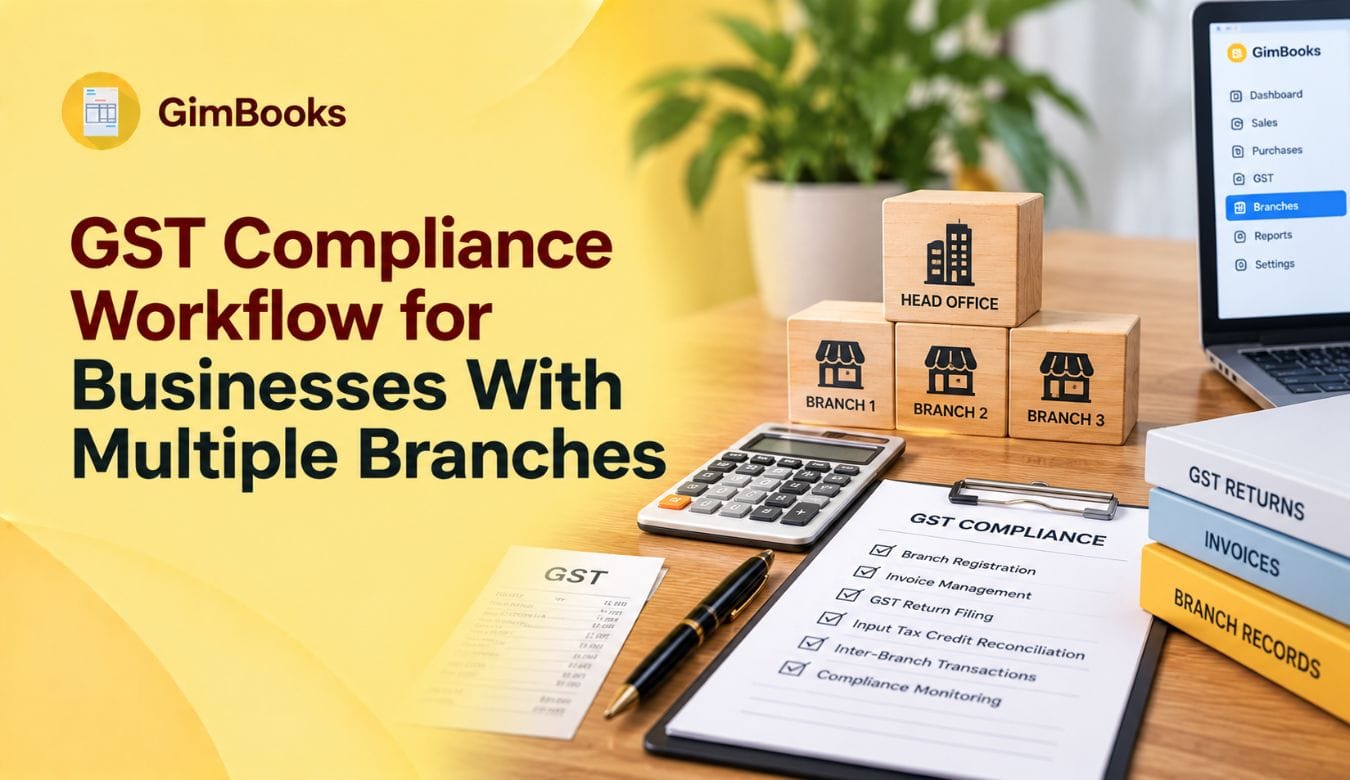
Running one business from several branches can make GST compliance significantly more complex.
A company may have its head office in Maharashtra, a warehouse in Gujarat, a sales branch in Karnataka and additional locations within the same state. Although all these locations may belong to the same legal entity, their GST treatment is not always the same.
For businesses managing gst compliance multiple branches, the challenge is not just filing GST returns. Teams need to know which GSTIN should be used, whether a location is an additional place of business or a separate registration, how branch transfers should be recorded, which branch can claim Input Tax Credit, and how invoices, e-way bills and returns should be reconciled.
This guide explains a practical GST compliance workflow for multiple branches so finance, billing, warehouse and management teams can work from the same process.
How Does GST Work for a Business With Multiple Branches?
GST registration is state-specific.
A business operating from several locations therefore needs to first determine how each location is registered.
Broadly, there are two situations:
For example, a business may operate a head office and two warehouses in Maharashtra under one GSTIN, while its Karnataka operation has another GSTIN.
This distinction affects almost every part of multi-branch GST compliance, including invoicing, stock transfers, Input Tax Credit, e-way bills and GST returns.
If you're opening another location within an existing registration, read GimBooks' guide on how to add an additional place of business in GST before changing your branch setup.
Why GST Compliance Becomes More Complex With Multiple Branches
A single-location business usually works with one GSTIN, one sales register and one purchase register.
A multi-location organisation may have:
- Multiple GSTINs
- Multiple invoice series
- Separate sales registers
- Separate purchase registers
- Different state tax registrations
- Inter-branch stock transfers
- Head-office expenses
- Branch-specific ITC
- Multiple e-invoice records
- Multiple e-way bill workflows
- Separate GSTR-1 and GSTR-3B filings
- Consolidated management accounts
Without a clear GST branch compliance process, it becomes easy to use the wrong GSTIN or invoice series, assign purchases to the wrong branch, miss inter-branch transactions or discover return differences only at month-end.
The solution is to create a standard workflow that every location follows.
Step 1: Create a GST Branch Master
The first step in GST compliance for multiple branches is creating one master list of every business location.
Your branch master can include:
Do not rely on employees remembering which GSTIN belongs to which location.
The correct GSTIN should be mapped in the billing or accounting system before transactions are created.
For teams managing registrations across states, GimBooks' GST State Code List can also help validate the first two digits of each GSTIN.
Step 2: Separate Same-GSTIN and Different-GSTIN Branches
This is one of the most important controls.
Branches Under the Same GSTIN
Where locations operate as principal and additional places under the same GST registration, they normally belong to the same registered person for that GSTIN.
Internal movement between such locations should therefore not automatically be treated in the same way as a movement between two separately registered GSTINs.
However, the movement may still require appropriate inventory and transport documentation depending on the transaction.
Branches With Separate GSTINs
Separate GST registrations are treated independently for GST compliance purposes.
This means transactions between them may need to be recorded as supplies even though both registrations belong to the same organisation.
For example:
Maharashtra GSTIN → Karnataka GSTIN
is different from:
Mumbai warehouse → Pune warehouse under the same Maharashtra GSTIN
Your accounting team should therefore classify every location according to its registration before deciding the GST treatment.
Step 3: Assign Every Transaction to the Correct GSTIN
A multi-branch business should never allow transactions to be posted only under the company's PAN or general company name.
Every relevant transaction should be associated with a specific GST registration.
For sales, verify:
- Supplier GSTIN
- Billing branch
- Invoice series
- Customer GSTIN
- Place of supply
- Dispatch location
- Delivery location
- Applicable GST type
- E-invoice applicability
- E-way bill requirement
For purchases, verify:
- Supplier GSTIN
- Recipient GSTIN
- Receiving branch
- Ship-to address
- Tax amount
- Purchase category
- ITC eligibility
This branch-wise GST accounting prevents transactions belonging to one registration from being reported under another.
Step 4: Maintain Controlled Branch-Wise Invoice Series
Businesses with multiple branches often use separate invoice series to make reconciliation easier.
For example:
- MUM/26-27/001
- DEL/26-27/001
- BLR/26-27/001
A controlled series makes it easier to identify:
- Which branch generated the invoice
- Which GSTIN should appear
- Missing invoice numbers
- Duplicate invoices
- Cancelled documents
- Incorrect branch selection
However, creating branch codes in the invoice number does not replace GST compliance requirements.
The supplier GSTIN, address, invoice number, recipient information, taxable value, HSN/SAC, GST rate and other applicable details still need to be correct.
Use GimBooks' GST Invoice Mandatory Fields Audit Checklist for a detailed invoice-level review.
Step 5: Validate Place of Supply Before Charging GST
Multiple branches increase the risk of incorrectly applying CGST + SGST instead of IGST, or vice versa.
Your billing team should distinguish between:
- Bill-from location
- Dispatch-from location
- Customer billing address
- Ship-to location
- Customer GSTIN
- Place of supply
Do not determine tax simply by comparing the customer's address with the branch address.
For example, transactions involving another warehouse, a different delivery location or bill-to/ship-to arrangements may require additional review.
For goods transactions, use the Place of Supply Audit Checklist for Goods Invoices when setting up your billing controls.
Step 6: Create a Separate Workflow for Inter-Branch Transfers
One of the biggest areas of risk in GST compliance for branch offices is inter-branch movement.
First ask:
Are both branches under the same GSTIN?
If yes, the movement should be recorded correctly in inventory and supported by the appropriate movement documents where required.
Do the branches have different GSTINs?
If yes, the transaction may be treated as a supply between distinct registrations even when there is no external customer involved.
This can apply to transfers such as:
- Finished goods
- Raw materials
- Trading stock
- Equipment
- Other business assets
The transaction may therefore require applicable valuation, tax documentation, reporting and movement documentation.
Do not treat every stock transfer as a simple warehouse movement.
Step 7: Link Stock Transfers With the Correct Movement Documents
Inventory and GST records should tell the same story.
Suppose stock moves from the Maharashtra registration to the Karnataka registration.
Your records should clearly identify:
Source GSTIN → document → goods → destination GSTIN → e-way bill where applicable → receiving entry
For goods movement, the business may need to manage documents such as:
- Tax invoice
- Delivery challan
- E-way bill
- Transport document
- Goods receipt record
The correct document depends on why the goods are moving and the GST registration structure.
For detailed movement-document controls, see GimBooks' guide on linking delivery challan, invoice and e-way bill.
Step 8: Maintain Branch-Wise Purchase and ITC Records
A purchase invoice should not simply enter a central accounting system without a branch tag.
For every purchase, capture:
- Supplier GSTIN
- Invoice number
- Invoice date
- Recipient GSTIN
- Receiving branch
- Taxable value
- GST amount
- ITC eligibility
- Expense or inventory category
This helps maintain accurate branch-wise Input Tax Credit reconciliation.
Why recipient GSTIN matters
Suppose your supplier issues an invoice to the Maharashtra GSTIN but the accounting team records it under the Karnataka registration.
The organisation may have incurred the expense, but the GST document belongs to a specific registered recipient.
That mismatch needs to be investigated rather than manually shifting credit between branch ledgers.
Step 9: Reconcile GSTR-2B GSTIN by GSTIN
Do not perform one combined GSTR-2B reconciliation for the entire PAN and assume the result is sufficient.
Run reconciliation separately for each GSTIN.
A practical structure is:
Purchase Register → Recipient GSTIN → GSTR-2B → ITC Eligibility → Exception
Check for:
- Invoice missing in GSTR-2B
- Wrong recipient GSTIN
- Wrong taxable value
- Wrong tax value
- Duplicate invoice
- Credit note
- Supplier amendment
- Ineligible ITC
- Invoice booked by the wrong branch
This GST reconciliation for multiple branches makes errors easier to trace back to the responsible location.
Step 10: Review Head Office and Common Expenses
Multi-branch organisations commonly receive central expenses such as:
- Software subscriptions
- Professional services
- Advertising
- Audit fees
- Consultancy
- Technology services
- Shared administrative services
- Other central costs
The finance team should determine which registration received the supply and how the related GST treatment and Input Tax Credit should be handled.
Where common input-service credit relates to multiple registrations, the organisation should review the applicable Input Service Distributor (ISD) requirements and other relevant GST provisions instead of allocating ITC informally through spreadsheets.
Create a separate monthly list of common expenses requiring allocation or GST review.
Step 11: Manage E-Invoices Branch by Branch
Where e-invoicing applies, each applicable invoice must use the correct supplier GSTIN and document details.
A useful multi-branch e-invoice workflow is:
Branch creates invoice
The billing user selects the correct branch and GSTIN.
System validates invoice
Check:
- Supplier GSTIN
- Invoice number
- Invoice date
- Buyer GSTIN
- HSN/SAC
- Tax values
- Place of supply
Invoice is reported to IRP
The invoice is submitted using the correct registration.
IRN is stored against the source invoice
The accounting system should retain the IRN and relevant QR-code data against the invoice.
Exception report is reviewed
Monitor:
- Failed IRNs
- Duplicate-document errors
- Incorrect GSTINs
- Pending invoices
- Cancelled documents
- Documents requiring correction
Branches should not maintain disconnected spreadsheets for IRN tracking if the company can maintain one controlled system.
Step 12: Control E-Way Bills Across Warehouses and Branches
Businesses with many warehouses frequently face mismatches between:
- Bill-from address
- Dispatch-from address
- Supplier GSTIN
- Ship-to address
- Recipient GSTIN
- Vehicle number
- Invoice
- Delivery challan
- E-way bill
Warehouse staff should not generate an e-way bill only from transport information.
They need the correct source transaction.
A simple approval flow can be:
Sales/Transfer Entry → GST Document → Dispatch Check → E-Way Bill → Vehicle Dispatch → Delivery Confirmation
For businesses sending goods to several destinations in one route, the E-Way Bill for Multi-Stop Deliveries guide can be used as a separate operational reference.
Step 13: Prepare GSTR-1 Separately for Each GSTIN
Each applicable GST registration should have its own outward-supply reconciliation.
Before GSTR-1 preparation, compare:
Branch Sales Register → E-Invoice Data → Credit/Debit Notes → Branch Transfers → GSTR-1
Check:
- Missing invoices
- Wrong GSTIN
- Duplicate invoices
- Incorrect tax type
- Branch-transfer invoices
- Credit/debit notes
- Amendments
- E-invoice differences
Do not first consolidate every GSTIN and then attempt to separate the transactions during return filing.
Compliance records should remain GSTIN-specific from the time the transaction is created.
Step 14: Prepare GSTR-3B GSTIN by GSTIN
The same approach applies to GSTR-3B.
Review separately for every registration:
- Outward tax liability
- Reverse-charge liability
- Eligible ITC
- ITC reversals
- Tax payable
- Electronic cash ledger
- Electronic credit ledger
- Payment status
Your company may prepare consolidated financial statements, but GST return compliance for multiple GSTINs still requires registration-level control.
Step 15: Perform a Central GST Reconciliation
After the individual registrations have been reviewed, head office should perform one consolidated control review.
A useful dashboard can look like this:
This gives management a consolidated view without mixing the underlying compliance records.
Recommended Monthly GST Workflow for Multiple Branches
A practical monthly process can follow this sequence.
During the Month
Each branch should:
- Create invoices using the correct GSTIN
- Record purchases under the correct recipient GSTIN
- Generate applicable e-invoices
- Create applicable e-way bills
- Record stock transfers
- Upload supporting documents
- Flag transaction exceptions immediately
At Month-End
Each branch should:
- Close sales records
- Close purchase records
- Reconcile stock movements
- Review credit/debit notes
- Check cancelled invoices
- Review pending IRNs
- Review e-way bill exceptions
Before GST Return Filing
The finance team should:
- Reconcile branch sales.
- Review outward supplies.
- Reconcile purchases with GSTR-2B.
- Check ITC eligibility.
- Review inter-branch transactions.
- Check common input-service credits.
- Reconcile e-invoices.
- Reconcile e-way bills.
- Prepare GSTR-1.
- Review GSTR-3B.
- Pay applicable tax.
- File the applicable returns.
After Filing
Head office should:
- Store acknowledgements
- Compare filed returns with books
- Track unresolved exceptions
- Follow up on supplier mismatches
- Carry forward required corrections
- Update the central compliance dashboard
For a wider month-by-month schedule, refer to GimBooks' GST Compliance Calendar for Small Businesses.
GST Compliance Responsibility Matrix for Multiple Branches
Compliance becomes easier when every task has an owner.
The objective is to avoid situations where everyone assumes another branch is handling the transaction.
Common GST Compliance Mistakes in Multi-Branch Businesses
Using the Wrong GSTIN on an Invoice
A user may select the company's GSTIN but not the GSTIN belonging to the branch making the supply.
Control: Lock GSTIN selection based on branch login or business location.
Recording All Purchases at Head Office
This can create difficulties when invoices actually name another GST registration.
Control: Capture recipient GSTIN before posting the purchase.
Ignoring Inter-Branch Transactions
Teams sometimes assume there is no GST impact because both locations belong to the same company.
Control: Determine whether the locations have the same GSTIN or separate GSTINs before processing the movement.
Mixing Invoice Series
Invoices from several branches may be generated from an uncontrolled common sequence.
Control: Configure controlled registration-wise or branch-wise invoice series.
Moving Stock Without GST Review
Warehouse teams may transfer goods before finance decides whether an invoice, delivery challan or e-way bill is required.
Control: Add a document-validation step before dispatch.
Reconciling ITC Only at Company Level
A consolidated purchase report can hide GSTIN-level mismatches.
Control: Reconcile GSTR-2B separately for each GST registration.
Filing Branch Returns Independently Without Central Review
Individual branches may file correctly from their own perspective while group-level inconsistencies remain unnoticed.
Control: Perform both GSTIN-level reconciliation and consolidated exception review.
Multi-Branch GST Compliance Checklist
GST Registration
- Every operational location is mapped
- Principal and additional places are identified
- Separate GSTINs are mapped correctly
- Branch GSTIN details are current
- State codes have been validated
Sales
- Correct supplier GSTIN is selected
- Correct branch invoice series is used
- Customer GSTIN is verified
- Place of supply is reviewed
- Correct CGST/SGST/IGST is applied
- Credit/debit notes are mapped correctly
Purchases and ITC
- Recipient GSTIN is correct
- Purchase belongs to the correct branch
- GSTR-2B is reconciled GSTIN-wise
- ITC eligibility has been reviewed
- Common expenses have been separately reviewed
- Applicable ISD requirements have been considered
Inter-Branch Transactions
- Source branch is identified
- Destination branch is identified
- GSTIN relationship is checked
- GST treatment is reviewed
- Applicable valuation is checked
- Correct invoice/challan is prepared
- Inventory is updated at both locations
E-Invoice and E-Way Bill
- Correct GSTIN is used
- IRN is generated where applicable
- E-way bill is generated where required
- Dispatch location is correct
- Ship-to location is correct
- Vehicle/transport details are checked
- Failed or cancelled documents are reconciled
Returns
- GSTR-1 is reconciled GSTIN-wise
- GSTR-3B is reviewed GSTIN-wise
- Branch transfers have been considered
- ITC has been reviewed
- Tax liability has been verified
- Payments and ledgers have been checked
- Filing acknowledgements have been retained
How GST Billing Software Can Help Manage Multiple Branches
As branch count increases, spreadsheet-based GST management becomes difficult because the same information must be controlled across billing, purchases, inventory and return preparation.
A centralised GST billing software for multiple branches can help businesses maintain:
- Branch-wise customer records
- Supplier records
- Multiple GST registrations
- Invoice series
- GST calculations
- HSN/SAC information
- Inventory records
- Purchase records
- E-invoice workflows
- E-way bill workflows
- Branch-level reports
- Consolidated business records
With GimBooks, businesses can organise their billing, accounting and GST-related transaction records in a more structured way instead of maintaining disconnected branch files.
Software does not replace GST review, but better source data makes multi-location GST compliance and reconciliation easier.
Frequently Asked Questions
How is GST compliance managed for multiple branches?
GST compliance should first be organised according to GSTIN. Map every branch to its applicable registration, maintain branch-wise sales and purchase records, monitor inter-branch movements, reconcile ITC separately, prepare applicable GST returns for each registration and then perform a consolidated head-office review.
Does every branch require a separate GST registration?
Not necessarily. Multiple business locations within the same state may operate under one registration with applicable additional places of business, while businesses operating across states may require separate state-wise GST registrations depending on their activities and registration obligations. Separate registration within the same state can also arise in permitted circumstances.
Can two branches of the same company have different GSTINs?
Yes. A business can have multiple GSTINs under the same PAN. This commonly occurs when it operates across different states and can also occur where separate registrations are permitted within a state.
Is GST applicable on branch transfers?
A movement between two locations under separate GST registrations may have GST implications because separate registrations are treated as distinct persons. A movement between locations covered by the same GSTIN is different and should not automatically be treated in the same manner. The exact transaction and documentation should be reviewed.
How should Input Tax Credit be managed for multiple GSTINs?
Purchases should be recorded against the GSTIN shown as the recipient on the tax document. Each GSTIN's purchase records should then be reconciled with the relevant GST data and ITC eligibility conditions. Common input services received centrally should also be reviewed under the applicable ISD and other GST provisions.
Should GSTR-2B be reconciled separately for each branch?
Where branches have separate GST registrations, GSTR-2B reconciliation should be performed GSTIN-wise. Combining all purchase invoices before reconciliation can hide invoices booked under the wrong registration.
Can multiple branches use different invoice series?
Businesses may maintain controlled invoice series for different branches or business units, subject to applicable GST invoice-numbering requirements. Separate series can make branch identification and reconciliation easier.
How should stock transfers between branches be recorded?
First determine whether the locations operate under the same GSTIN or separate GSTINs. Then identify the appropriate tax and movement documentation. The inventory entry, GST document, e-way bill where applicable and receiving records should all be linked.
What is the best GST workflow for a multi-branch business?
A strong workflow is:
Branch setup → GSTIN mapping → invoice/purchase entry → inter-branch transaction review → e-invoice/e-way bill checks → GSTR-2B reconciliation → GSTR-1 → GSTR-3B → central reconciliation → exception tracking
This keeps transaction-level data accurate before return filing begins.
Conclusion
Managing gst compliance multiple branches becomes difficult when every branch follows its own process.
The most effective approach is to standardise the workflow across the organisation.
Start with a reliable branch and GSTIN master. Record sales and purchases against the correct registration. Separate same-GSTIN movements from transactions between different GSTINs. Reconcile ITC registration-wise. Control e-invoices and e-way bills at the source. Prepare returns GSTIN by GSTIN, and finally perform a consolidated review at head office.
A structured GST compliance workflow for multiple branches gives finance teams better visibility and reduces the chances of discovering GSTIN, invoice, ITC or stock-transfer mismatches only when returns are due.
As the number of branches grows, using GST billing and accounting software such as GimBooks can also help keep billing, purchases, inventory and GST-related records organised across locations.