
IRN vs Invoice Number: What Is the Difference Under GST?
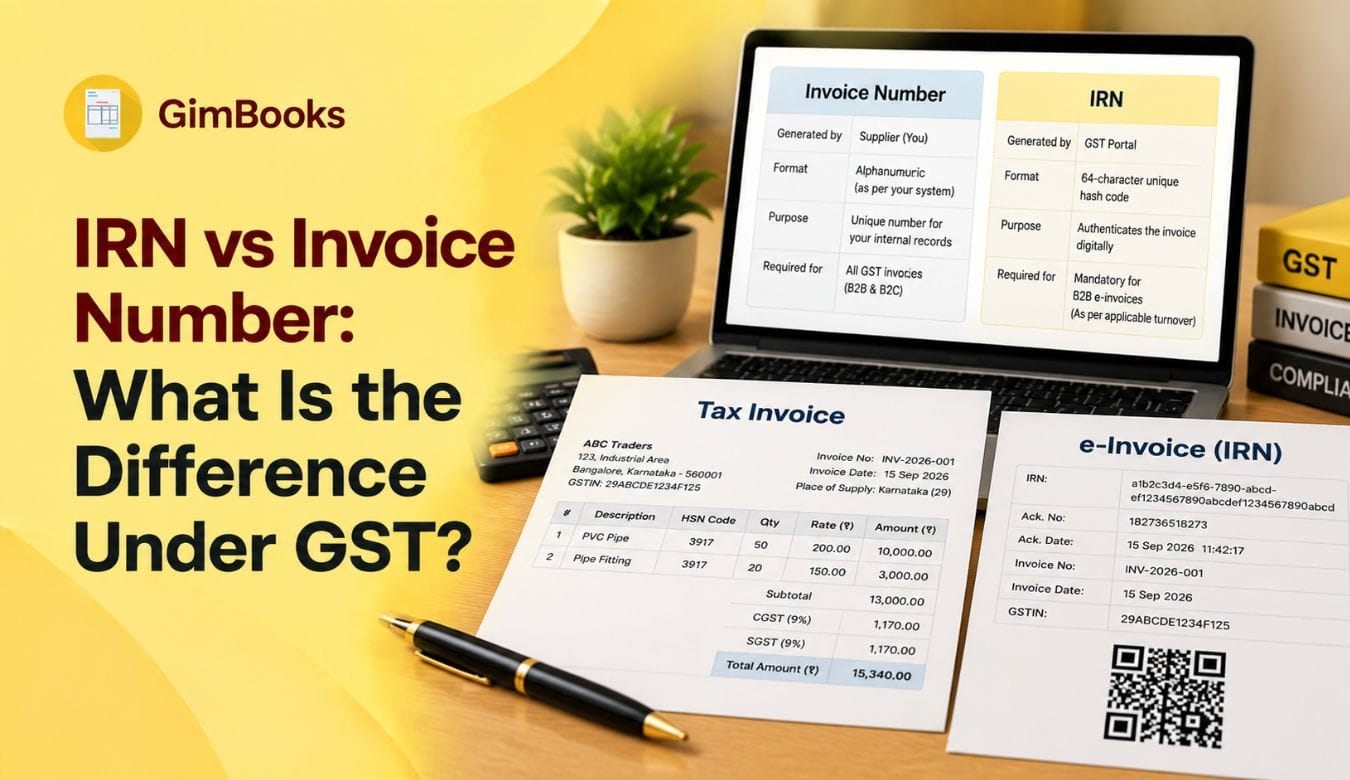
When a business generates an e-invoice under GST, two different identifiers can appear in the invoicing process: the invoice number created by the business and the Invoice Reference Number (IRN) generated after the invoice is registered through the Invoice Registration Portal.
Understanding IRN vs invoice number is important because these identifiers perform different functions. The invoice number identifies the transaction in the supplier's billing and accounting records, whereas the IRN identifies the registered e-invoice in the GST e-invoicing system.
In simple terms:
Invoice Number = Number assigned by your business to the invoice
IRN = Unique reference generated after successful e-invoice registration
This guide explains the IRN and invoice number difference, how both numbers are generated, how they work together and what businesses should check while managing e-invoices.
IRN vs Invoice Number: Quick Comparison
If you're searching for invoice reference number vs invoice number, this table explains the difference at a glance.
The easiest way to remember the difference between IRN and invoice number is that your business creates the invoice number first. The e-invoice system subsequently generates an IRN for an applicable document after registration.
What Is an Invoice Number Under GST?
An invoice number is the unique serial identifier assigned to an invoice by the supplier.
For example:
INV/26-27/0015
The invoice number under GST helps distinguish one invoice from another and supports:
- transaction tracking;
- sales records;
- bookkeeping;
- customer references;
- payment reconciliation;
- GST reporting;
- audits; and
- e-invoice registration where applicable.
Every business should maintain a controlled invoice-numbering structure instead of creating random numbers for individual transactions.
For a detailed explanation of numbering structures, permitted formats and common errors, read the Invoice Numbering Rules Under GST.
What Should a GST Invoice Number Look Like?
A GST invoice number should be unique within the applicable invoice series and follow GST invoice-numbering requirements.
Businesses may use a structured numbering method such as:
- INV001
- INV/001
- FY26/001
- DEL/INV/001
- PUN/26/001
The correct invoice number format under GST does not mean every business must use an identical format. A business can establish a format suited to its operations while complying with the applicable GST requirements.
For example:
Single-location business
INV/001INV/002INV/003
Multiple locations
DEL/001MUM/001PUN/001
Financial-year-based series
26-27/INV/00126-27/INV/00226-27/INV/003
Businesses managing many transactions should make sure their invoice series prevents accidental duplication and remains easy to reconcile.
What Is IRN in E-Invoice?
If you're wondering what is IRN in e-invoice, IRN is the unique reference associated with an invoice after applicable invoice data is successfully registered through an Invoice Registration Portal.
The IRN full form in GST is Invoice Reference Number.
The invoice reference number in GST forms part of the e-invoicing process and helps uniquely identify a registered e-invoice.
Unlike the normal invoice number, the supplier does not manually choose the IRN.
The IRN is generated through the e-invoice registration process.
For businesses wanting a more detailed explanation specifically about IRN, read Everything You Should Know About IRN in E-Invoice.
What Is an IRN Number in E-Invoice?
The term IRN number in e-invoice is commonly used by businesses, although IRN itself already stands for Invoice Reference Number.
An IRN is represented by a unique 64-character hash associated with a registered e-invoice.
The IRN in GST helps establish a unique reference for a document processed through the e-invoice system.
Think of it this way:
Your billing software identifies the transaction using the invoice number.
The e-invoice system identifies the registered document using its IRN.
That distinction is the foundation of understanding IRN vs invoice number.
How Is IRN Generated?
IRN generation happens as part of e-invoice registration.
The typical workflow is:
Create invoice → Submit applicable invoice information → IRP validates it → IRN generated → Signed QR code returned
To understand how IRN is generated, consider this simplified example.
Suppose a business creates:
Invoice Number: INV/26-27/125
The business then submits the prescribed invoice information for registration through the IRP.
Key document information is used to uniquely identify the document, including elements such as:
- supplier GSTIN;
- document type;
- document number; and
- financial year.
After the information passes the applicable validations, the e-invoice receives an IRN.
The original invoice number remains:
INV/26-27/125
and the registered document now also has a separate IRN.
What Is IRP Invoice Registration?
IRP invoice registration refers to the process through which applicable invoice data is reported and validated through an Invoice Registration Portal.
The basic flow is:
Step 1: Create the invoice
The supplier creates an invoice using its billing, accounting or ERP system.
Step 2: Assign an invoice number
For example:
INV/26-27/458
Step 3: Validate invoice details
Important information should be checked before reporting, including:
- supplier GSTIN;
- recipient GSTIN;
- invoice number;
- invoice date;
- HSN/SAC;
- taxable value;
- GST amount;
- place of supply; and
- other applicable particulars.
For a broader invoice validation process, use the GST Invoice Mandatory Fields Audit Checklist.
Step 4: Submit applicable data for registration
The invoice information is sent to the IRP.
Step 5: IRN is generated
After successful registration, the system generates the unique IRN.
Step 6: Signed QR code is returned
The registered e-invoice also receives a signed QR code containing key information relating to the document.
Invoice Reference Number Example
Here's a simple invoice reference number example to show how an invoice number and IRN can relate to the same transaction.
Suppose ABC Distributors creates an invoice:
The supplier-created number remains:
ABC/26-27/0158
The IRN is added separately after e-invoice registration.
This means the IRN never becomes a replacement for ABC/26-27/0158.
E-Invoice Number vs Invoice Number: Are They the Same?
The phrase e-invoice number vs invoice number can create unnecessary confusion because an e-invoice still has the supplier's normal invoice number.
There isn't a separate supplier-created "e-invoice number" that replaces it.
An applicable invoice normally progresses through this sequence:
Business invoice number
↓
Invoice information reported for e-invoicing
↓
IRN generated
↓
Signed QR code returned
Therefore, the GST e-invoice number you use for normal transaction identification remains your invoice number, while the IRN works as the separate e-invoice registration reference.
Does IRN Replace the Invoice Number?
No.
An IRN does not replace the supplier's invoice number.
Suppose your accounting software creates:
INV/26-27/078
After e-invoice registration, that number remains the invoice number.
The transaction would have:
Invoice Number: INV/26-27/078IRN: Unique 64-character reference
The two identifiers should therefore be stored separately.
A useful way to structure billing records is:
Unique Invoice Number GST Requirements and IRN
Maintaining a unique invoice number GST structure becomes especially important for businesses using e-invoicing.
A duplicate or incorrectly entered document number can disrupt:
- accounting records;
- invoice reconciliation;
- GST reporting;
- customer records;
- e-invoice registration; and
- internal audits.
For example, suppose your system has:
INV/101INV/102INV/103
but someone accidentally creates another:
INV/102
The duplicate invoice number can create confusion because document identity is important during the e-invoice registration process.
Using an automated invoice-numbering system can reduce these issues.
For detailed numbering controls, refer to the Invoice Numbering Rules Under GST.
IRN and QR Code: What Is the Difference?
Another common source of confusion is IRN and QR code.
They are connected, but they are not the same thing.
The signed QR code generated through the e-invoice process contains key information relating to the registered document, including the IRN.
So:
Invoice Number ≠ IRN ≠ QR Code
All three can relate to the same e-invoice, but each has a different purpose.
Does Every GST Invoice Need an IRN?
No. Every GST invoice does not automatically require an IRN.
The invoice must first meet the normal applicable GST invoice requirements. E-invoicing and IRN requirements apply separately based on the relevant taxpayer and transaction conditions.
Therefore:
Normal GST invoice
Has an applicable invoice number and required invoice particulars.
Invoice covered under e-invoicing
Has its normal invoice number plus an IRN generated through successful registration.
This is why businesses should not assume that a GST invoice number and IRN are interchangeable.
What Happens After an E-Invoice IRN Is Generated?
Once an e-invoice IRN has been successfully generated, the business should retain the IRN against the corresponding invoice.
A typical record might include:
- invoice number;
- invoice date;
- customer GSTIN;
- taxable value;
- GST amount;
- IRN;
- acknowledgement details;
- QR code; and
- e-invoice status.
A simple status workflow could be:
Invoice created → E-invoice pending → IRN generated → Verified → Invoice issued
This makes it easier for finance teams to identify applicable invoices that have not completed the e-invoicing process.
Can the Invoice Number Be Changed After IRN Generation?
Businesses should carefully verify invoice information before IRN generation.
Once the document has been registered, businesses should not treat it like an editable draft in their accounting software.
If a material error is discovered, such as:
- incorrect customer GSTIN;
- wrong invoice number;
- incorrect taxable amount;
- wrong tax values;
- incorrect transaction details; or
- invoice generated for a cancelled transaction,
the appropriate cancellation or correction process should be followed.
For the detailed workflow, read How to Handle E-Invoice Cancellation Within the Allowed Window.
Better internal workflow
Use:
Create invoice → Review → Approve → Generate IRN → Verify → Issue
instead of:
Create invoice → Generate IRN immediately → Find mistakes later
A simple approval step can prevent avoidable corrections.
Can the Same Invoice Number Generate Another IRN?
Businesses should not treat invoice numbers as reusable identifiers after an e-invoice has already been registered.
The invoice number forms part of the document identity used during registration.
If an e-invoice is cancelled because the underlying document is incorrect, businesses should follow the applicable cancellation and document-creation process rather than simply trying to reuse the old invoice number.
This is another reason why disciplined invoice-numbering controls are important.
Why Invoice Number and IRN Reconciliation Matters
Businesses generating large volumes of invoices should periodically reconcile invoice numbers against IRNs.
A useful reconciliation report can look like this:
This helps identify:
- invoices without IRNs;
- rejected invoices;
- duplicate documents;
- cancelled IRNs;
- incorrect invoice numbers;
- mismatched transaction values; and
- invoices awaiting registration.
IRN Reporting Should Not Be Left Until Month-End
E-invoicing should ideally form part of the normal invoicing workflow rather than becoming a GST-return-filing task at the end of the month.
Where reporting timelines apply, delaying invoice registration can create problems with IRN generation.
Businesses covered by applicable reporting restrictions should monitor invoice ageing regularly.
For a dedicated control process, read the E-Invoice 30-Day Reporting Rule Checklist.
A simple tracking system can categorise invoices as:
- IRN generated;
- IRN pending;
- rejected;
- cancelled; or
- correction required.
This makes exceptions visible before they become month-end reconciliation problems.
Common IRN vs Invoice Number Mistakes
1. Treating IRN as the normal invoice number
This is incorrect.
The supplier's invoice number remains the primary business document number. The IRN is an additional identifier generated through e-invoice registration.
2. Using duplicate invoice numbers
Duplicate invoice numbers can create accounting, reconciliation and e-invoice registration problems.
Maintain a controlled sequence and investigate duplicates immediately.
3. Changing invoice details after IRN generation without checking the proper process
Once an invoice has completed registration, changes should not simply be made independently in the billing software.
The business should determine the appropriate cancellation or correction process.
4. Assuming every invoice requires IRN
Normal GST invoicing requirements and e-invoicing applicability are separate considerations.
Not every GST invoice automatically requires IRN generation.
5. Confusing the IRN with the QR code
The IRN is the unique e-invoice reference.
The QR code is the machine-readable signed code generated as part of the registered e-invoice process.
6. Not matching the IRN with the original invoice number
If IRNs are stored separately without a clear connection to source invoices, reconciliation becomes unnecessarily difficult.
Every applicable IRN should remain mapped to its corresponding invoice.
7. Using month-end as the first IRN check
Businesses processing e-invoices should monitor IRN generation as invoices are created instead of discovering missing registrations only while preparing returns.
Practical Checklist Before Generating IRN
Before submitting invoice data for IRN generation, check:
Supplier information
- GSTIN
- Legal/business details
- Applicable registration information
Customer information
- Customer name
- GSTIN
- Address
- State information
Invoice information
- Invoice number
- Invoice date
- Invoice series
- Document type
Tax information
- HSN/SAC
- Taxable value
- GST rate
- CGST/SGST/IGST
- Place of supply
E-invoice checks
- Does e-invoicing apply?
- Has this document already been registered?
- Is the invoice number correct?
- Is the invoice within any applicable reporting timeline?
- Is the invoice data ready for submission?
For a more complete pre-issue review, use the GST Invoice Mandatory Fields Audit Checklist.
How GST Billing Software Helps Manage Invoice Numbers and IRNs
Businesses processing a few invoices may initially manage invoicing manually. However, maintaining invoice numbering, customer details, GST data and e-invoice records becomes harder as transaction volume grows.
A GST billing system can help organise:
- invoice numbering;
- customer and supplier records;
- GST calculations;
- HSN/SAC information;
- e-invoice workflows;
- IRN records;
- QR-code information;
- e-way bills;
- inventory;
- accounting records; and
- GST reports.
With GimBooks e-invoicing software, businesses can manage GST invoices and e-invoice-related workflows through a more structured process.
Instead of treating invoices and IRNs as disconnected records, businesses can maintain a workflow such as:
Create Invoice → Validate Details → Generate E-Invoice → Receive IRN → Maintain GST Records
This can reduce manual work and make invoice and IRN reconciliation easier.
Frequently Asked Questions
What is the difference between IRN and invoice number?
The difference between IRN and invoice number is primarily who generates them and what they identify. The supplier creates the invoice number to identify its business document, while the IRN is generated through the Invoice Registration Portal to identify the registered e-invoice.
Is IRN the same as an invoice number?
No. The invoice number is created by the supplier. The IRN is a separate reference generated after successful e-invoice registration.
What is IRN full form in GST?
The IRN full form in GST is Invoice Reference Number.
What is an invoice reference number in GST?
An invoice reference number in GST is the unique reference associated with an applicable invoice registered through the GST e-invoicing system.
Who generates the invoice number?
The supplier generates the invoice number through its billing, accounting or ERP system while following applicable GST invoice-numbering rules.
Who generates the IRN?
The IRN is generated through an authorised Invoice Registration Portal after successful registration of applicable invoice information.
What is the difference between invoice reference number vs invoice number?
For invoice reference number vs invoice number, the invoice number identifies the document in the supplier's records, whereas the Invoice Reference Number identifies the registered e-invoice within the e-invoice system.
Does IRN replace the GST invoice number?
No. The original invoice number remains unchanged. IRN is an additional unique reference associated with the registered e-invoice.
How is IRN generated?
When applicable invoice information is submitted and successfully validated through the IRP, the e-invoice system generates the unique IRN.
Is an IRN required for every GST invoice?
No. IRN requirements depend on e-invoicing applicability. A GST invoice may still require its normal invoice number even where e-invoicing does not apply.
Is IRN the same as a QR code?
No. The IRN is a unique reference associated with the registered e-invoice. The signed QR code is a machine-readable code containing key authenticated invoice information, including the IRN.
Can the same invoice number be used twice?
Businesses should maintain unique invoice numbers within the applicable invoice series and financial year. Reusing or duplicating numbers can cause bookkeeping, GST reconciliation and e-invoice problems.
Conclusion
Understanding IRN vs invoice number becomes straightforward once you recognise that they belong to two different stages of the invoicing process.
The business first creates an invoice and assigns its normal invoice number.
If e-invoicing applies, the relevant invoice information is then registered through the IRP and receives an IRN.
So the process is:
Invoice Number → IRP Registration → IRN → Signed QR Code
The invoice number remains the supplier's transaction identifier, while the IRN becomes the unique registration reference for the e-invoice.
Maintaining a clear connection between both identifiers helps businesses improve invoice tracking, GST reconciliation and e-invoice record management.
Businesses that want a more organised workflow can use GimBooks e-invoicing software to manage GST invoices and e-invoicing processes without treating invoice numbers, IRNs and related records as separate manual tasks.