GST Compliance Checklist for Small Businesses: What to Review Every Month
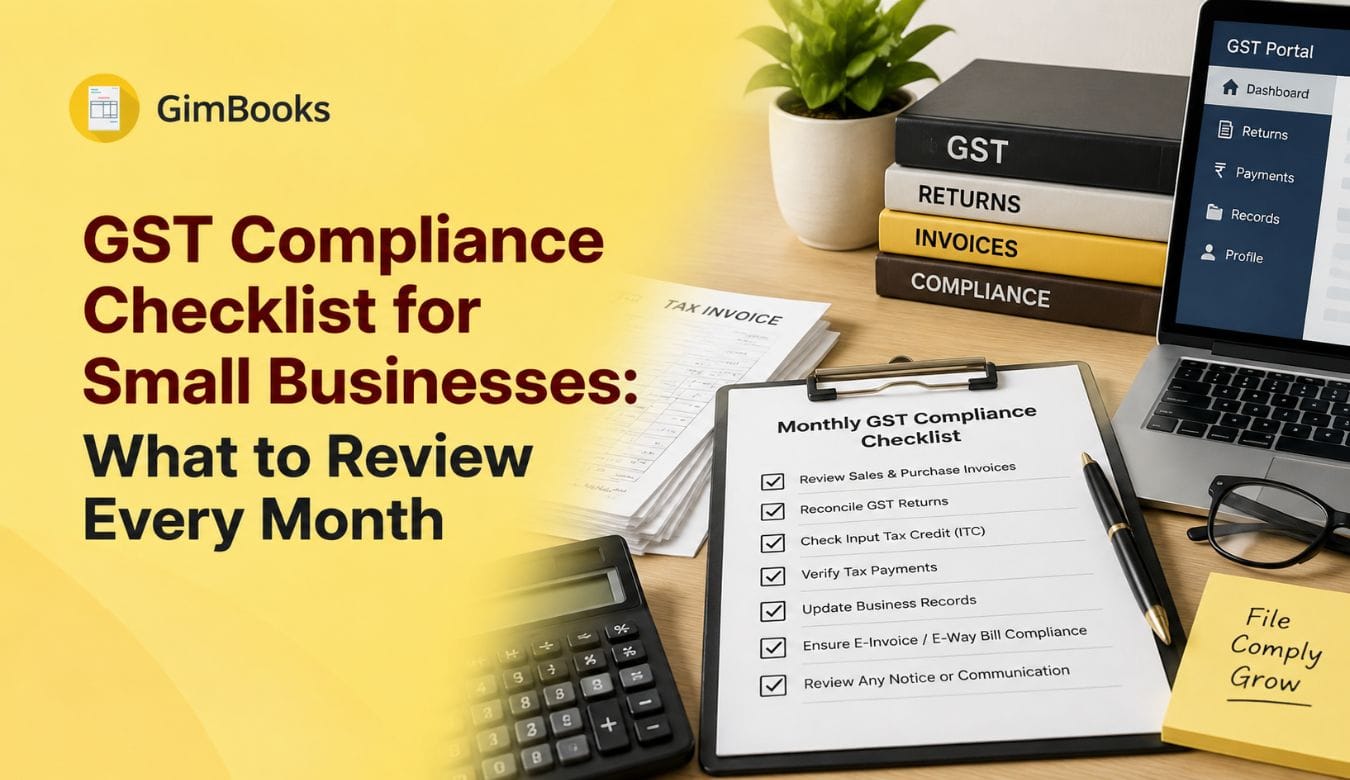
GST compliance is more than filing a return on time. A practical gst compliance checklist helps small businesses review invoices, sales, purchases, input tax credit, GST returns, e-invoices, e-way bills, payments and records before problems become difficult to correct.
The exact requirements depend on your GST registration, filing frequency, turnover, transaction type and whether specific provisions such as e-invoicing, reverse charge, exports or the composition scheme apply.
What is a GST Compliance Checklist?
A gst compliance checklist is a recurring list of checks a business uses to review its GST obligations and records. It can cover sales invoices, purchase invoices, GST returns, input tax credit, e-invoices, e-way bills, tax payments, ledgers and supporting records. The checklist helps identify errors or missing information before filing or reconciliation.
Key Takeaways
- Review sales and purchase records before preparing GST returns.
- Reconcile eligible ITC with available GST data and investigate mismatches.
- Check GSTR-1/IFF and GSTR-3B against your books and tax records.
- Verify e-invoice and e-way bill information where applicable.
- Review GST payments, electronic ledgers and outstanding liabilities.
- Maintain supporting invoices, notes, returns and reconciliation records.
- Separate monthly, quarterly, composition and other conditional obligations.
- Use a repeatable process rather than treating GST compliance as a month-end activity.
GST Compliance Checklist for Small Businesses
Use this table as a practical starting point. Not every row applies to every taxpayer.
GSTR-1 is the statement of outward supplies and may be filed monthly or quarterly depending on the taxpayer's filing arrangement. The GST Portal states that the standard monthly GSTR-1 due date is the 11th of the succeeding month, while quarterly filers generally have the 13th of the month following the quarter, subject to extensions.
GST Compliance Checklist Before Issuing Invoices
Before an invoice is finalised, check:
- Supplier GSTIN and registration details
- Buyer GSTIN and legal name, where applicable
- Invoice number and date
- Correct invoice series
- Product or service description
- HSN/SAC
- Quantity and unit for goods
- Taxable value and discounts
- Applicable GST rate
- CGST/SGST, IGST or UTGST as applicable
- Place of supply
- Reverse-charge indicator, where applicable
- Export/SEZ/LUT details, where applicable
- IRN and QR code, where e-invoicing applies
- Delivery information and e-way bill linkage, where applicable
Before adding a new customer or supplier to your records, verify GSTIN details to confirm the registration status, legal name and taxpayer information.
You can also use the GST state code list to confirm whether the state code in a GSTIN matches the relevant state or union territory.
Don't duplicate a full invoice-field guide here. For the detailed field-by-field review, link to GimBooks' GST Invoice Mandatory Fields Audit Checklist. That existing article covers supplier, recipient, invoice, HSN/SAC, tax, place-of-supply and digital compliance fields.
Monthly Sales and Output-Tax Review
At the end of each month, reconcile your sales records before preparing the applicable return.
Check your sales register
Confirm that:
- Every issued invoice is recorded.
- Invoice numbers run correctly.
- Cancelled invoices are identified.
- Duplicate invoices are investigated.
- Missing invoices are followed up.
- Credit and debit notes are recorded.
- Amendments are reflected correctly.
Review supply categories
Where relevant, separately review:
- B2B supplies
- B2C supplies
- Export supplies
- SEZ supplies
- Exempt supplies
- Nil-rated supplies
- Other non-taxable transactions
Businesses selling goods across states should also review the place of supply for goods invoices, particularly for Bill-to/Ship-to, interstate and delivery-location scenarios.
Compare tax figures
Compare the GST collected or payable in your accounting records with the figures prepared for the applicable return.
If the numbers don't match, identify whether the difference comes from an omitted invoice, credit note, amendment, classification issue, tax calculation or another accounting adjustment.
Important: Return frequency and due dates vary by taxpayer and filing arrangement. Don't build a GST compliance calendar around one universal filing date.
Monthly Purchase and ITC Reconciliation Checklist
Input tax credit should be reviewed as a recurring process rather than only when a return is about to be filed.
Review your purchase records
Check:
- Supplier GSTIN
- Invoice number and date
- Taxable value
- GST amount
- HSN/SAC where relevant
- Whether the invoice belongs to the business
- Whether the document is duplicated
- Whether the transaction has been cancelled or amended
Compare purchases with GSTR-2B
Download and review GSTR-2B for the relevant period and compare it with your purchase records.
GSTR-2B is a static, read-only ITC statement generated on the GST Portal. For monthly recipients it is generated on the 14th of the succeeding month; quarterly recipients receive it on the 14th of the month following the quarter.
Look for:
- Missing supplier invoices
- Duplicate invoices
- Incorrect GSTIN
- Differences in taxable value
- Differences in tax amount
- Credit/debit notes
- ITC that requires eligibility review
- ITC reversals or reclaims
A GSTR-2B match is not by itself a legal determination that ITC is available. The business must also consider the applicable GST conditions and restrictions.
Review payment-related ITC conditions
Where applicable, check whether consideration and tax have been paid to the supplier within the prescribed period. The CGST framework contains a 180-day payment condition for specified ITC situations, with corresponding reversal and later re-availment provisions.
GSTR-1 and GSTR-3B Review
These returns should not be treated as two completely separate exercises.
GSTR-1 or IFF
Review:
- Outward invoices
- Credit notes
- Debit notes
- Amendments
- B2B transactions
- Other applicable outward-supply details
For QRMP taxpayers, IFF is an optional facility for the first two months of a quarter, while GSTR-1 is filed for the quarter. The GST Portal documents the IFF facility and its timeline.
GSTR-3B
Review:
- Outward tax liability
- Eligible ITC
- Reverse-charge liability
- Tax payable
- Tax payment
- Relevant adjustments
Before filing, compare GSTR-3B with:
Sales records → GSTR-1/IFF → purchase/ITC reconciliation → books → tax ledgers
If there is a difference, investigate it before filing rather than assuming the portal figures are correct.
E-Invoice Compliance Checklist
E-invoicing applies only to taxpayers covered by the applicable rules and subject to exemptions.
For businesses within the e-invoicing system, review:
- Whether the business currently falls within the applicable AATO threshold
- Whether any exemption applies
- Correct supplier GSTIN
- Correct recipient GSTIN
- Invoice number and date
- HSN/SAC
- Taxable values
- GST amounts
- Place of supply
- IRN generation
- Signed QR code
- Rejected IRNs
- Data transmitted to the IRP
- Cancellation/correction requirements
The current e-invoicing regime should be checked against the latest government requirements before publication or implementation because applicability and procedural requirements can change.
Important 30-day control
For taxpayers covered by the current 30-day IRP reporting restriction, businesses with AATO of ₹10 crore and above must report applicable e-invoices within 30 days of the document date. The restriction has applied to this turnover category since 1 April 2025.
GimBooks already has a dedicated article covering this specific rule, so this checklist should link to the E-Invoice 30-Day Reporting Rule Checklist rather than reproducing the detailed procedure.
Businesses covered by this restriction can use the detailed e-invoice 30-day reporting checklist to monitor invoice ageing, IRN generation and reporting controls.
E-Way Bill Compliance Checklist
Where e-way bill rules apply, check the movement against the source document.
Before or during movement
Verify:
- Consignor details
- Consignee details
- Invoice or delivery challan number
- Invoice/challan date
- HSN
- Goods description
- Value
- Quantity
- Dispatch-from location
- Ship-to/delivery location
- Transporter information
- Vehicle number
- Distance
- Applicable e-way bill details
The e-way bill system describes e-way bills as electronic documentation for applicable movement of goods and maintains specific rules around movement, value and exemptions.
Don't repeat GimBooks' detailed articles on e-way bill tracking, delivery-challan linking or other specific e-way bill errors. Use contextual internal links instead. GimBooks already has a dedicated tracking guide covering active, cancelled, expired and completed movements.
GST Payments, Ledgers and Reverse Charge
Before completing the return cycle, review:
Electronic ledgers
Check:
- Electronic liability ledger
- Electronic cash ledger
- Electronic credit ledger
- Tax payments
- Challans
- Outstanding liabilities
Reverse charge
Identify transactions where GST may be payable under Reverse Charge Mechanism (RCM).
Check:
- Whether RCM applies
- Taxable value
- Applicable tax treatment
- Payment
- Return reporting
- Related ITC treatment, where eligible
Do not assume that every purchase from an unregistered person or every specialised transaction automatically attracts RCM. The applicable provision should be checked for the particular transaction.
GST Compliance Checklist for Different Small-Business Types
The key point is that GST compliance requirements are not identical for every business.
Service providers should separately review the place of supply for service invoices, because the applicable rule may depend on recipient location, service type, property location, event location or other transaction-specific factors.
Monthly GST Compliance Workflow
A repeatable workflow can look like this:
Step 1: Update sales and purchase records
Ensure transactions for the period are recorded.
Step 2: Validate master data
Check GSTINs, customer/supplier details, HSN/SAC and tax configuration.
Step 3: Review invoices and notes
Check invoices, credit notes, debit notes, cancellations and amendments.
Step 4: Reconcile purchases and ITC
Compare purchase records with GSTR-2B and investigate differences.
Step 5: Review e-invoices and e-way bills
Where applicable, reconcile generated documents with invoices and movement records.
Step 6: Prepare GSTR-1/IFF
Review outward-supply data before submission.
Step 7: Review GSTR-3B
Compare liability and ITC with books and the relevant GST data.
Step 8: Pay tax
Review liability and make the required payment.
Step 9: File the applicable return
Complete the relevant filing within the applicable timeline.
Step 10: Save records
Retain filed returns, acknowledgements, reconciliations, challans and supporting documents.
Step 11: Carry forward unresolved issues
Maintain a simple exception list for anything that needs supplier correction, amendment or professional review.
What to Do When You Find a GST Mismatch
Don't simply overwrite the number that looks wrong. First identify the source.
For detailed issues such as GSTIN verification, place-of-supply errors, e-invoice HSN errors or e-invoice cancellation, use the dedicated GimBooks guides rather than making this checklist article another troubleshooting manual. GimBooks already publishes dedicated resources for these subjects.
GST Compliance Calendar and Filing Frequency
Not every GST-registered business follows the same filing calendar.
Monthly filers
Regular taxpayers filing monthly returns should maintain a recurring cycle for:
- Sales reconciliation
- Purchase/ITC reconciliation
- GSTR-1
- GSTR-3B
- Tax payment
- E-invoice/e-way bill review where applicable
The GST Portal states that monthly GSTR-1 is generally due on the 11th of the following month and GSTR-3B follows its applicable taxpayer-specific timeline. Government notifications can extend dates.
QRMP taxpayers
Eligible small taxpayers can use the Quarterly Return with Monthly Payment (QRMP) scheme. GST Portal guidance states that the scheme is available to eligible taxpayers with aggregate turnover up to ₹5 crore, subject to the scheme conditions.
Under QRMP:
- GSTR-1 is filed quarterly.
- GSTR-3B is filed quarterly.
- Tax is paid monthly for the first two months.
- IFF can be used for relevant B2B invoice reporting in the first two months.
Do not apply the monthly-filer calendar to QRMP taxpayers automatically.
Composition taxpayers
Composition taxpayers follow a different compliance process, including CMP-08 and the applicable annual return requirements.
The GST Portal's taxpayer guidance identifies CMP-08 as the quarterly statement for composition taxpayers.
Annual review
Businesses should also plan for annual compliance such as GSTR-9 and, where applicable, GSTR-9C.
The CGST framework provides for annual returns and separate reconciliation-statement requirements subject to the applicable provisions and thresholds.
Conditional obligations
Depending on the business, additional reviews may be required for:
- LUT
- Exports
- SEZ supplies
- Reverse charge
- E-invoicing
- E-way bills
- Composition scheme
- GST TDS/TCS
- Annual return/reconciliation requirements
Always verify the current filing calendar on the GST Portal before acting on a deadline.
How GST Billing Software Helps With Compliance
A GST compliance process becomes easier when transaction data is structured from the beginning.
GimBooks can help businesses organise:
- GST invoice creation
- Customer and supplier records
- Product and HSN/SAC records
- GST calculations
- Inventory and purchase records
- E-invoice workflows
- E-way bill workflows
- GST reports
- Invoice history
- Business records
GimBooks' existing product and content pages document capabilities including GST invoice generation, customer/supplier records, product masters, HSN/SAC data, GST-rate configuration, tax calculations, inventory and purchase records, e-invoice and e-way bill workflows, and GST reporting.
Software can reduce manual data entry and make reconciliation easier, but it does not automatically make every business legally compliant. Businesses still need to review applicable GST rules and obtain professional advice where required.
GimBooks can help small businesses organise billing, invoice records, inventory and GST-related workflows in one place.
GST Compliance Audit Checklist
Use this as a final monthly or periodic control list:
Registration
- ☐ GST registration details are correct
- ☐ GSTIN is active and correctly recorded
- ☐ Business/branch master data is updated
Invoices
- ☐ Invoice numbering is consistent
- ☐ Invoice data is complete
- ☐ GST rates are reviewed
- ☐ HSN/SAC is appropriate
- ☐ Place of supply is reviewed
- ☐ Credit/debit notes are recorded
Returns
- ☐ GSTR-1/IFF data is reconciled
- ☐ GSTR-3B figures are reviewed
- ☐ Differences are investigated
ITC
- ☐ Purchase register is updated
- ☐ GSTR-2B is reviewed
- ☐ Missing invoices are followed up
- ☐ Duplicate ITC is identified
- ☐ Eligibility/reversal conditions are reviewed
E-invoicing
- ☐ Applicability is confirmed
- ☐ IRNs are generated where required
- ☐ QR codes are checked
- ☐ Rejected documents are investigated
- ☐ Applicable reporting windows are monitored
E-way bills
- ☐ Invoice/EWB details match
- ☐ Transport details are correct
- ☐ Active and completed movements are reviewed
- ☐ Exceptions are followed up
Payments & records
- ☐ GST liability is reviewed
- ☐ Challans are saved
- ☐ Electronic ledgers are checked
- ☐ Books are reconciled
- ☐ GST records are backed up
- ☐ Open compliance issues are documented
Under Section 36 of the CGST Act, registered persons required to maintain accounts and records generally have to retain them for 72 months from the due date of the annual return for the relevant year, subject to the additional provisions that can apply when proceedings or investigations are involved.
Frequently Asked Questions
What is a GST compliance checklist?
A gst compliance checklist is a recurring list of GST-related checks covering invoices, sales, purchases, ITC, returns, payments, e-invoices, e-way bills and records. It helps businesses identify missing information, mismatches and pending actions before filing or reconciliation.
How often should a small business review GST compliance?
A small business should review key GST records throughout the month and complete a more detailed reconciliation before each applicable filing. The exact workflow depends on whether the business files monthly, uses QRMP, follows the composition scheme or has additional obligations.
What should be checked every month for GST compliance?
A gst compliance checklist should generally cover sales and purchase records, invoice details, GST rates, HSN/SAC, place of supply, credit/debit notes, ITC reconciliation, applicable GST returns, e-invoices, e-way bills, tax payments and supporting records.
How do I check GST compliance?
Start by checking your GST registration details, sales and purchase records, applicable returns, ITC reconciliation, tax payments and any e-invoice or e-way bill obligations. Then compare the information in your books with the relevant GST Portal data and investigate discrepancies.
What is included in GST return compliance?
GST return compliance includes preparing the applicable return or statement, reconciling the underlying sales, purchase and tax records, reviewing eligible ITC and liabilities, paying applicable tax and filing within the applicable timeline.
Is GSTR-2B reconciliation mandatory for claiming ITC?
GSTR-2B is an important source for reviewing supplier-reported documents, but it is a static ITC statement and is not a substitute for checking all legal conditions for ITC eligibility. Businesses should reconcile GSTR-2B with their records and apply the relevant GST provisions.
Is e-invoicing applicable to every small business?
No. E-invoicing applies to taxpayers covered by the applicable GST rules and thresholds, subject to notified exemptions and other conditions. Businesses should verify their current applicability rather than assuming that every GST-registered small business must generate e-invoices.
What is the difference between GST compliance and GST return filing?
GST return filing is one part of GST compliance. Compliance also involves correct registration details, invoicing, tax classification, ITC checks, e-invoicing, e-way bills, payments, record maintenance and other applicable obligations.
Is there an official GST compliance rating for every business?
Businesses should not assume that there is a universal official GST compliance rating or score available to every taxpayer. Terms such as “GST compliance rating” should be verified against current GST Portal functionality and official guidance before being used as a compliance requirement.
Can GST billing software help with compliance?
Yes. GST billing software can help organise invoices, customer and supplier records, tax calculations, inventory, purchase information, e-invoice/e-way bill workflows and reports. It can reduce manual work, but businesses remain responsible for reviewing applicable GST requirements.
Can I download a GST compliance checklist PDF or Excel file?
A business can create its own GST compliance checklist in PDF or Excel for internal use. Such a checklist should not be presented as an official GST government document unless it has been specifically issued by the relevant authority.
What records should a business retain for GST compliance?
Businesses should maintain applicable books, invoices, credit/debit notes, return records, payment documents, reconciliation records and other supporting documents required under GST. The CGST framework generally requires specified records to be retained for 72 months from the due date of the relevant annual return, subject to additional rules for ongoing proceedings or investigations.
Conclusion
A repeatable gst compliance checklist helps small businesses move from last-minute GST filing to a more controlled monthly process. Reviewing invoices, sales, purchases, ITC, returns, e-invoices, e-way bills, payments and records regularly can make mismatches easier to identify and resolve.
The exact GST compliance requirements depend on your taxpayer type, filing frequency, transactions and applicable GST provisions, so use this checklist as a working control rather than a substitute for professional tax advice.
GimBooks can help businesses organise billing, invoices, inventory and GST-related workflows in one place while keeping the underlying compliance review with the business and its advisors.