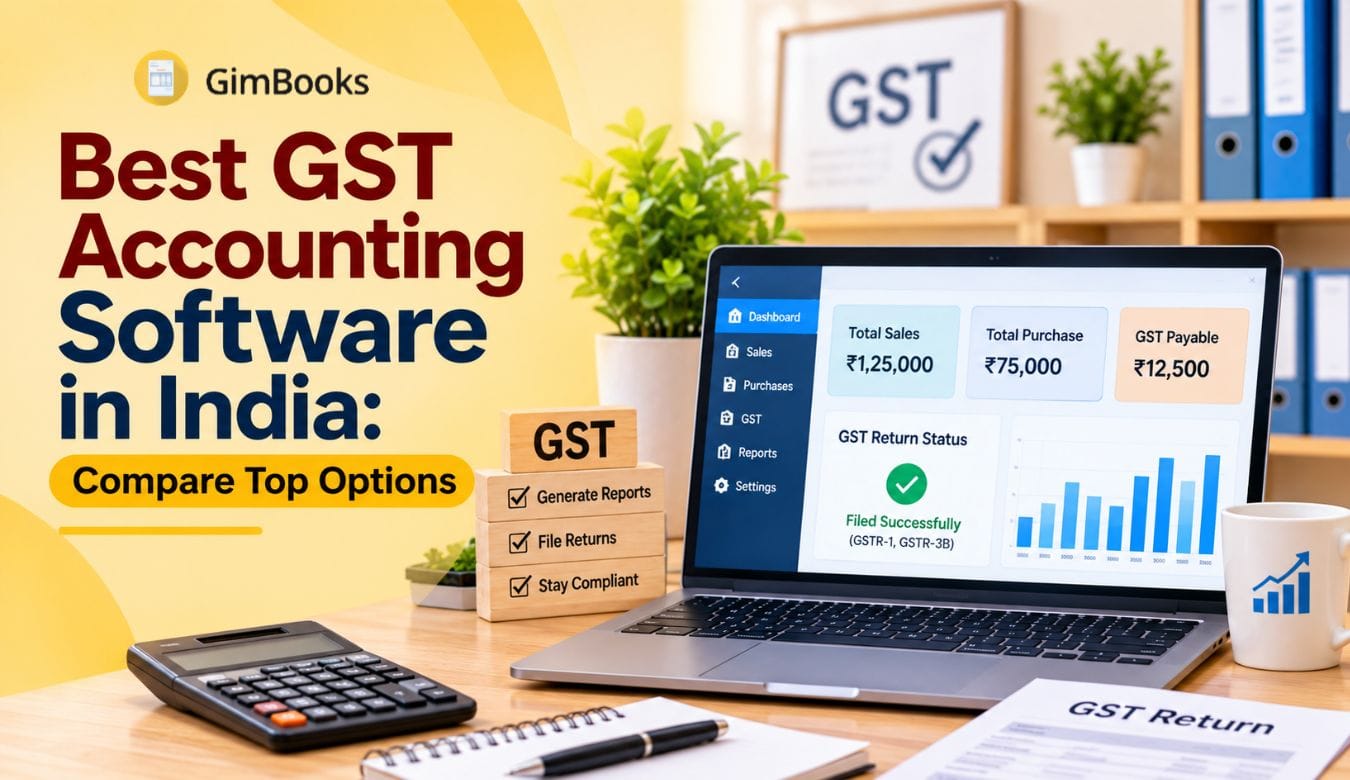
Best GST Accounting Software in India: Compare Top Options
A business may issue hundreds of GST invoices every month but still struggle to answer three basic questions: How much tax is payable? Which purchases qualify for input tax credit? And do the figures in its accounts match the GST returns?
This is where the right GST accounting software becomes important. Rather than treating invoicing, bookkeeping, inventory, tax calculations and GST reporting as separate activities, an integrated system can help businesses maintain more organised financial records.
However, not every solution offers the same capabilities. Some platforms focus on fast invoicing, others provide detailed accounting and inventory management, while specialist GST tools concentrate on return filing and reconciliation.
The best GST accounting software in India depends on your business requirements. GimBooks is worth considering for small-business billing and bookkeeping, Zoho Books for cloud accounting, TallyPrime for detailed accounting workflows, BUSY for inventory-heavy businesses, and ClearTax for specialised GST compliance.
This guide compares seven options, explains their strengths and limitations, and helps Indian businesses choose suitable software.
Key Takeaways
- GST accounting software should connect invoices, purchases, expenses, ledgers and applicable GST reports.
- GimBooks, Zoho Books, TallyPrime, BUSY, Vyapar, myBillBook and ClearTax serve different business requirements.
- GSTR-2B reconciliation, input tax credit checks and return preparation are important for GST-registered businesses.
- Inventory-heavy businesses should prioritise purchase accounting, stock valuation and supplier records.
- Not every billing application provides complete financial accounting or direct GST return filing.
- Compare total costs, user access, e-invoicing, reporting features and data migration before subscribing.
What Is GST Accounting Software?
GST accounting software is a financial management application that helps Indian businesses record transactions, calculate applicable GST, maintain accounting records and prepare tax-related reports.
Depending on the product, it may include:
- GST invoice creation and tax calculations
- Sales and purchase accounting
- Customer and supplier ledgers
- Expense and payment tracking
- Inventory management
- Profit-and-loss and balance-sheet reports
- GST return preparation or filing
- Input tax credit reconciliation
- E-invoice and e-way bill generation
For example, when a distributor purchases goods worth ₹50,000 plus applicable GST, the accounting system should record the purchase, supplier liability and tax details. If integrated inventory management is available, it should also update the stock.
When the distributor sells those goods, the system can record the sale, update the customer ledger and provide relevant information for GST reporting.
The purpose is to connect business transactions with accounting records instead of repeatedly entering the same information in separate applications.
GST Accounting Software vs GST Billing Software: What's the Difference?
Although the terms are sometimes used interchangeably, their functionality can differ.
A small retailer may only need GST invoices, stock management and customer balances.
A growing wholesaler may require financial statements, credit management, purchase reconciliation, inventory valuation and multiple-user access.
When comparing GST billing and accounting software, look beyond invoice templates and confirm the depth of its accounting functionality.
Best GST Accounting Software in India: Quick Comparison
The following software options are relevant to different Indian businesses.
Comparison based on publicly documented product capabilities as of November 2026. Features, integrations and pricing depend on the selected edition.
7 Best GST Accounting Software Options in India
1. GimBooks — For Small Business GST Billing and Accounting
GimBooks is an India-focused billing and accounting platform designed for small businesses, retailers, wholesalers, distributors and service providers.
It combines everyday business transactions such as invoices, purchases, expenses and customer balances with inventory management and GST-related workflows.
Key features
- GST invoice generation and customisation
- Sales and purchase records
- Customer and supplier ledgers
- Business expense tracking
- Inventory and item management
- Payment reminders
- Accounting and business reports
- GSTR-1 and GSTR-3B workflows
- GSTR-2A/2B reports and reconciliation features
- Mobile and web access
How it helps businesses
Consider a wholesaler supplying goods to several retailers on credit.
The wholesaler needs to create invoices, record purchases, check stock quantities and monitor customer payments.
GimBooks can help organise these activities within a connected billing and bookkeeping workflow.
Its GST filing product page also describes GSTR-1 and GSTR-3B filing, invoice reconciliation and downloadable GSTR-2A/2B reports.
Best suited for: Small Indian businesses seeking accessible GST billing, bookkeeping, inventory management and payment tracking.
What to verify: Detailed bank reconciliation, advanced financial reporting, multiple GST registrations, GST reconciliation depth and the exact functionality available in the selected plan.
2. Zoho Books — For Cloud-Based GST Accounting
Zoho Books is a cloud accounting platform offering financial management and India-specific GST workflows.
It is particularly relevant to businesses that want accounting, banking, purchases, customer invoicing and tax reporting within an online platform.
Key features
- GST invoices and tax calculations
- Expense and purchase management
- Bank reconciliation
- Customer and supplier records
- Profit-and-loss and balance-sheet reports
- GSTR-1 and GSTR-3B workflows
- GSTR-2B reconciliation
- Invoice Management System support
- Project and inventory features in applicable plans
How it helps businesses
A consulting business may need to record customer invoices, employee reimbursements, vendor payments and bank transactions.
Zoho Books can help maintain these records and provide financial reports to the business owner or accountant.
Its documentation also explains how purchase transactions can be matched with GSTR-2B records, including invoices missing from the accounting system and partially matched entries.
Best suited for: Growing SMEs, service businesses and teams requiring detailed cloud GST accounting software.
What to verify: User limits, annual invoice limits, advanced inventory features, multi-currency requirements and plan-specific GST functionality.
3. TallyPrime — For Detailed Accounting and GST Management
TallyPrime is a well-established accounting platform used by businesses and accounting professionals in India.
It provides detailed financial accounting, inventory records, taxation workflows and reporting functionality.
Key features
- General-ledger accounting
- GST sales and purchase records
- Inventory and stock valuation
- Bank reconciliation
- Financial statements
- GST return-related reports
- GSTR-2B reconciliation
- E-invoicing and e-way bill functionality
- Accounting controls and audit-related features
How it helps businesses
A distributor maintaining several supplier accounts may need to analyse outstanding payables, purchase returns, stock valuation and tax records.
TallyPrime provides accounting and reporting tools for these requirements.
Its official GSTR-2B documentation describes identifying unmatched invoices, GST amount differences and transactions available only in the books or GST Portal.
Best suited for: Established businesses, accountants and finance teams requiring detailed accounting records.
What to verify: Deployment requirements, licence costs, remote access, user training, data backups and implementation support.
4. BUSY — For GST Accounting and Inventory-Heavy Businesses
BUSY combines accounting, GST reporting and inventory management for Indian trading and distribution businesses.
Its product range includes different editions for businesses requiring varying levels of stock control, reconciliation and branch management.
Key features
- GST billing and purchase accounting
- General-ledger accounting
- GSTR-1 and GST-related reports
- GSTR-2A/2B reconciliation
- E-invoicing and e-way bill workflows
- Batch-wise and multiple-unit inventory
- Supplier and customer balances
- Financial statements
- Multi-branch and multiple-GSTIN features in applicable editions
How it helps businesses
A wholesale distributor may purchase the same product from different suppliers at different prices.
It needs to track stock, supplier payments, purchase invoices and GST-related records accurately.
BUSY provides accounting and inventory features suited to this type of operation.
Its documentation specifically describes downloading GST data and comparing purchase transactions with GSTR-2A or GSTR-2B.
Best suited for: Traders, wholesalers, distributors and inventory-intensive MSMEs.
What to verify: Whether the required features are part of BUSY Magic or BUSY 21, along with edition limits, mobile access and deployment charges.
5. Vyapar — For Retailers and Small Trading Businesses
Vyapar focuses on billing, inventory, expenses and everyday business records.
It is relevant to small retailers that want an accessible system for managing sales and purchases.
Key features
- GST invoices and quotations
- Sales and purchase records
- Business expense tracking
- Inventory management
- Customer and supplier balances
- Payment reminders
- Business and GST reports
- Desktop and mobile workflows
How it helps businesses
A hardware retailer may issue invoices throughout the day and purchase additional stock from multiple suppliers.
Vyapar can help maintain invoices, stock records and outstanding balances without requiring a complex accounting setup.
Best suited for: Retailers, shop owners and small trading businesses prioritising simple billing and stock management.
What to verify: Detailed financial statements, GSTR-2B matching, bank reconciliation, device compatibility and subscription limits.
6. myBillBook — For Simple Billing and Business Records
myBillBook focuses on GST billing, inventory, sales, purchases and payment management for small businesses.
It is designed around day-to-day operational requirements rather than complex financial accounting.
Key features
- GST invoice generation
- Sales and purchase tracking
- Inventory records
- Customer and supplier management
- Payment reminders
- Business reports
- Mobile and web-based workflows, depending on plan
How it helps businesses
A small retail shop may need to prepare invoices, manage products, maintain customer dues and review daily sales.
myBillBook provides tools to organise these activities.
Best suited for: Microbusinesses and small shops with relatively straightforward invoicing and accounting requirements.
What to verify: General-ledger accounting depth, bank reconciliation, advanced inventory, GST return workflows and accountant access.
7. ClearTax — For GST Reconciliation and Filing
ClearTax offers specialised GST compliance software through ClearGST.
Unlike a general accounting system, its primary strength is handling tax-related reporting and reconciliation workflows.
Key features
- GST return preparation and filing workflows
- GSTR-2B reconciliation
- Purchase-register matching
- GST reporting
- Multi-GSTIN compliance workflows
- E-invoicing and related tax solutions
How it helps businesses
A business with thousands of supplier invoices may need to identify mismatches between its purchase register and GSTR-2B.
A specialised GST platform can support this review and help the finance team investigate differences.
ClearTax may be used alongside an accounting or ERP platform rather than replacing it.
Best suited for: Accountants, tax professionals and businesses with complex GST reconciliation requirements.
What to verify: Subscription scope, supported integrations, filing functionality and whether a separate accounting system is required.
What Features Should GST Accounting Software Have?
The right accounting software with GST should address both financial management and tax-related requirements.
1. GST-Compliant Invoicing and Automatic Calculations
Invoice accuracy is the starting point.
Check whether the system supports:
- Supplier and customer GSTINs
- Invoice numbers and dates
- HSN/SAC codes
- Taxable values and discounts
- CGST and SGST/UTGST
- IGST
- Credit and debit notes
- Applicable place-of-supply information
For example, a business supplying goods within the same state and one making an interstate supply may require different GST treatment.
Software should support the correct configuration, but it cannot determine every tax treatment without accurate transaction information.
For detailed requirements, see GimBooks' GST invoice mandatory fields checklist.
2. Sales, Purchases and Expense Accounting
GST accounting involves more than outward sales.
Businesses should also record:
- Supplier purchase invoices
- Freight and operating expenses
- Customer receipts
- Supplier payments
- Purchase returns
- Sales returns
- Credit and debit notes
- Applicable tax adjustments
A suitable system should help organise these transactions into the relevant accounts.
For example, when a customer pays only part of an invoice, the outstanding customer balance should remain visible until the remaining amount is settled or adjusted.
3. GSTR-2B and Input Tax Credit Reconciliation
GSTR-2B reconciliation software helps businesses compare purchase records with supplier-reported information.
GSTR-2B is an auto-drafted input tax credit statement available through the GST Portal.
Useful software should help identify:
- Purchase invoices missing from GSTR-2B
- GSTIN mismatches
- Differences in taxable value
- Differences in GST amount
- Duplicate entries
- Supplier credit notes
- Transactions requiring eligibility review
Importantly, a document appearing in GSTR-2B does not automatically make the related input tax credit legally eligible.
Businesses must review the applicable GST conditions before claiming credit.
4. GST Return Preparation and Filing
Look for software supporting applicable GSTR-1 and GSTR-3B workflows.
GSTR-1 records outward supplies, while GSTR-3B is used to report summary tax liabilities, eligible credits and other relevant amounts.
Before purchasing, distinguish between three different capabilities:
- Generating GST reports for review
- Preparing data for upload to the GST Portal
- Filing returns through supported GST integrations
Not every platform supports all three.
5. E-Invoicing and E-Way Bill Integration
Businesses subject to e-invoicing requirements need supported IRN generation and registered e-invoice records.
The notified e-invoicing threshold generally applies to covered taxpayers whose aggregate turnover exceeded ₹5 crore in any financial year from 2017–18 onwards, subject to exclusions.
E-way bill requirements depend on the movement of goods and applicable rules.
For covered e-invoices, check IRN generation, rejected submissions, cancellations and reconciliation with the invoice register.
For a detailed process, read GimBooks' guide to reconciling IRNs with invoice records.
6. Inventory and Stock Management
GST accounting software with inventory management is useful for retailers, manufacturers, wholesalers and distributors.
It should support the inventory records needed by the business, such as:
- Item-wise stock quantities
- Purchase and sale movements
- Multiple units
- Inventory valuation
- Low-stock notifications
- Stock adjustments
- Applicable batch, serial or warehouse tracking
For example, a distributor may need to know both the value of goods purchased and the quantity available for future sales.
GimBooks offers inventory management tools for product records, quantities, stock valuation and reports.
7. Financial Reports and Reconciliation
Before selecting software, check whether it generates the financial information your accountant needs.
Important reports include:
A system offering sales reports alone should not automatically be treated as full-featured accounting software.
8. Security, Data Export and Accountant Access
Financial records should remain accessible, protected and auditable.
Check user permissions, backups, authentication, recovery options and whether the software permits reliable data export.
Also ask whether your accountant can review transaction details without sharing the owner's login credentials.
How Does GST Accounting Software Help With Monthly Reconciliation?
Consider a wholesaler preparing its monthly GST records.
The business has the following illustrative transactions:
The ₹3,000 difference may arise from a supplier filing delay, incorrect GSTIN, omitted document or another issue.
It does not automatically mean the credit is permanently lost or that the remaining ₹15,000 is fully eligible.
The accounts team should:
- Compare purchase invoices with GSTR-2B.
- Identify missing or mismatched records.
- Review ITC eligibility and any required reversals.
- Reconcile output tax with the sales register.
- Review GSTR-1 and GSTR-3B figures.
- Determine the correct tax liability under the applicable rules.
If ₹15,000 is confirmed as eligible ITC and no other adjustments apply, the illustrative net liability would be ₹21,000 before considering other ledger balances or payments.
A suitable accounting system can help organise this reconciliation, but the tax treatment must still be reviewed.
For a more detailed monthly workflow, see the GST compliance checklist for small businesses.
How to Choose GST Accounting Software for Your Business
Different businesses should prioritise different capabilities.
These are starting points, not definitive rankings.
Seven Questions to Ask Before Purchasing
- Does it support the accounting functions my business actually needs?
- Can I reconcile purchases with GSTR-2B?
- Can my accountant review and export relevant records?
- Does it support my inventory and reporting requirements?
- Are e-invoices and e-way bills included or charged separately?
- Can existing customer, supplier and accounting data be migrated?
- What will the complete subscription or ownership cost be?
GST Accounting Software Pricing in India
GST accounting software prices vary significantly according to the product, subscription period, accounting depth and optional features.
Examples from publicly listed vendor pricing:
These prices are not directly comparable: some represent subscriptions, others are licences or specialist compliance services.
When calculating affordability, include:
Total software cost = Subscription/licence + GST + Additional users + Add-ons + Implementation + Maintenance
Also consider migration, training, backups and accounting support.
A lower monthly price is not necessarily the lowest total cost.
Cloud vs Desktop GST Accounting Software
Both cloud and locally installed systems can support GST accounting.
Cloud-based software commonly provides easier remote access and centrally managed application updates.
Desktop-oriented solutions may offer local operation and additional deployment choices.
The right option depends on internet connectivity, user requirements, security controls, accounting workflows and costs.
Businesses evaluating web access can explore GimBooks' cloud accounting software guide for a deeper comparison.
How GimBooks Can Help Indian Small Businesses
GimBooks combines billing, bookkeeping, inventory and GST-related tools for Indian MSMEs.
Manage Sales and Purchase Records
Businesses can create invoices, record purchases, track expenses and maintain customer or supplier records.
Monitor Payments and Business Activity
Party ledgers, payment reminders and reports can help owners keep track of customer balances and business transactions.
Review GST Information
GimBooks' GST return filing solution describes GSTR-1 and GSTR-3B filing workflows, GSTR-2A/2B reports and invoice reconciliation.
These functions can support return preparation and financial review while leaving final tax decisions with the business or its accountant.
Work Across Supported Devices
GimBooks supports mobile applications and desktop-web access, making it relevant for owners who need access to business records outside their main office.
Evaluate the Right Plan
GimBooks offers a seven-day trial. Businesses can use it to test invoicing, purchases, ledgers, inventory and reports.
Because e-invoicing and e-way bill charges are listed separately in the pricing information, confirm required entitlements before subscribing.
GST Accounting Software Buying Checklist
Use this checklist when comparing products:
If a vendor cannot demonstrate a function important to your business, do not assume it is available merely because the marketing page describes the software as all-in-one.
Frequently Asked Questions
1. Which is the best GST accounting software in India?
The best option depends on accounting complexity and business type. GimBooks suits everyday billing and bookkeeping needs, Zoho Books provides cloud accounting, TallyPrime offers detailed accounting, and BUSY is relevant for inventory-heavy businesses. ClearTax specialises in GST compliance.
2. What is the difference between GST billing and GST accounting software?
GST billing software focuses on invoicing and sales records. GST accounting software also manages financial transactions, ledgers, expenses and accounting reports, although product capabilities overlap.
3. Can GST accounting software file GSTR-1 and GSTR-3B?
Some platforms support direct filing, while others prepare reports or export return data. Confirm the supported workflow and subscription eligibility.
4. Can GST accounting software reconcile GSTR-2B?
Some applications offer automated or assisted purchase-register matching. Others provide reports that users reconcile separately. ITC eligibility must still be checked.
5. Is free GST accounting software available in India?
Yes. Certain vendors offer free plans or limited accounting editions. Compare transaction limits, financial reports, GST functionality and support before relying on them.
6. Is GST accounting software suitable for small businesses?
Yes. Small businesses can benefit from organised invoices, expenses, ledgers and reports. The required functionality depends on transaction volume and GST obligations.
7. Does GST accounting software include e-invoicing?
Some platforms support IRN generation through eligible integrations. E-invoicing applies only to covered taxpayers and transaction types, subject to statutory conditions and exemptions.
8. How should I compare GST accounting software prices?
Compare the full ownership cost, including software fees, GST, users, add-ons, updates, cloud access, support and migration. Verify current plan terms directly with the provider.
Conclusion
Choosing the best GST accounting software in India requires looking beyond invoice generation and advertised pricing.
A suitable platform should help manage sales, purchases, customer balances, financial records and relevant GST information. Businesses with more complex needs should also evaluate input tax credit reconciliation, inventory, financial statements, accountant access and return-filing workflows.
For Indian small businesses seeking connected GST billing, bookkeeping and inventory management, GimBooks is an option worth evaluating.
Explore GimBooks GST billing and accounting software and check the available features, reporting tools and plans to determine whether they match your business.