
Invoice Numbering Rules Under GST: Format, Requirements & Examples (2026 Guide)
Key Takeaways
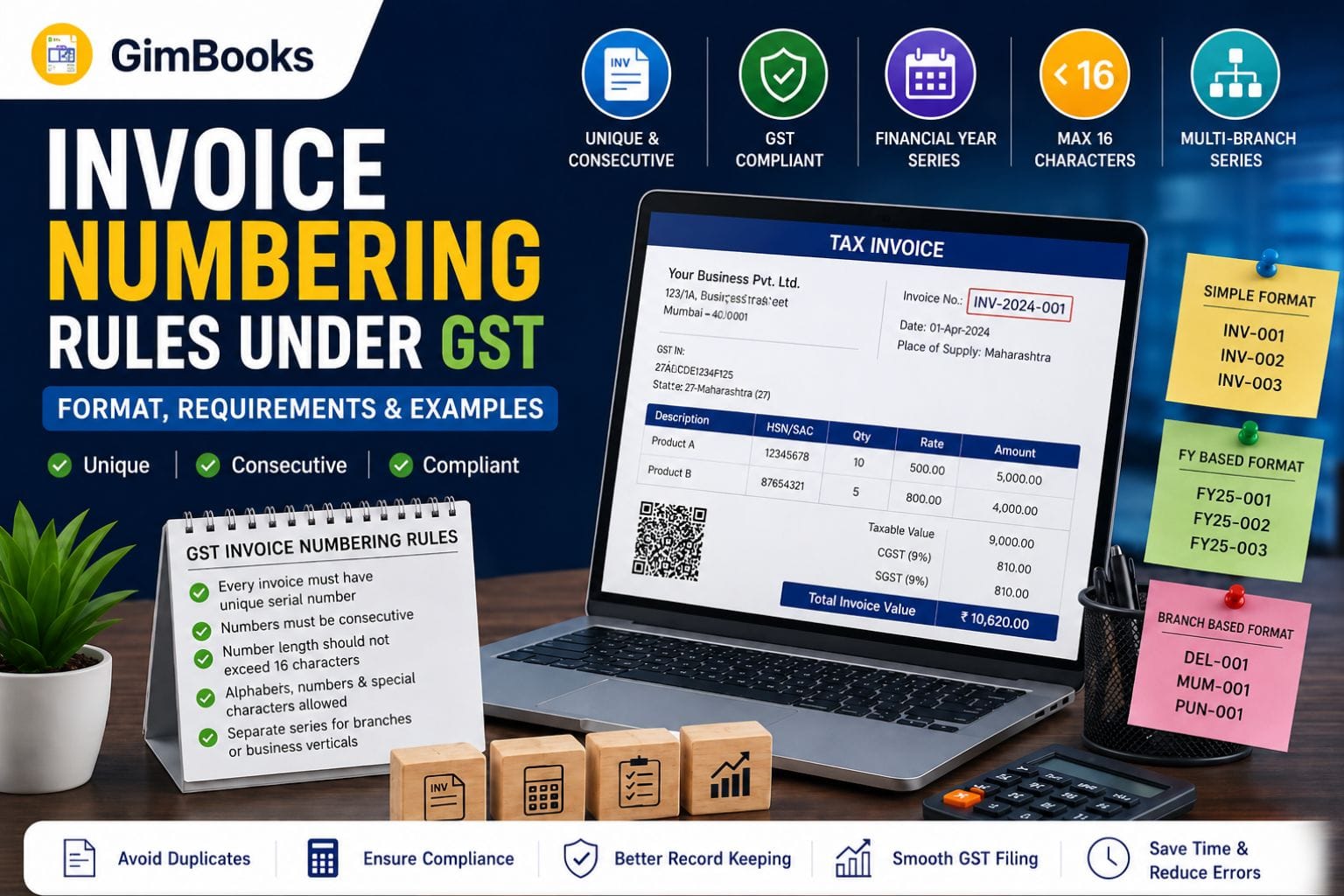
- GST law requires every tax invoice to contain a unique serial invoice number.
- Invoice numbers must be consecutive and unique for a financial year.
- Businesses can use alphabets, numbers, special characters, or combinations.
- The invoice serial number cannot exceed 16 characters.
- Duplicate invoice numbers can lead to GST reconciliation issues and compliance risks.
- Proper invoice numbering improves bookkeeping, audit readiness, and GST return accuracy.
- Modern GST billing software automatically generates compliant invoice numbers and reduces manual errors.
Introduction
Invoice numbering may seem like a small administrative task, but it plays a critical role in GST compliance, accounting accuracy, and business record management. Every GST-registered business in India must follow specific invoice numbering rules while issuing tax invoices.
Improper invoice numbering can create challenges during GST return filing, audits, reconciliations, e-Invoicing, and Input Tax Credit (ITC) verification. As GST compliance becomes increasingly digital in 2026, maintaining a structured invoice numbering system is more important than ever.
Whether you're a small business owner, accountant, trader, manufacturer, freelancer, startup, or service provider, understanding invoice numbering rules under GST can help avoid compliance issues and improve financial recordkeeping. This guide explains the latest GST invoice numbering requirements, practical formats, examples, common mistakes, and best practices.
What Is an Invoice Number Under GST?
An invoice number is a unique identification number assigned to each invoice issued by a business.
It acts as a tracking reference for:
- Sales transactions
- GST reporting
- Customer records
- Accounting entries
- Audit verification
- E-Invoicing processes
- Tax assessments
Under GST regulations, every tax invoice must have a unique serial number to ensure transparency and traceability.
Why Invoice Numbering Is Important Under GST
Many businesses focus on GST rates and return filing while overlooking invoice numbering compliance.
However, invoice numbers serve as the foundation for transaction tracking throughout the GST ecosystem.
Benefits of Proper Invoice Numbering
Better GST Compliance
Ensures accurate reporting in GST returns.
Easier Audit Management
Helps auditors trace transactions efficiently.
Improved Record Keeping
Makes invoice retrieval faster and more organized.
Reduced Reconciliation Issues
Simplifies matching between invoices, returns, and accounting records.
Supports E-Invoicing
Accurate invoice numbers are critical for IRN generation and GST validation.
What Does GST Law Say About Invoice Numbering?
As per GST invoicing requirements, every tax invoice must contain a consecutive serial number that is unique for a financial year.
The invoice number should:
- Be unique
- Not exceed 16 characters
- Be consecutive
- Remain unique within a financial year
- Contain alphabets, numerals, hyphens (-), slashes (/), or special combinations
These rules apply to most GST-registered businesses issuing tax invoices.
GST Invoice Numbering Rules Explained
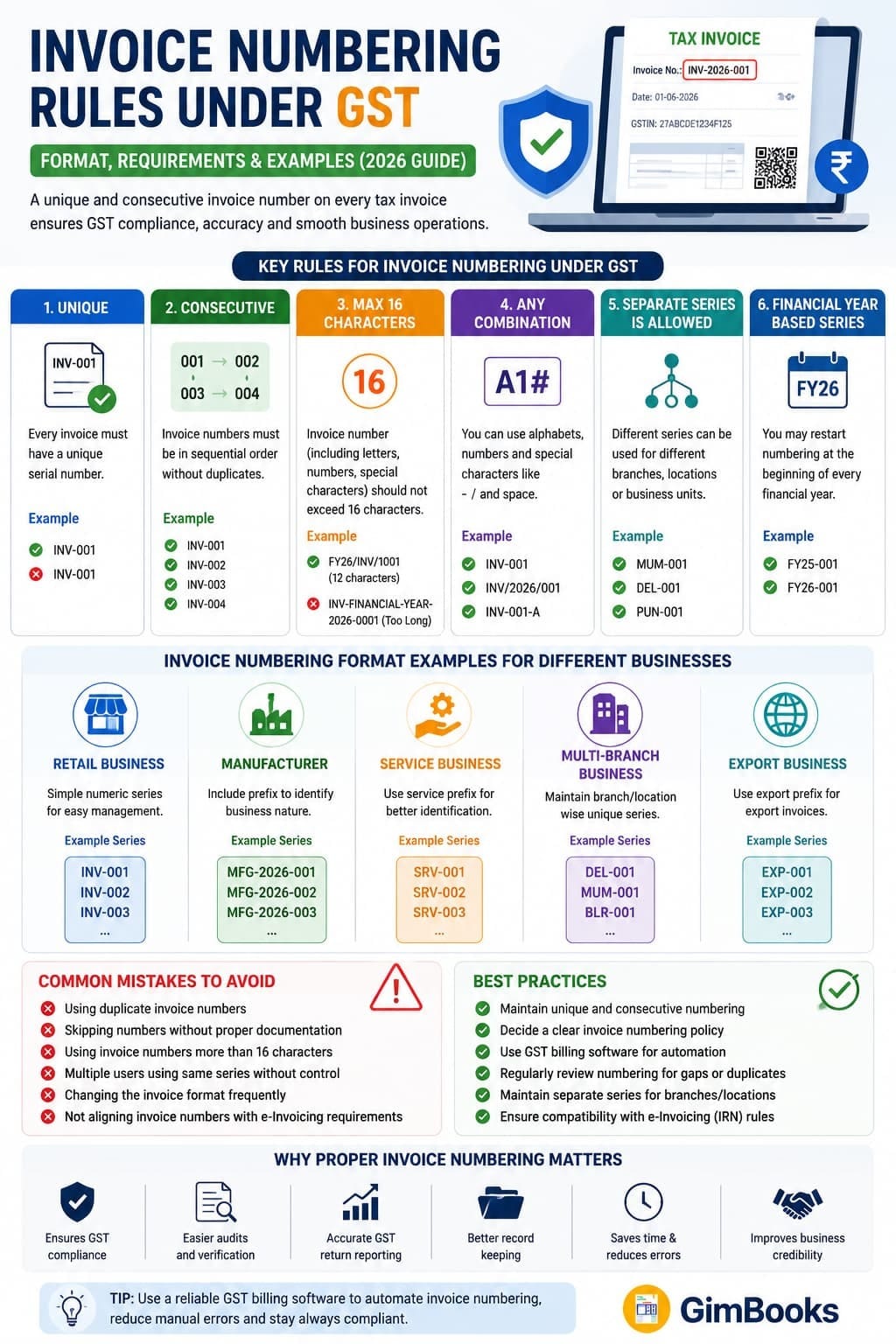
Rule 1: Invoice Number Must Be Unique
Every invoice issued during a financial year must have a different serial number.
Correct Example
INV001
INV002
INV003
Incorrect Example
INV001
INV002
INV001 (duplicate)
Duplicate numbers can create GST reconciliation issues.
Rule 2: Maximum Length Is 16 Characters
The invoice serial number cannot exceed 16 characters.
Valid Examples
INV-2026-001
FY26/INV/1001
MUM-001-2026
Invalid Example
INV-MUMBAI-BRANCH-2026-000001
(Exceeds permissible limit)
Rule 3: Consecutive Numbering Must Be Maintained
Businesses should maintain logical sequential numbering.
Example
INV001
INV002
INV003
INV004
Skipping numbers without proper documentation can create audit concerns.
Rule 4: Separate Series Can Be Used
Businesses may maintain different invoice series for different locations, branches, business units, or transaction types.
Example
This is particularly useful for businesses operating from multiple locations.
Rule 5: Financial Year-Based Numbering Is Allowed
Many businesses reset invoice numbering at the start of each financial year.
Example
FY25-001
FY25-002
FY25-003
Next Financial Year:
FY26-001
FY26-002
This approach improves record organization.
What Should a GST Invoice Number Look Like?
There is no single mandatory format prescribed under GST.
Businesses can create formats that fit their operations while complying with GST rules.
Popular GST Invoice Number Formats
The key requirement is uniqueness and consistency.
Invoice Numbering Examples for Different Businesses
Different industries often use different numbering structures.
Retail Business Example
INV-001
INV-002
INV-003
Simple and easy to maintain.
Manufacturer Example
MFG-2026-001
MFG-2026-002
MFG-2026-003
Helps identify manufacturing transactions.
Service Business Example
SRV-001
SRV-002
SRV-003
Useful for consultants and agencies.
Multi-Branch Business Example
DEL-001
DEL-002
MUM-001
MUM-002
Allows branch-level tracking.
Export Business Example
EXP-001
EXP-002
EXP-003
Useful for export invoice identification.
Invoice Numbering for E-Invoicing
Businesses covered under e-Invoicing regulations must pay special attention to invoice numbering.
The Invoice Registration Portal (IRP) validates invoice data before generating the Invoice Reference Number (IRN).
Why Invoice Numbering Matters for E-Invoicing
Invoice numbers form a critical component of:
- IRN generation
- Invoice uniqueness validation
- GST reporting
- E-Way Bill integration
Duplicate invoice numbers can result in IRN rejection.
Common Invoice Numbering Mistakes Businesses Make
Many GST notices and reconciliation issues originate from poor invoice management practices.
Duplicate Invoice Numbers
Repeated invoice numbers can trigger reporting inconsistencies.
Missing Sequence Numbers
Large gaps in numbering may raise audit questions.
Manual Numbering Errors
Human errors increase as transaction volumes grow.
Multiple Employees Using Same Series
Can lead to accidental duplication.
Excessively Long Invoice Numbers
May violate GST requirements.
Using Unstructured Formats
Creates confusion during audits and reporting.
How GST Billing Software Solves Invoice Numbering Problems
Businesses generating large numbers of invoices should avoid manual numbering systems.
Modern GST billing software automatically generates compliant invoice numbers.
Key Benefits
Automatic Number Generation
Reduces manual effort.
Duplicate Prevention
Ensures unique invoice series.
Multi-Branch Management
Supports separate numbering for different locations.
E-Invoicing Compatibility
Helps maintain IRN-ready invoice structures.
GST Compliance
Supports accurate recordkeeping and return filing.
Recommended Invoice Numbering Formats for 2026
Businesses should adopt formats that support future growth.
Small Businesses
INV-001
INV-002
INV-003
Growing Businesses
FY26-INV-001
FY26-INV-002
FY26-INV-003
Multi-Location Businesses
DEL-INV-001
MUM-INV-001
BLR-INV-001
Manufacturers
MFG-FY26-001
MFG-FY26-002
MFG-FY26-003
Invoice Numbering Best Practices
A good numbering system should remain easy to manage as the business grows.
Follow Consistent Formatting
Avoid changing formats frequently.
Maintain Proper Documentation
Document numbering policies internally.
Use Automated Systems
Billing software reduces compliance risks.
Conduct Regular Reviews
Check for duplicate or missing numbers.
Separate Branch Series
Useful for businesses operating from multiple locations.
Align with E-Invoicing Requirements
Future-proofs compliance processes.
Invoice Numbering Checklist
Before issuing invoices, ensure:
Why GimBooks Helps Maintain GST-Compliant Invoice Numbering
For growing businesses, manually managing invoice sequences becomes difficult over time.
GimBooks helps businesses simplify invoice management through:
- Automatic invoice generation
- GST-compliant invoice formats
- Multi-business management
- Inventory integration
- E-Invoice readiness
- Business reporting
- Customer management
- Cloud-based access
Instead of manually maintaining invoice registers in spreadsheets, businesses can automate numbering and reduce compliance risks while improving operational efficiency.
Conclusion
Invoice numbering is one of the most important yet often overlooked aspects of GST compliance. A properly structured invoice numbering system helps businesses maintain accurate records, simplify audits, improve GST reporting, and support e-Invoicing requirements.
As businesses scale, manual invoice management becomes increasingly difficult. Implementing a consistent numbering strategy and using GST-compliant billing software can significantly reduce errors and strengthen compliance processes.
Whether you're a retailer, manufacturer, trader, freelancer, startup, or enterprise, establishing a robust invoice numbering framework today will help create a more organized and audit-ready business tomorrow.
FAQs
What is the maximum length of an invoice number under GST?
The invoice serial number can contain a maximum of 16 characters.
Can invoice numbering restart every financial year?
Yes. Businesses can restart numbering at the beginning of a new financial year while maintaining uniqueness within that year.
Can two branches use the same invoice series?
It is generally recommended to maintain separate series for different branches to avoid duplication and simplify record management.
Is invoice numbering mandatory under GST?
Yes. Every GST invoice must contain a unique serial number.
Can invoice numbers contain alphabets and special characters?
Yes. GST allows alphabets, numerals, hyphens, slashes, and combinations thereof.
What happens if duplicate invoice numbers are used?
Duplicate invoice numbers can create reconciliation issues, audit concerns, and e-Invoicing validation failures.
Does invoice numbering affect IRN generation?
Yes. Invoice number is one of the key fields used during IRN generation and validation.
Is GST billing software useful for invoice numbering compliance?
Yes. Billing software automates invoice numbering and significantly reduces manual errors.