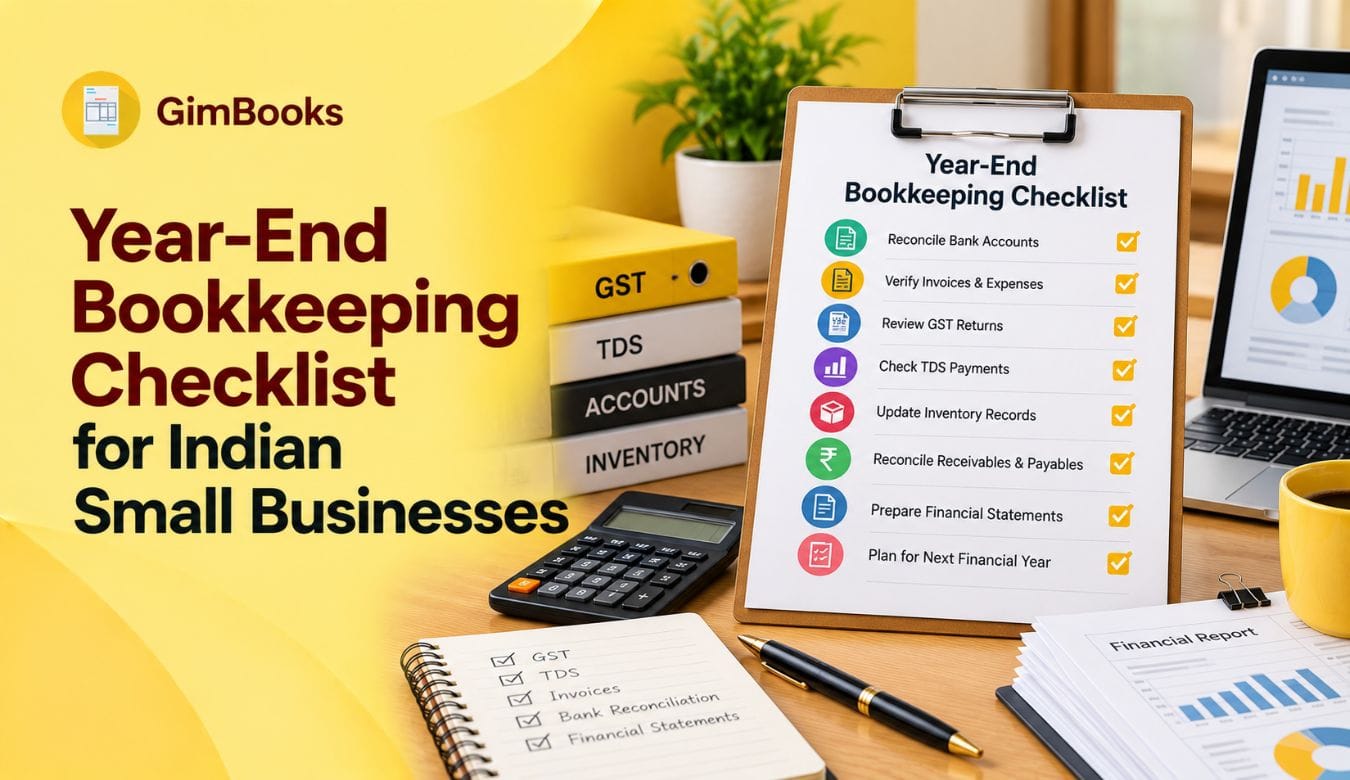
Year-End Bookkeeping Checklist for Indian Small Businesses
For a small business, March 31 is more than the end of another month. It is the point at which a full year of sales, purchases, expenses, customer dues, supplier payments, stock movements and tax records come together.
If entries have been missed or balances have not been reconciled during the year, those problems usually become visible while closing the books.
A practical year end bookkeeping checklist India can help you identify those gaps before final accounts, tax filings or discussions with your accountant become more complicated.
This guide explains what Indian small businesses should review before March 31, what should be verified on the financial year-end date, what should be completed after the year closes, and which records should be prepared for your accountant or CA.
What Is Year-End Bookkeeping?
Year-end bookkeeping is the process of reviewing and finalising your business records for the completed financial year.
For most Indian businesses, the financial year runs from April 1 to March 31.
Your year end bookkeeping for small business typically includes checking whether:
- All sales have been recorded
- Purchase bills are entered
- Business expenses are complete
- Bank balances match your books
- Cash balances are correct
- Customer outstanding amounts are accurate
- Supplier balances are complete
- Stock quantities and values are reviewed
- Credit notes and debit notes are recorded
- Fixed assets are listed correctly
- Loans and repayments are accounted for
- GST-related books are reconciled
- Supporting documents are available
- Closing balances are ready to carry forward into the next financial year
The purpose is not simply to “finish accounting.” It is to make sure the records you carry into the next financial year reflect what actually happened in the business.
Quick Year-End Bookkeeping Checklist
Here is a quick financial year end checklist for small businesses:
Before March 31: Start Preparing Your Books
A common mistake is waiting until the financial year has already ended before looking for missing transactions.
A better financial year closing process begins during March.
1. Complete All Pending Bookkeeping Entries
Start by asking a simple question:
Is every business transaction for the financial year recorded?
Review:
- Sales invoices
- Purchase bills
- Expense vouchers
- Payment receipts
- Payments made
- Cash transactions
- Bank transactions
- Sales returns
- Purchase returns
- Credit notes
- Debit notes
- Advance payments
- Customer advances
Small businesses often have transactions sitting in WhatsApp chats, email attachments, paper bills or bank statements that never made it into the books.
Before closing the year, those records should be identified and entered.
If you maintain party-wise accounts, this is also a good time to review your ledgers. GimBooks' guide on maintaining a ledger book for a small business explains how customer, supplier, sales, purchase and cash/bank ledgers can be organised.
2. Reconcile Every Bank Account
Bank reconciliation is one of the most important parts of a March 31 accounting checklist.
Do not assume that the balance shown in your accounting software is correct simply because transactions have been entered.
Compare the books with the actual bank statement.
Check for:
- Payments in the statement but missing from books
- Receipts not entered in your records
- Bank charges
- Interest credited
- Failed transactions
- Cheques issued but not cleared
- Cheques deposited but not realised
- Duplicate entries
- UPI settlement differences
- Payment gateway deductions
- Transfers between business bank accounts
Example
Your books show:
Bank balance: ₹4,25,000
The actual bank statement shows:
₹4,18,500
The ₹6,500 difference should not simply be adjusted to force both figures to match. Find the transaction causing it.
That difference may represent an unrecorded bank charge, payment, receipt or timing difference.
3. Verify Your Cash Balance
Cash requires the same attention as your bank balance.
Compare:
Actual cash available → Cash book balance
If your books show ₹75,000 in cash but only ₹28,000 can actually be accounted for, there is a year-end issue that needs investigation.
Check for:
- Cash expenses not recorded
- Owner withdrawals
- Cash sales
- Cash deposits into bank
- Small office expenses
- Petty cash
- Supplier payments
- Employee reimbursements
Keeping day-to-day cash transactions organised makes this much easier.
If your business handles frequent cash transactions, maintaining a structured cash book instead of relying on informal notes can make the year end reconciliation considerably simpler.
4. Review Accounts Receivable
Accounts receivable represents money customers still owe your business.
Your accounts receivable reconciliation should answer three questions:
- Who owes us money?
- How much do they owe?
- Is the amount genuinely recoverable?
Generate a list of all customer outstanding balances and review them individually.
Check:
- Invoice number
- Customer name
- Invoice date
- Due date
- Invoice value
- Amount received
- Remaining amount
- Days overdue
Separate receivables into categories such as:
- Current
- 1–30 days overdue
- 31–60 days overdue
- 61–90 days overdue
- More than 90 days overdue
- Disputed
- Potentially unrecoverable
A customer ledger showing an amount outstanding does not always mean the customer genuinely owes that figure. The payment may have been received but never recorded.
For businesses that regularly sell on credit, GimBooks' guide on managing customer credit and outstanding payments provides a useful framework for tracking credit bills, partial payments and customer balances.
Don't Carry Incorrect Customer Balances Into April
Look closely at very old outstanding invoices.
Ask:
- Has the customer already paid?
- Was the payment recorded against the wrong invoice?
- Was part of the order returned?
- Was a discount agreed later?
- Should a credit note have been issued?
- Is the balance disputed?
- Has the customer stopped operating?
Incorrect receivable balances can distort your financial position.
5. Reconcile Supplier Payables
Next review everything your business owes suppliers.
Your accounts payable reconciliation should include:
- Supplier invoices received
- Bills awaiting payment
- Partially paid invoices
- Advance payments
- Purchase returns
- Debit notes
- Supplier credits
- Payments made but not entered
Compare the supplier ledger with supplier statements wherever possible.
Example
Your books show:
ABC Suppliers payable: ₹1,20,000
The supplier statement shows:
₹95,000
Do not carry the ₹25,000 difference forward without investigating it.
It could be caused by:
- An unrecorded supplier credit
- Duplicate purchase entry
- Payment missing from your books
- Purchase return not recorded
- Invoice entered twice
6. Record All Business Expenses
One of the most common year-end bookkeeping mistakes is missing expenses.
Review your expense reconciliation carefully.
Look for:
- Office rent
- Electricity
- Internet
- Telephone
- Software subscriptions
- Professional fees
- Transport
- Freight
- Packaging
- Advertising
- Repairs
- Employee reimbursements
- Travel expenses
- Bank charges
- Payment gateway fees
- Courier charges
- Business insurance
- Loan interest
Also review recurring payments appearing in your bank or card statements.
A transaction may be visible in the bank statement but absent from your expense register.
For a broader day-to-day process, you can refer to GimBooks' guide on managing business expenses for MSMEs.
7. Check Sales and Purchase Cut-Off
Year-end bookkeeping is not just about whether a transaction was entered—it is also about whether it belongs to the correct financial year.
This is known as a cut-off review.
Transactions relating to the closing financial year should not accidentally move into the new year merely because the paperwork was processed late.
Review transactions around:
- March 28
- March 29
- March 30
- March 31
- April 1
- April 2
- April 3
Pay particular attention to:
- Goods dispatched before March 31
- Goods received before March 31
- Invoices raised after delivery
- Purchase bills received in April for March transactions
- Services already consumed but not billed
Ask your accountant how year-end cut-off and accrual treatment should apply to your business.
8. Verify Credit Notes, Debit Notes and Returns
Returns and post-sale adjustments are easy to miss.
Review whether all:
- Sales returns
- Purchase returns
- Discounts
- Rate differences
- Quantity differences
- Damaged goods
- Invoice corrections
have been properly recorded.
Where a sale requires a downward adjustment, a proper credit note may be needed rather than deleting or changing the original transaction.
GimBooks' guide on how to create a credit note for sales returns explains the operational process in more detail.
9. Conduct Physical Inventory Verification
If your business sells goods, inventory deserves a dedicated year-end review.
Do not rely only on the quantity shown in your software.
Perform a physical stock count and compare it with your records.
Your inventory reconciliation should review:
- Opening stock
- Purchases
- Sales
- Sales returns
- Purchase returns
- Damaged items
- Expired products
- Lost stock
- Promotional/free items
- Transfers between locations
- Closing stock
Example
System quantity:
250 units
Physical quantity:
238 units
Difference:
12 units
Investigate why those 12 units are missing.
Possible causes include:
- Unrecorded sales
- Damage
- Theft
- Incorrect purchase quantity
- Wrong unit conversion
- Stock issued internally
- Data-entry errors
For ongoing controls, read GimBooks' guide on inventory management for MSME businesses.
Review Slow-Moving and Damaged Stock
A year-end stock review should also identify:
- Dead stock
- Obsolete products
- Damaged products
- Expired inventory
- Near-expiry items
- Very slow-moving SKUs
A warehouse full of inventory does not automatically mean the business has strong working capital if much of that inventory cannot realistically be sold.
Your accountant should determine the appropriate valuation and accounting treatment.
10. Review Your Fixed Asset Register
Every business asset should ideally be reflected in the fixed asset register.
Review assets such as:
- Computers
- Laptops
- Furniture
- Machinery
- Vehicles
- Printers
- Office equipment
- Air conditioners
- Tools
- Mobile devices used by the business
For each asset, verify:
- Purchase date
- Purchase amount
- Supplier
- Asset category
- Location
- Whether the asset still exists
- Whether it was sold or disposed of
- Applicable depreciation treatment
Do not continue carrying assets indefinitely if they were sold, scrapped or lost during the year.
11. Review Depreciation With Your Accountant
Assets are usually not treated in the same way as ordinary day-to-day expenses.
Year-end accounting may therefore require a depreciation review.
Provide your accountant with:
- Opening fixed asset list
- New asset purchases
- Asset sale details
- Disposal information
- Supporting purchase invoices
Do not randomly calculate depreciation without considering the accounting and tax treatment applicable to your business.
12. Reconcile Loans and Borrowings
If your business has:
- Business loans
- Working capital facilities
- Vehicle finance
- Equipment loans
- Overdrafts
- Director/promoter loans
- Loans from other parties
check that the closing balance matches the relevant loan statement.
Separate:
Principal repayment from interest expense.
A monthly EMI of ₹40,000 does not necessarily mean the entire ₹40,000 should be treated as an expense.
The underlying loan statement normally separates principal and interest.
13. Review Owner Withdrawals and Capital Introduced
Small-business owners frequently pay business expenses personally or withdraw business funds for personal use.
These should not be mixed with normal business income or expenses.
Review:
- Money introduced by owner
- Personal expenses paid from business account
- Business expenses paid personally
- Owner drawings
- Transfers between owner and business
Ask your accountant to classify these correctly based on your business structure.
14. Perform GST Reconciliation Separately
GST deserves its own review, but a year-end bookkeeping article does not need to repeat every monthly GST check.
At a high level, review whether your sales, purchases, credit notes, debit notes and tax records agree with the GST records applicable to your business.
Typical GST reconciliation year end checks can include:
- Sales register versus applicable outward-supply records
- Purchase register versus available supplier data
- Credit notes
- Debit notes
- GST payable
- ITC records
- Reverse-charge transactions
- E-invoices where applicable
- E-way bills where applicable
- Amendments or unresolved mismatches
For the detailed GST review, use the GST compliance checklist for small businesses instead of duplicating that complete workflow here.
You can also use the GST compliance calendar for small businesses when planning recurring return and reconciliation work.
15. Check Employee and Payroll-Related Entries
If you have employees, review whether all year-end payroll-related entries have been captured.
Depending on your business, this may include:
- Salaries
- Incentives
- Bonuses
- Reimbursements
- Salary advances
- Unpaid salary
- Employee deductions
- Employer contributions
- Travel claims
Compare payroll records with payments made from bank accounts.
Missing employee reimbursements are particularly common when employees submit March claims in April.
16. Review Advances and Deposits
Not every payment is automatically an expense.
Review balances such as:
- Security deposits
- Rent deposits
- Supplier advances
- Customer advances
- Employee advances
- Prepaid subscriptions
- Advance insurance
- Advance rent
Similarly, not every amount received from a customer should automatically be treated as completed sales.
Proper classification helps prevent overstating revenue or expenses.
17. Clean Up Suspense and Unidentified Entries
Before closing the books, review accounts containing labels such as:
- Suspense
- Miscellaneous
- Unknown payment
- Unidentified receipt
- Temporary adjustment
- Other expense
- Other income
These often become dumping grounds for transactions that no one classified during the year.
A year-end balance in such accounts should trigger a review.
For every entry, ask:
What exactly was this transaction?
Then move it to the appropriate account with proper documentation.
18. Review Customer and Supplier Ledgers for Negative or Unusual Balances
A useful year-end control is searching for unusual balances.
For example:
Customer showing a credit balance
Possible reasons:
- Excess payment received
- Advance received
- Credit note not adjusted
- Wrong payment allocation
Supplier showing a debit balance
Possible reasons:
- Advance paid
- Purchase return
- Duplicate payment
- Supplier credit not adjusted
Do not automatically assume such balances are wrong, but investigate them.
19. Review Profit and Loss Statement
After the major reconciliations are complete, review your year end financial statements, starting with the profit and loss statement.
Compare:
- Current-year sales
- Current-year gross profit
- Major expenses
- Net profit
- Previous-year figures
- Monthly trends
Look for unusual changes.
Example
Electricity expense last year: ₹1.8 lakhElectricity expense this year: ₹4.9 lakh
That might be genuine—but it deserves investigation.
Similarly:
Advertising expense last year: ₹3 lakhThis year: ₹20,000
Did marketing genuinely stop, or are invoices missing?
20. Review the Balance Sheet
The balance sheet can expose errors that are not immediately obvious in the P&L.
Review:
- Bank balances
- Cash
- Receivables
- Payables
- Inventory
- Fixed assets
- Loans
- Advances
- Deposits
- Taxes payable
- Owner's capital
Ask whether every balance makes practical sense.
A balance sheet showing ₹18 lakh of customer receivables should be supported by actual customers who owe approximately ₹18 lakh.
March 31: What Should Be Checked on the Last Day?
The closing books of accounts process becomes easier if a few controls are completed as close to March 31 as practical.
March 31 Year-End Checklist
- Record all sales completed up to year-end
- Record purchase transactions relating to the period
- Record final cash transactions
- Download bank statements
- Verify physical cash
- Conduct or document stock count
- Record sales and purchase returns
- Review goods in transit where relevant
- Review outstanding customers
- Review supplier dues
- Identify pending expenses
- Check customer advances
- Check supplier advances
- Review fixed asset additions/disposals
- Preserve supporting documents
- Take a backup of accounting records
After March 31: Do Not Immediately Lock the Books
March 31 has passed, but the bookkeeping review is not necessarily finished.
April is often when previously missing information arrives.
Examples:
- Supplier sends a March invoice on April 5
- Employee submits a March travel claim
- Bank statement reveals a charge not entered
- Customer confirms a balance discrepancy
- Physical stock count reveals a difference
- Accountant identifies an incorrect ledger classification
Create a controlled year-end correction period before treating your accounts as final.
21. Prepare a Year-End Exception List
One useful improvement over a basic bookkeeping checklist for small business is maintaining an exception list.
Instead of trying to resolve every issue silently, record unresolved items separately.
This prevents small unresolved issues from disappearing once normal April work begins.
22. Prepare Documents for Your CA or Accountant
A clean bookkeeping file reduces unnecessary back-and-forth.
Prepare a year end accounting checklist India handover pack containing the documents relevant to your business.
Sales
- Sales register
- Sales invoices
- Credit notes
- Customer outstanding report
Purchases
- Purchase register
- Purchase bills
- Debit notes
- Supplier outstanding report
Banking
- Bank statements
- Bank reconciliation
- Loan statements
Expenses
- Expense ledger
- Supporting invoices
- Large or unusual expense documents
Inventory
- Closing stock summary
- Physical inventory count
- Damaged/expired stock list
Fixed Assets
- Asset register
- New asset purchase invoices
- Asset sale/disposal details
Tax and Compliance
- Relevant GST reports
- TDS records where applicable
- Other statutory records applicable to the business
Other
- Customer advances
- Supplier advances
- Security deposits
- Loans from/to parties
- Important agreements
Red Flags to Fix Before Closing the Books
Your business bookkeeping India year-end review should flag these situations:
Bank balance does not match the statement
Reconcile before closing.
Cash balance looks unrealistically high
Verify physical cash and owner withdrawals.
Old customers still show balances
Confirm whether the amounts are actually recoverable.
Suppliers show balances that no one recognises
Obtain supplier confirmations.
Negative inventory appears without explanation
Check missing purchase or sales entries.
Inventory exists in the system but not physically
Investigate shrinkage, damage or recording errors.
Expense accounts suddenly changed significantly
Compare with prior-year and monthly trends.
Loans do not match lender statements
Reconcile principal and interest.
Suspense accounts have large balances
Identify the underlying transactions.
Numerous March bills were entered in April without review
Check financial-year cut-off.
Year-End Bookkeeping by Business Type
Not every small business has the same bookkeeping priorities.
Simple 4-Stage Financial Year Closing Process
A structured year end bookkeeping checklist India becomes easier when divided into four stages.
Stage 1: Capture
Make sure all transactions have been entered.
Sales → Purchases → Expenses → Receipts → Payments → Adjustments
Stage 2: Reconcile
Match your records with independent sources.
Books → Bank statements → Supplier statements → Customer confirmations → Physical stock
Stage 3: Review
Investigate unusual balances and missing information.
Receivables → Payables → Inventory → Loans → Assets → Taxes
Stage 4: Close
Complete year-end adjustments with your accountant, generate final reports and carry correct closing balances forward.
What Should Carry Forward Into the New Financial Year?
Your closing balances on March 31 become the opening balances for the new financial year.
This can include:
- Cash
- Bank balances
- Customer receivables
- Supplier payables
- Inventory
- Fixed assets
- Loans
- Deposits
- Advances
- Capital balances
- Other balance-sheet accounts
This is why incorrect year-end bookkeeping can continue causing problems even after April begins.
If a customer's March 31 balance is wrong, the incorrect figure may become their opening balance on April 1.
Year-End Bookkeeping Checklist for Business Owners
Even if an accountant handles your books, the business owner should personally review a few key numbers.
Ask for:
- Total annual sales
- Gross profit
- Net profit
- Cash balance
- Bank balance
- Total customer dues
- Top overdue customers
- Total supplier dues
- Closing stock value
- Total loans
- Major expenses
- GST or other liabilities requiring attention
You do not need to inspect every journal entry.
But you should understand what your business owns, owes, earns and spends.
How Bookkeeping Software Can Make Year-End Closing Easier
The hardest year-end closes usually begin with poor daily bookkeeping.
When transactions are maintained consistently through the year, March becomes a review exercise rather than a reconstruction exercise.
A good bookkeeping software for small businesses can help keep:
- Sales invoices
- Purchase bills
- Customer ledgers
- Supplier ledgers
- Cash transactions
- Bank transactions
- Inventory
- Credit notes
- Payment receipts
- Expenses
- Outstanding balances
- Business reports
in one organised system.
If you want to understand these features in more detail, see GimBooks' guide to online bookkeeping software for small businesses.
For businesses that want invoicing, inventory, payment tracking and business reporting together, you can also explore GimBooks GST billing software for small businesses.
Software does not replace the judgement of an accountant or tax professional, but maintaining cleaner source records throughout the year can significantly reduce the number of transactions that need to be reconstructed at year-end.
Complete Year-End Bookkeeping Checklist for Indian Small Businesses
Use this final year end accounting checklist as your working review.
Sales and Income
- All sales invoices recorded
- Cash sales recorded
- Credit sales recorded
- Other income entered
- Cancelled invoices reviewed
- Sales returns recorded
- Credit notes recorded
- Customer advances checked
Purchases
- Purchase invoices recorded
- March bills received later identified
- Purchase returns recorded
- Supplier credits reviewed
- Supplier advances reconciled
Cash and Bank
- Bank accounts reconciled
- Cash physically verified
- Petty cash reconciled
- Bank charges recorded
- Interest recorded
- Unidentified transactions investigated
Customers
- Customer ledgers reviewed
- Outstanding invoices verified
- Old balances investigated
- Partial payments adjusted
- Advances separated
- Bad/disputed balances reviewed
Suppliers
- Supplier balances reviewed
- Statements reconciled
- Missing invoices requested
- Payments correctly allocated
- Unusual debit balances investigated
Expenses
- All expenses entered
- Employee reimbursements recorded
- Recurring subscriptions reviewed
- Prepayments identified
- Pending expenses identified
- Personal expenses separated
Inventory
- Physical count completed
- Closing stock verification completed
- Book versus physical stock reconciled
- Damaged stock identified
- Expired stock identified
- Dead stock reviewed
Fixed Assets
- Asset register updated
- New purchases entered
- Disposed assets removed/reviewed
- Asset invoices retained
- Depreciation discussed with accountant
Loans
- Loan statements obtained
- Closing balances reconciled
- Principal recorded correctly
- Interest recorded correctly
GST and Compliance
- Sales records reconciled
- Purchase records reconciled
- Credit/debit notes checked
- GST mismatches reviewed
- Outstanding compliance issues listed
Final Review
- Profit and loss reviewed
- Balance sheet reviewed
- Suspense accounts cleared
- Unusual balances investigated
- Supporting documents organised
- Data backup created
- CA/accountant handover pack prepared
- Year-end exception list prepared
Common Year-End Bookkeeping Mistakes
Waiting Until April to Start
Trying to reconstruct twelve months of records after year-end creates unnecessary pressure.
Begin reviewing accounts during March.
Treating the Bank Statement as the Books
A bank statement shows money movement, not necessarily the accounting nature of each transaction.
Ignoring Small Differences
Repeated ₹100, ₹500 or ₹1,000 mismatches can add up.
Carrying Old Customer Balances Forever
Review whether old receivables are genuine and recoverable.
Forgetting Inventory Adjustments
Book stock and physical stock can differ substantially.
Mixing Personal and Business Expenses
Separate them before final accounts are prepared.
Deleting Transactions to Make Balances Match
Corrections should have a clear audit trail.
Closing Before Supplier Bills Arrive
Review whether late-arriving invoices relate to the completed financial year.
Frequently Asked Questions
What is a year-end bookkeeping checklist in India?
A year end bookkeeping checklist India is a structured review of a business's sales, purchases, expenses, bank accounts, cash, customer dues, supplier balances, inventory, assets, loans and tax-related records before finalising the books for the financial year.
When should small businesses start year-end bookkeeping?
Ideally, start the preliminary review during March rather than waiting until after March 31. Bank reconciliation, customer follow-ups, supplier confirmations and stock preparation can all begin before the year actually closes.
What should I check before closing my books on March 31?
Your financial year end checklist should cover sales, purchases, bank balances, cash, receivables, payables, inventory, fixed assets, loans, expenses, GST records and supporting documents.
What is the difference between bookkeeping and year-end accounting?
Bookkeeping records day-to-day financial transactions.
Year-end accounting uses those records to review balances, make applicable adjustments and prepare final financial statements and tax-related information.
Good bookkeeping therefore makes year-end accounting much easier.
What accounts should be reconciled at year-end?
At minimum, review bank accounts, cash, customer receivables, supplier payables, inventory, loans, advances and other significant balance-sheet accounts.
Why is bank reconciliation important at year-end?
Bank reconciliation helps confirm that the transactions in your books agree with the actual bank statement and identifies missing receipts, payments, fees, interest or duplicate entries before final accounts are prepared.
Should I verify inventory physically at year-end?
Businesses holding stock should compare physical quantities with accounting or inventory records. Differences should be investigated rather than simply adjusting the software quantity without understanding the reason.
What documents should I give my accountant at year-end?
Depending on your business, provide sales and purchase registers, bank statements, reconciliations, expense records, outstanding customer and supplier reports, inventory records, loan statements, fixed asset information and relevant tax records.
Can bookkeeping software help with year-end closing?
Yes. Small business bookkeeping software India can help maintain invoices, purchases, expenses, ledgers, payments, inventory and reports throughout the year. This reduces the amount of manual reconstruction required during year-end closing.
Is year-end bookkeeping only required for GST-registered businesses?
No. Even businesses that do not have the same GST obligations still need accurate books to understand revenue, expenses, assets, liabilities, customer dues, supplier payments and overall business performance.
Conclusion
The best year end bookkeeping checklist India is not one that begins on March 31.
It begins with organised records throughout the financial year and ends with a structured review of every important balance before the books are finalised.
For most Indian small businesses, the essential sequence is:
Record transactions → reconcile balances → verify stock and dues → review taxes and adjustments → prepare reports → hand clean records to your accountant → carry accurate balances into the new year.
Regular bookkeeping also means that year-end does not become a search for missing invoices, unexplained payments and forgotten expenses.
Using a structured bookkeeping system such as GimBooks can help small businesses keep invoices, payments, inventory, expenses and business records organised throughout the year, making the financial year-end review much easier.