What is GSTIN Number? Meaning, 15-Digit Format & How to Verify
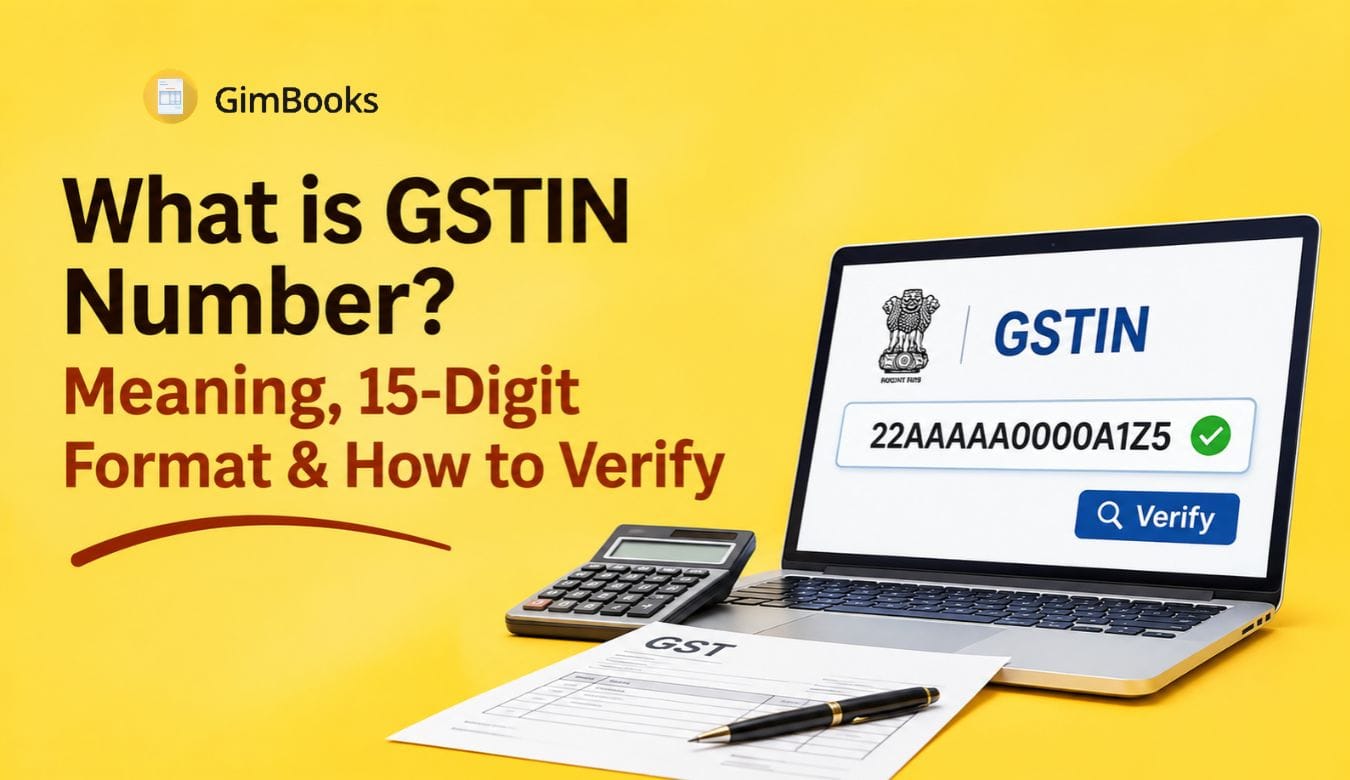
Every GST-registered business in India has a unique identification number used on tax invoices, GST returns, and other tax-related documents. This number is called GSTIN. Whether you're a business owner checking a supplier's invoice or an accountant entering customer details, understanding the GSTIN number helps prevent billing errors and tax-related issues.
A GSTIN contains 15 characters that identify the state of registration, the taxpayer's PAN, and other registration details. But how do you read these characters, and how can you check whether a GST number is genuine?
This guide explains the GSTIN meaning, its format with an example, how to verify it online, and why it matters for GST billing and accounting.
What is GSTIN Number?
GSTIN stands for Goods and Services Tax Identification Number. It is a unique 15-character alphanumeric identification number assigned to a taxpayer registered under India's Goods and Services Tax (GST) system.
In simple words, a GSTIN identifies a registered business for GST purposes. It is used to issue tax invoices, report taxable transactions, file GST returns, and identify the supplier or recipient in GST-related records.
The GSTIN full form is Goods and Services Tax Identification Number.
For example, when a GST-registered wholesaler sells goods to another registered business, the invoice generally contains the supplier's GSTIN and the buyer's GSTIN. These details help identify the parties involved in the transaction.
A GSTIN is issued after GST registration is approved. Businesses that want to understand the application process can refer to this guide to apply for GSTIN.
GST Number Format: How Many Digits Are in GSTIN?
A common question is GST number how many digits? The answer is 15 characters.
The standard GST number format includes numbers and letters arranged in a fixed structure.
GSTIN Format Explained With an Example
Consider the following illustrative GSTIN:
27ABCDE1234F1Z5
This is a format illustration, not a verified or active GSTIN.
Here's how to read a GST number using this structure.
1. First Two Digits: State Code
The first two digits identify the state or union territory in which the taxpayer is registered.
Examples include:
- 07 – Delhi
- 09 – Uttar Pradesh
- 19 – West Bengal
- 24 – Gujarat
- 27 – Maharashtra
- 29 – Karnataka
- 33 – Tamil Nadu
A GSTIN beginning with 27 identifies a registration in Maharashtra, while one beginning with 29 identifies a registration in Karnataka.
The GSTIN state code indicates the state of registration. It does not, by itself, determine the place of supply for every transaction.
2. Next Ten Characters: PAN Number
Characters 3 to 12 represent the taxpayer's Permanent Account Number (PAN).
PAN is a ten-character alphanumeric identifier issued by the Income Tax Department. The same PAN can be associated with multiple GST registrations.
For example, a company operating through registered establishments in Maharashtra and Karnataka may have different GSTINs associated with the same PAN.
3. Thirteenth Character: Entity Code
The 13th character is an alphanumeric entity code used to distinguish registrations associated with the same PAN in a particular state.
It is commonly represented by characters such as 1, 2, or 3 for different registrations.
It should not be confused with the total number of branches a company operates across India.
4. Fourteenth Character: Z
The 14th character is normally the letter Z in the standard GSTIN structure.
5. Fifteenth Character: Check Character
The final character is a checksum used to detect certain errors in the GSTIN.
This helps validate whether the number follows the required structure. However, a GSTIN that passes a format or checksum check is not necessarily an active registration.
To establish whether the registration is active, you must verify it on the official GST portal.
How to Verify GSTIN Number Online
You can perform GSTIN verification on the official GST portal without logging into an account.
Follow these steps:
- Visit the official GST Portal.
- Open the Search Taxpayer menu.
- Select Search by GSTIN/UIN.
- Enter the 15-character GSTIN you want to check.
- Enter the captcha shown on the screen.
- Click Search to view the available taxpayer information.
The search results can display the legal business name, trade name, registration status, registration date, taxpayer type, and other available details.
What Should You Check After Searching a GSTIN?
Finding a GSTIN in the government database is only the first step.
Compare these details with the supplier or customer information in your records:
If the GSTIN is inactive, the legal name differs, or the registration details do not match the invoice, investigate before proceeding.
For a detailed walkthrough of registration-status checks and business information, read GimBooks' GSTIN verification and taxpayer details guide.
How to Find a GST Number Using PAN
The GST portal also provides a facility to search for GST registrations associated with a PAN.
To search:
- Visit the GST portal.
- Select Search Taxpayer.
- Choose Search by PAN.
- Enter the PAN and captcha.
- Click Search.
The portal will display the GST registrations available against that PAN.
This can be useful when a business operates in multiple states and you need to identify its registrations.
However, a PAN search should not replace verification of the GSTIN mentioned on a particular invoice.
Difference Between GSTIN, GST Number, PAN, and GSTN
These terms are often used interchangeably, but they refer to different things.
GST number, GST no, and GSTIN generally refer to the same 15-character identification number.
GSTN, however, is not another name for a GSTIN.
Why is GSTIN Important for Businesses?
A GSTIN serves several practical purposes in GST accounting, invoicing, and compliance.
GST Invoicing
Registered suppliers must include their GSTIN on tax invoices as required by applicable invoice rules. Recipient GSTIN details are also required in relevant transactions.
For example, when a registered distributor sells goods to a registered retailer, correctly recording both GSTINs helps ensure the invoice identifies the parties accurately.
Input Tax Credit (ITC)
The correct GSTIN is important when businesses purchase goods or services and seek to claim eligible input tax credit.
For example:
A registered retailer purchases goods worth ₹20,000 plus ₹3,600 GST from a supplier.
If the supplier reports the invoice against an incorrect recipient GSTIN, the purchase may not appear correctly in the intended recipient's GST records.
The buyer may then need to request a correction and review the applicable ITC requirements.
A correct GSTIN is important, but it does not automatically guarantee ITC eligibility. Other statutory conditions must also be satisfied.
GST Return Filing
GSTIN is used to identify registered taxpayers when reporting outward supplies, reconciling purchase data, and filing applicable GST returns.
Incorrect customer or supplier GSTIN details can create reconciliation problems between invoices, books of accounts, and GST records.
E-Invoicing
For taxpayers covered by e-invoicing requirements, accurate supplier and recipient GSTIN information is important for reporting applicable invoices through the Invoice Registration Portal (IRP).
Incorrect details may lead to validation errors or require appropriate corrections.
Identification of Registered Businesses
A GSTIN allows customers and businesses to verify publicly available registration details on the GST portal before completing relevant transactions.
Can One Business Have Multiple GST Numbers?
Yes. A business can have multiple GSTINs.
GST registration is PAN-based and state-specific. A company operating in more than one state may need separate registrations in those states.
For example, consider a company with registered establishments in:
- Maharashtra
- Karnataka
- Delhi
It may hold three different GSTINs while using the same PAN.
Separate registrations can also be permitted within the same state under applicable GST provisions.
Therefore, having multiple GSTINs does not necessarily mean a business has multiple PANs or is operating as separate legal entities.
What Happens If You Use the Wrong GSTIN on an Invoice?
Entering an incorrect GST no can affect billing records and GST-related processes.
Common consequences include:
- Customer invoices containing incorrect registered-buyer details
- Supplier invoice mismatches in purchase records
- Problems identifying the intended recipient for ITC reporting
- E-invoice generation or reporting errors
- Additional corrections and reconciliation work
Common GST Number Mistakes
These issues are easier to prevent when GSTIN details are checked before invoices are issued.
How Does GSTIN Affect GST Calculation and Accounting?
A GSTIN helps identify the registered parties involved in a transaction, but GST calculations depend on more than the identification number.
Consider a business registered in Maharashtra selling taxable goods to another business.
If the transaction qualifies as an intra-state supply, CGST and SGST generally apply. If it qualifies as an inter-state supply, IGST generally applies.
The actual treatment depends on the place-of-supply rules and other applicable provisions.
For example, on a taxable value of ₹10,000 at an illustrative GST rate of 18%:
The total GST is the same in this illustration, but the tax components differ.
For more information about tax components, read the difference between CGST and SGST. You can also refer to the GST rates in India to understand how rates vary across goods and services.
How Billing Software Helps Manage GSTIN Details
Businesses that issue multiple invoices every day often maintain customer and supplier information in billing software.
Instead of entering the same GSTIN repeatedly, they can save it in the party master and reuse it when preparing invoices.
For example, a wholesale business supplying 30 regular retailers can maintain customer records containing:
- Customer or business name
- GSTIN
- Billing address
- State
- Contact details
- Transaction history
When the wholesaler creates a new invoice, the saved customer information can be used instead of being entered from scratch.
Using GimBooks billing software for small businesses, businesses can manage customer details, create GST invoices, maintain transaction records, and organise billing information.
Businesses covered by mandatory e-invoicing can also explore GimBooks' e-invoicing software for creating and managing applicable e-invoice documents.
Billing software helps reduce repetitive data entry, but businesses should still confirm that GSTINs are correct and that registrations remain valid.
Frequently Asked Questions About GSTIN
1. What is GSTIN full form?
The GSTIN full form is Goods and Services Tax Identification Number. It is a unique 15-character identification number assigned to a registered taxpayer under India's GST system.
2. How many digits are in a GST number?
A GST number contains 15 alphanumeric characters. The first two identify the state, the next ten represent the PAN, and the remaining three represent the entity code, default character, and checksum.
3. Are GSTIN and GST number the same?
Yes. GSTIN and GST number refer to the same identification number. GST no. is simply another commonly used abbreviation.
4. How can I check whether a GST number is valid?
Visit www.gst.gov.in, open Search Taxpayer, select Search by GSTIN/UIN, and enter the number and captcha. Review the business name, registration details, and current status displayed by the portal.
5. Can I find a GST number using a business name?
The official GST portal provides taxpayer searches using GSTIN/UIN and PAN. A business name alone is not a substitute for these identifiers in the standard GSTIN lookup process. Request the GSTIN from the business or check its tax invoice before verifying it.
6. Is GSTIN mandatory for every business?
No. GST registration depends on applicable turnover thresholds, the nature of supplies, the state, and other legal requirements. Certain businesses may also register voluntarily. Not every small business must obtain a GSTIN.
7. Can two businesses have the same GSTIN?
No. A GSTIN uniquely identifies a particular GST registration. Separate taxpayers or registrations cannot share the same GSTIN.
8. Can a business have multiple GSTIN numbers?
Yes. A business operating in different states may hold multiple GST registrations linked to the same PAN. Separate registrations within a state may also be permitted under applicable rules.
9. How do I find my own GSTIN?
You can find your GSTIN on your GST registration certificate, GST portal account, or previously issued GST invoices. You can also use the GST portal's PAN search facility to identify registrations associated with your PAN.
10. Can I identify the state from a GST number?
Yes. The first two characters of a GSTIN represent the state or union territory code. For example, 27 indicates Maharashtra, while 29 indicates Karnataka.
11. Does a valid GSTIN mean a business is GST compliant?
Not necessarily. A GSTIN may be structurally valid without establishing the taxpayer's current registration status. Even an active GST registration does not, by itself, prove that all GST returns, tax payments, or other obligations have been completed.
12. Can I get a GSTIN without a PAN?
Most regular GST registrations are PAN-based. However, specific registration categories, such as certain non-resident taxable persons, can follow separate identification requirements under GST law.
Conclusion
A GSTIN is a 15-character identification number that connects a registered taxpayer to India's GST system. Understanding the GST number format helps businesses identify the state code, PAN, and registration details, while online GSTIN verification helps confirm whether the number belongs to the intended registered taxpayer.
For business owners and accountants, checking GSTIN details before creating invoices can prevent avoidable billing errors, purchase mismatches, and GST reconciliation problems.
With GimBooks, businesses can organise customer and supplier information, generate GST invoices, and manage billing records without repeatedly entering the same details.
Create your first GST invoice with GimBooks. Start a 7-day free trial and simplify GST billing for your business.