Types of GST in India: CGST, SGST, IGST & UTGST Explained with Examples
Understanding the different types of GST is essential for businesses selling goods or services in India. Whether you operate a retail shop, supply products across states or provide professional services, charging the correct GST component helps prevent invoice errors, input tax credit mismatches and unnecessary refund procedures.
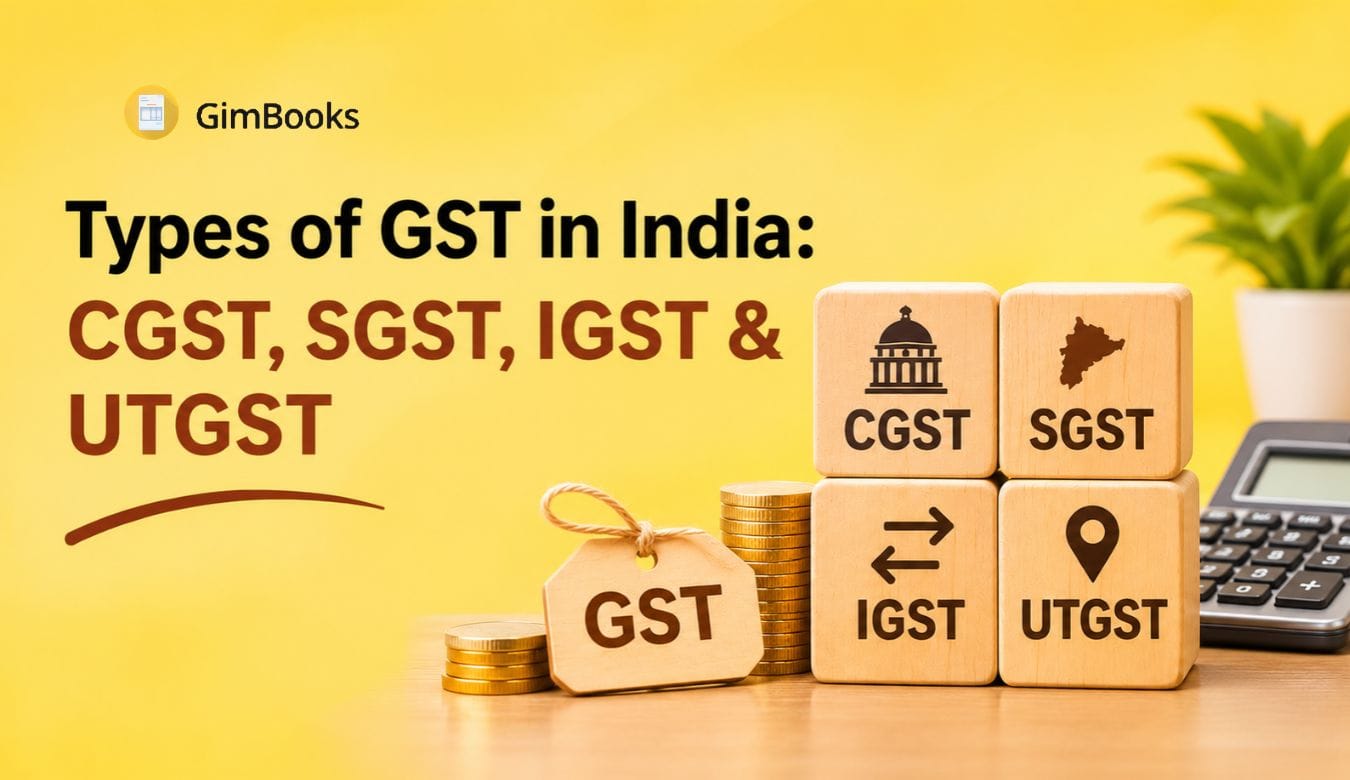
There are four types of GST in India: Central Goods and Services Tax (CGST), State Goods and Services Tax (SGST), Integrated Goods and Services Tax (IGST) and Union Territory Goods and Services Tax (UTGST).
The applicable type of GST depends primarily on the location of the supplier and the place of supply. For example, a transaction within Maharashtra generally attracts CGST and SGST, while a supply from Maharashtra to Gujarat generally attracts IGST.
This guide explains how each GST component works, when it applies, how to calculate it and how businesses can manage different GST transactions accurately.
What Are the Types of GST in India?
GST is a destination-based indirect tax introduced in India on 1 July 2017. It replaced several earlier indirect taxes and established a common taxation framework for the supply of goods and services.
India follows a dual GST model, allowing the Central and State Governments to participate in tax collection. The four GST types in India help distribute tax revenue according to the nature and destination of a supply.
The total applicable GST rate generally remains the same regardless of whether the transaction attracts IGST or a combination of CGST and SGST or UTGST.
How Many Types of GST Are There in India?
If you are wondering how many types of GST are applicable in India, there are four main components: CGST, SGST, IGST and UTGST. However, businesses do not charge all four taxes on a single transaction.
The applicable combinations are:
- CGST + SGST: Supplies within the same state.
- CGST + UTGST: Supplies within specified Union Territories.
- IGST: Inter-state supplies and other transactions classified as inter-state supplies under GST law.
For example, if a product attracts 18% GST, an intra-state transaction generally attracts 9% CGST and 9% SGST. An inter-state transaction attracts 18% IGST.
However, 18% is only an illustrative rate. The actual rate depends on the classification of the goods or services being supplied. Businesses can refer to the guide on GST rates in India to understand applicable tax rates.
How Do Different Types of GST Work? A Practical Example
Suppose a registered electronics wholesaler sells goods worth ₹20,000 at an applicable GST rate of 18%.
The tax components recorded on the invoice depend on the location of the supplier and the place of supply.
The customer pays the same total amount in all three situations. However, the type of GST recorded on the invoice and in the supplier's accounting records is different.
GST Calculation Formula
For a tax-exclusive transaction:
GST amount = Taxable value × GST rate ÷ 100
Total invoice value = Taxable value + GST amount
For a tax-inclusive transaction:
GST amount = Inclusive price × GST rate ÷ (100 + GST rate)
Businesses can use the free online GST calculator to calculate GST amounts and final invoice values without performing manual calculations.
4 Types of GST in India Explained with Examples
Each of the four GST types in India serves a different purpose within the indirect taxation system. Understanding these differences helps businesses determine which tax to charge in different billing situations.
1. CGST (Central Goods and Services Tax)
CGST stands for Central Goods and Services Tax. It is the central component of GST charged on taxable intra-state supplies of goods and services.
CGST is generally charged alongside SGST or UTGST and is administered under the Central Goods and Services Tax Act, 2017.
When does CGST apply?
- Sales within the same state.
- Services classified as intra-state supplies.
- Local supplies within Union Territories, alongside the applicable SGST or UTGST.
Example of CGST:
A furniture dealer in Pune sells office chairs worth ₹30,000 to a business in Mumbai. Assuming an applicable GST rate of 18%, the invoice will contain:
The Central Government receives the CGST component, while Maharashtra receives the SGST component.
2. SGST (State Goods and Services Tax)
SGST stands for State Goods and Services Tax. It is the state component of GST charged on taxable supplies within the same state.
SGST is generally equal to the CGST component for an intra-state transaction. Both taxes are charged separately on the same taxable value.
When does SGST apply?
- Local sales made within a state.
- Services where the supplier location and place of supply are within the same state, subject to applicable rules.
- Intra-territory supplies in Delhi, Puducherry and Jammu and Kashmir under their respective GST laws.
Example of SGST:
A stationery wholesaler in Jaipur supplies office stationery worth ₹10,000 to a retailer in Jodhpur.
Assuming an applicable GST rate of 18%:
Although both taxes appear on the same invoice, they are accounted for separately.
Read our detailed guide on the difference between CGST and SGST to understand how central and state taxation work together.
3. IGST (Integrated Goods and Services Tax)
IGST stands for Integrated Goods and Services Tax. This type of GST is generally charged when the supplier location and place of supply are in different states or Union Territories.
IGST is administered under the Integrated Goods and Services Tax Act, 2017. The Central Government collects the tax, and the revenue is subsequently apportioned according to applicable settlement provisions.
When does IGST apply?
- Supply of goods between different states.
- Supply between different Union Territories.
- Supply between a state and a Union Territory.
- Applicable imports of goods and services.
- Supplies to or by Special Economic Zone (SEZ) units or developers, subject to applicable provisions.
Example of IGST:
A manufacturer in Gujarat supplies machinery components worth ₹50,000 to a distributor in Karnataka. Assuming an applicable GST rate of 18%:
The supplier charges IGST instead of separately charging CGST and SGST.
Exports and eligible supplies to SEZ units or developers for authorised operations are subject to separate zero-rated supply provisions and should not be treated as ordinary domestic inter-state transactions.
4. UTGST (Union Territory Goods and Services Tax)
UTGST stands for Union Territory Goods and Services Tax. It serves a similar purpose to SGST but applies to local taxable supplies within specified Union Territories.
UTGST is governed by the Union Territory Goods and Services Tax Act, 2017, and is generally charged alongside CGST.
Where is UTGST applicable in India?
UTGST applies to the following Union Territories:
- Andaman and Nicobar Islands
- Chandigarh
- Dadra and Nagar Haveli and Daman and Diu
- Lakshadweep
- Ladakh
Delhi, Puducherry and Jammu and Kashmir have their own GST legislation and generally follow the CGST and SGST model for intra-territory supplies.
Example of UTGST:
A computer accessories dealer in Chandigarh sells goods worth ₹15,000 to a local business. Assuming an applicable GST rate of 18%:
If the same dealer supplies these goods to a customer in Punjab and the place of supply is Punjab, IGST would generally apply instead.
Difference Between CGST, SGST, IGST and UTGST
The main difference between the four types of GST in India is their applicability, governing legislation and distribution of tax revenue.
While each GST component has a different purpose, businesses primarily need to identify the correct supply classification before issuing an invoice.
Which GST Applies on Interstate Sale?
IGST generally applies to an interstate sale when the location of the supplier and the place of supply are in different states or Union Territories.
For example, if a registered trader in Maharashtra supplies goods to a customer in Rajasthan and the place of supply is Rajasthan, the trader charges IGST.
However, the customer's billing address alone does not always determine the applicable type of GST. Businesses must follow the place-of-supply provisions under the IGST Act.
Intra-State vs Inter-State GST Examples
Does the Customer's GSTIN Always Determine the Type of GST?
No. Although a GSTIN helps identify the customer's registered state or Union Territory, the applicable GST component depends on the statutory place-of-supply rules and supplier location.
For example, a Maharashtra-based company may order goods from a Gujarat supplier and instruct that supplier to deliver them directly to another party in Gujarat.
Under applicable bill-to, ship-to provisions, the place of supply may be Maharashtra despite the goods being delivered within Gujarat.
Special place-of-supply rules also apply to certain services, including accommodation, immovable property-related services and events.
This is why businesses should verify the nature of the transaction rather than selecting GST solely from the delivery address or customer GSTIN.
How to Identify the Correct Type of GST for an Invoice
Before generating a GST invoice, businesses should follow these five steps:
- Identify the supplier location: Determine the GST registration and location from which the supply is made.
- Determine the place of supply: Apply the relevant GST provisions for the goods or services.
- Compare the locations: Identify whether the supply is intra-state or inter-state.
- Verify the applicable GST rate: Check the HSN or SAC classification and applicable rate.
- Select the tax component: Charge CGST and SGST, CGST and UTGST, or IGST as applicable.
Businesses operating from multiple states should also understand the GST registration procedure and maintain accurate registration details for each applicable business location.
Accounting Treatment of Different Types of GST
Businesses need to maintain separate accounting records for different types of GST. GST collected on sales is generally recorded as output tax liability, while eligible GST paid on purchases is recorded as input tax credit.
Accounting Entry for an Intra-State Sale
Suppose a registered business sells goods on credit worth ₹25,000 at 18% GST within the same state.
Accounting Entry for an Inter-State Sale
If the same goods are supplied to a customer in another state and the place of supply is in that state:
Accounting Entry for an Intra-State Purchase
Suppose the business purchases inventory on credit worth ₹10,000 at an applicable GST rate of 18% and is eligible for the full input tax credit.
Maintaining separate GST accounts helps businesses reconcile their purchases, sales, tax liabilities and return data.
Input Tax Credit Rules for CGST, SGST, IGST and UTGST
Input tax credit (ITC) allows eligible registered businesses to use GST paid on qualifying purchases against their output tax liability.
However, the credit available under different GST types in India cannot be used interchangeably without following the prescribed utilisation rules.
Available IGST credit must be exhausted before using CGST or SGST/UTGST credit, in accordance with the applicable GST provisions.
Input Tax Credit Utilisation Example
A registered wholesaler has the following GST liability and eligible input tax credit for a particular period:
The business can utilise its ITC as follows:
- Use ₹12,000 of IGST credit against the IGST liability.
- Use the remaining ₹3,000 of IGST credit against CGST liability.
- Use ₹5,000 of CGST credit against the remaining CGST liability.
- Use ₹5,000 of SGST credit against the SGST liability.
The remaining GST liability is ₹3,000 under SGST, which can be paid through the electronic cash ledger.
This example demonstrates why maintaining separate tax-head balances is important. Actual ITC utilisation remains subject to eligibility, restrictions and applicable GST rules.
What Happens If You Charge the Wrong Type of GST?
Charging the wrong type of GST can create inconsistencies between invoices, accounting records and GST returns. It may also affect the customer's input tax credit, particularly where the tax has been reported under an incorrect component.
Consider a supplier in Maharashtra who charges ₹1,800 IGST on an intra-state sale worth ₹10,000 when the correct treatment is ₹900 CGST and ₹900 SGST.
The total tax amount is correct, but the tax classification is wrong.
Depending on whether the invoice has been issued, reported or paid, the supplier may need to:
- Review the supplier location and place of supply.
- Correct the invoice through the applicable procedure.
- Amend the relevant GST return details where permitted.
- Pay the tax under the correct components.
- Claim a refund of the incorrectly paid tax, where eligible.
- Inform the customer about the correction.
Section 77 of the CGST Act and Section 19 of the IGST Act provide mechanisms for dealing with tax wrongly paid because a supply was incorrectly classified as intra-state or inter-state.
The CBIC has also issued Circular No. 162/18/2021-GST explaining the refund procedure in such cases.
Businesses should not assume that incorrectly paid tax can automatically be transferred between tax heads.
Common Mistakes Businesses Make When Applying Different Types of GST
Most of these errors can be reduced by reviewing transaction details before generating invoices instead of correcting them during return preparation.
How GimBooks Helps Businesses Manage Different Types of GST
Managing different types of GST in India manually becomes increasingly difficult as a business starts selling across states, handling multiple customers or expanding its product range.
GimBooks' GST billing software for small businesses helps traders, retailers, wholesalers and service providers simplify GST billing and organise their transaction records.
With GimBooks, businesses can:
- Automatically calculate CGST, SGST and IGST based on configured transaction details.
- Maintain customer GSTINs and business information.
- Store product details, HSN codes and applicable GST rates.
- Generate GST invoices with item-wise tax calculations.
- Maintain organised sales and purchase records.
- Access GST-related reports for accounting and reconciliation.
- Manage applicable e-invoice and e-way bill workflows.
- Reduce repetitive calculations and manual billing errors.
Businesses should still verify place-of-supply information, tax applicability and special transaction requirements before finalising invoices.
Create Your First GST Invoice Free with GimBooks
Start your 7-day free trial and simplify GST billing, inventory management and business accounting from one platform.
Conclusion
Understanding the four types of GST – CGST, SGST, IGST and UTGST – helps businesses generate accurate invoices, maintain separate tax records and manage input tax credit effectively.
CGST and SGST generally apply to intra-state transactions, IGST applies to inter-state transactions, and CGST with UTGST applies to local supplies within specified Union Territories.
By determining the correct place of supply, verifying GST rates and maintaining accurate accounting records, businesses can reduce tax mismatches and simplify GST compliance.
Using GST billing software like GimBooks can further reduce manual work and help businesses manage local and inter-state transactions more efficiently.
Frequently Asked Questions
1. How many types of GST are there in India?
There are four main types of GST in India: Central Goods and Services Tax (CGST), State Goods and Services Tax (SGST), Integrated Goods and Services Tax (IGST) and Union Territory Goods and Services Tax (UTGST).
2. What are the four GST types in India with their full forms?
The four GST types in India and their full forms are:
- CGST – Central Goods and Services Tax
- SGST – State Goods and Services Tax
- IGST – Integrated Goods and Services Tax
- UTGST – Union Territory Goods and Services Tax
3. Which GST applies on interstate sale?
IGST is generally applicable when the supplier location and place of supply are in different states or Union Territories. It is charged at the applicable GST rate without separately charging CGST and SGST.
4. What is the difference between IGST and CGST?
IGST generally applies to inter-state supplies, while CGST is the central component of GST charged on intra-state supplies alongside SGST or UTGST.
5. Is UTGST applicable in Delhi?
No. Delhi has its own GST legislation. Local taxable supplies within Delhi generally attract CGST and SGST, commonly referred to as Delhi GST, instead of UTGST.
6. Is GST 18% or 9% CGST and 9% SGST?
For an intra-state supply attracting 18% GST, the tax is generally divided into 9% CGST and 9% SGST. For an inter-state supply, the entire 18% is generally charged as IGST.
7. Can CGST and SGST be charged along with IGST on the same transaction?
Generally, no. A taxable supply is normally classified as either intra-state or inter-state. Accordingly, it attracts either CGST with SGST/UTGST or IGST.
8. Can CGST input tax credit be used to pay SGST?
No. CGST credit cannot be directly utilised against SGST liability, and SGST credit cannot be directly utilised against CGST liability. Both credits may be used against IGST, subject to prescribed utilisation rules.
9. Which type of GST applies to online sales?
The type of GST applicable to online sales depends on the supplier location, place of supply and applicable transaction rules. Local supplies generally attract CGST and SGST/UTGST, while inter-state supplies generally attract IGST.
10. What is the difference between GST types and GST slabs?
The types of GST determine the tax component applicable to a transaction, such as CGST, SGST, IGST or UTGST. GST slabs determine the percentage of tax applicable to the goods or services.
11. What are the types of GST registration in India?
GST registration categories are different from GST tax components. Common categories include regular taxpayers, composition taxpayers, casual taxable persons, non-resident taxable persons and other specialised registrations.
12. Is compensation cess another type of GST?
GST compensation cess is a separate levy under dedicated legislation and is not one of the four main GST components. Its applicability depends on the relevant notified goods, provisions and period.
13. Which type of GST applies to imports?
IGST generally applies to taxable imports of goods and services, subject to applicable exemptions and legal provisions. Imported goods may also attract applicable customs duties.
14. How can small businesses automatically calculate different GST types?
Businesses can use GST billing software to calculate tax components based on configured GST rates, supplier location and transaction information. Accurate master data and correct place-of-supply determination remain essential.