
PVC Pipe HSN Code 3917: Uses, Industry Relevance & GST Rates
PVC pipes and many other plastic tubes, pipes, hoses and their fittings fall under HSN heading 3917, which covers tubes, pipes and hoses, and fittings thereof, of plastics. The applicable GST rate for heading 3917 is currently 18% under the CBIC GST rate schedule.
However, 3917 is a heading, not necessarily the complete 8-digit classification for every product. The exact tariff item can depend on the material, construction and product characteristics.
For businesses selling PVC pipes, UPVC pipes, CPVC products and related plastic pipe fittings, getting the classification right matters for GST invoicing, tax calculation and reporting.
This guide explains the HSN 3917 classification, applicable GST rate, 4-digit and 8-digit codes, related pipe categories, invoice requirements and common classification mistakes.
PVC Pipe HSN Code & GST Rate at a Glance
The 18% rate for heading 3917 is reflected in the CBIC GST rate schedule.
What is HSN Code 3917?
HSN heading 3917 covers tubes, pipes and hoses made from plastics, along with specified fittings such as joints, elbows and flanges.
The heading sits within Chapter 39, which covers plastics and articles of plastics. The classification becomes more specific as you move from the heading to the relevant subheading and tariff item.
For businesses, this distinction matters because the phrase “HSN 3917” does not automatically tell you the exact 8-digit code for every plastic pipe product.
The product's material and technical characteristics should be checked before selecting the final tariff item.
HSN hierarchy
Chapter 39 → Heading 3917 → Subheading → Tariff item
This is why businesses searching for an “8-digit HSN code for PVC pipe” should not simply copy a generic 8-digit number without checking the exact product.
GST Rate on PVC Pipes Under HSN 3917
The CBIC GST rate schedule currently places heading 3917 — tubes, pipes and hoses, and fittings thereof, of plastics — at 18% GST.
For an intra-state sale, the total GST is generally split between:
- 9% CGST
- 9% SGST
For an inter-state sale, the applicable tax is generally:
- 18% IGST
The exact tax treatment should always be checked against the current notified classification and rate applicable to the product being supplied.
How to Calculate GST on PVC Pipes
Suppose a business sells PVC pipes worth ₹50,000 before GST and the applicable GST rate is 18%.
Taxable value: ₹50,000 GST @ 18%: ₹9,000 Invoice total: ₹59,000
For an intra-state transaction:
- CGST @ 9% = ₹4,500
- SGST @ 9% = ₹4,500
For an inter-state transaction:
- IGST @ 18% = ₹9,000
The actual tax calculation should follow the applicable GST rules and place-of-supply provisions for the transaction.
This captures the practical intent behind searches such as “PVC pipe GST rate,” “PVC pipe GST calculation” and “GST on PVC pipes.”
PVC vs UPVC vs CPVC: Does the HSN Code Change?
PVC, UPVC and CPVC are related plastic materials, but they are not identical products.
The important point is that material name alone should not be used to guess an 8-digit HSN code.
The product's technical characteristics and the applicable tariff schedule should be checked before final classification.
This is particularly important because your GSC data shows growing visibility across UPVC pipe HSN code and CPVC pipe HSN code queries.
3917 HSN Code: 4-Digit, 6-Digit and 8-Digit Classification
The HSN system becomes progressively more specific as the classification moves from the heading to the tariff item.
4-Digit HSN
3917 is the four-digit heading covering plastic tubes, pipes, hoses and specified fittings.
6-Digit HSN
A six-digit classification provides greater product-level specificity within the broader heading.
8-Digit HSN
The eight-digit Indian tariff item provides an even more specific classification for the product.
The correct 8-digit code should be selected based on the actual product description and technical characteristics rather than assuming that every PVC pipe uses the same tariff item.
Important: Businesses should verify the applicable tariff item against the latest official classification/rate information before using it on a tax invoice.
Table Notes
- 18% GST is split equally between CGST and SGST (for intra-state) or charged as IGST (for inter-state trade).
- Fittings, elbows, and joints for PVC pipes are classified under the same HSN and attract the same GST rate.
- No compensation cess applies to PVC pipes.
HSN 3917 and Common Plastic Pipe Categories
What Products Are Covered Under HSN 3917?
HSN heading 3917 covers plastic tubes, pipes and hoses along with specified fittings.
Depending on the product, businesses may encounter items such as:
- Plastic water pipes
- PVC pipes
- UPVC pipe products
- Plastic hoses
- Plumbing pipes
- Irrigation pipes
- Plastic pipe connectors
- Elbows
- Couplings
- Joints
- Flanges
However, businesses should not classify an item solely because it is commonly described as a “pipe” or “fitting.” The material, construction and exact product description should be checked against the applicable tariff classification.
How to Use HSN 3917 on a GST Invoice
Once the correct HSN classification has been established, businesses should ensure that the relevant HSN information is correctly recorded in their billing system and GST invoices.
An invoice should contain the applicable classification at the level required for the taxpayer and transaction. Businesses should also follow correct HSN and invoice requirements when preparing GST invoices.
Businesses should check:
- Product description
- HSN code
- GST rate
- Taxable value
- Quantity and unit
- GST amount
- Customer GSTIN, where applicable
- Place-of-supply details for applicable transactions
The required HSN digit level can depend on the taxpayer's circumstances and applicable GST rules. GimBooks' current invoice guidance also explains the importance of using the correct HSN level and ensuring the description matches the classification.
Key Exemptions Under GST for PVC Pipe
Currently, there are no GST exemptions specifically for PVC pipes (HSN 3917). All domestic and imported pipes/fittings attract 18% GST. Exemptions only apply to certain service contracts or small-value materials used in government housing, not to the pipes themselves.
Can You Claim ITC on GST Paid for PVC Pipes?
Input Tax Credit depends on the applicable GST rules and the business use of the purchase.
For a registered business, GST paid on purchases may be eligible for ITC when the relevant legal conditions are satisfied. Businesses should maintain appropriate tax invoices and supporting records and ensure the transaction meets the applicable ITC requirements.
Do not assume that every purchase of a PVC pipe automatically qualifies for ITC simply because GST was charged.
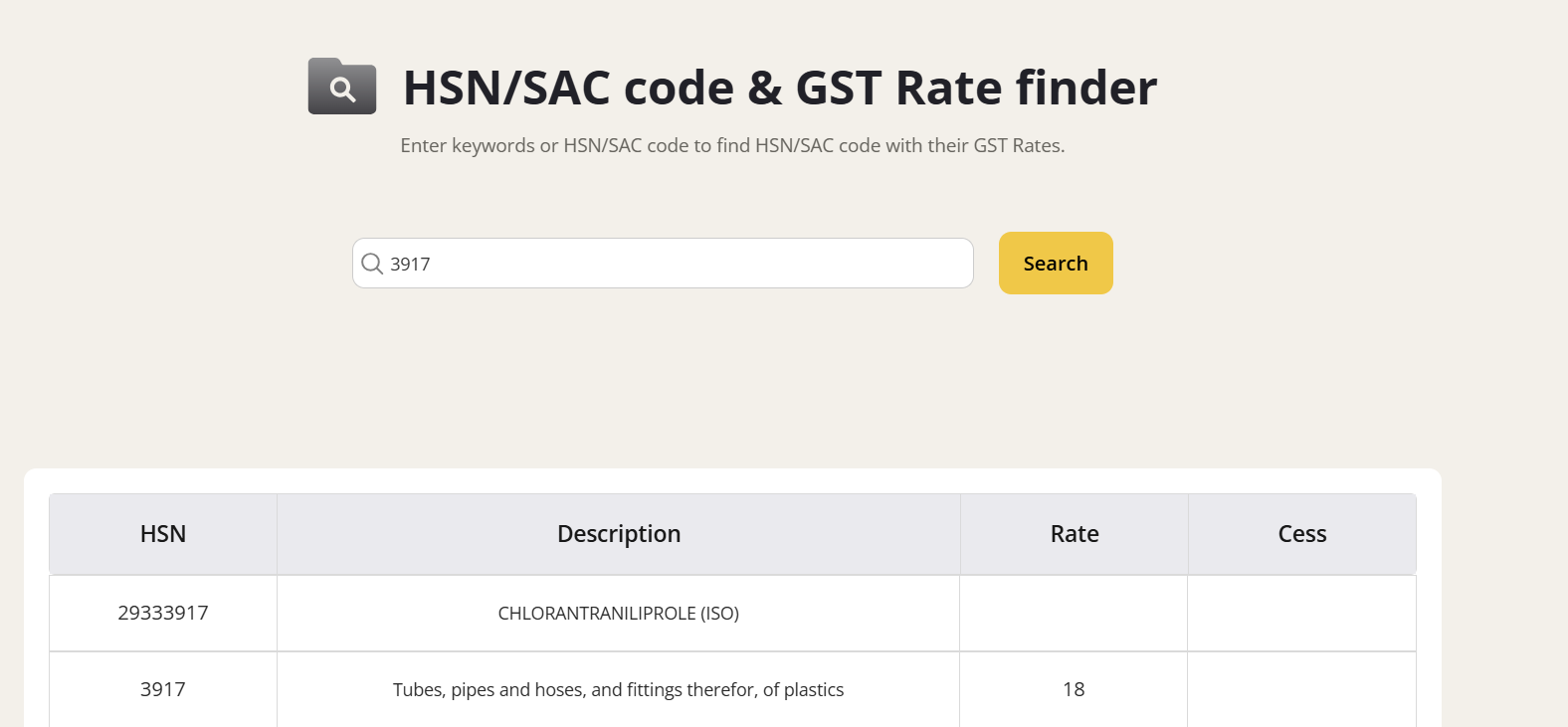
Explore More Check Gimbooks HSN/SAC code & GST Rate finder
PVC Pipe GST Billing: Practical Examples
Example 1: Intra-State Sale
A supplier sells PVC pipes to a GST-registered customer in the same state.
The invoice should show the taxable value and applicable CGST + SGST.
Example 2: Inter-State Sale
A supplier sells PVC pipes to a customer in another state.
The applicable GST is generally charged as IGST, subject to the transaction's place-of-supply rules.
Example 3: Retail Sale
A retailer sells PVC pipe to an end customer.
The invoice should contain the applicable product description, HSN information and tax details required for that transaction.
Example 4: Multiple Pipe Products
A distributor sells PVC, UPVC and different pipe fittings in the same order.
Each product should be mapped to its appropriate product classification rather than assigning one generic HSN to the entire order.
Common HSN Classification Mistakes for PVC Pipe Sellers
Using 3917 as the complete 8-digit code
3917 is the heading. It should not automatically be treated as the final tariff item where a more specific classification is required.
Copying an HSN code from another product
Two products that look similar may have different tariff classifications depending on their material or technical characteristics.
Using the wrong GST rate
Businesses should verify the current rate rather than relying on an old invoice, spreadsheet or supplier document.
Ignoring product description
The description on the invoice should accurately represent the product being supplied.
Using inconsistent HSN codes
The HSN used in invoices and GST reporting should be maintained consistently and accurately.
Not reviewing classification after a GST notification
GST rates and classification-related requirements can change. Businesses should periodically verify their product master.
How to Find the Correct HSN Code for a PVC Pipe
If you are unsure about a product's HSN classification, start with the product's exact description rather than searching only for the word “PVC.”
Check:
- Product material
- Product construction
- Intended use
- Pipe or hose type
- Whether it is a fitting or complete pipe
- Applicable tariff heading
- Current GST rate notification
GimBooks also provides an HSN/SAC Code & GST Rate Finder that can be used to search product/service classifications. The tool itself notes that its rates are indicative and recommends verifying the latest rate against the official GST source before filing.
How to Bill PVC Pipes With the Correct HSN Code
For a PVC pipe seller, the billing workflow should connect the product master with the correct HSN classification and GST rate.
A practical workflow is:
Create product → Add HSN → Select GST rate → Add quantity/unit → Generate invoice → Review tax details
This reduces the need to manually enter the classification every time a product is billed. Businesses can also add products with HSN codes and GST rates while setting up their product catalog, making the billing process easier and more consistent.
GimBooks allows businesses to add product details including HSN code, GST rate, unit, stock quantity and pricing when setting up products for billing.
Does HSN 3917 Matter for E-Invoicing?
For businesses that are required to generate e-invoices, product classification forms part of the invoice data submitted through the applicable e-invoicing system. That makes accurate product masters particularly important for businesses selling large numbers of SKUs.
If your business is subject to e-invoicing requirements, review the applicable rules and make sure product descriptions, HSN information and tax details are correctly maintained before you create e-invoices online.
Why Correct HSN Classification Matters for GST Reporting
HSN information is not only relevant to the invoice shown to the customer. Accurate product classification also helps businesses maintain consistent GST records and prepare their return-related information.
Businesses should reconcile:
- Product master
- Sales invoices
- HSN summary
- Tax amounts
- GST return data
This becomes particularly important when a business sells a large number of products under different HSN classifications. Keeping these details consistent also makes GSTR-1 and GST reporting easier to manage and review.
Conclusion
HSN Code 3917 standardizes GST rates and classification for PVC pipes and fittings in India. With a steady GST rate of 18% and clear ITC mechanisms, the updated tax regime simplifies compliance for manufacturers, traders, and users in 2025. Accurate HSN coding and robust invoice management remain key to claiming GST benefits.
Also check
 Vikash
 Vikash
 Vikash
FAQs
What is the HSN code for PVC pipes?
PVC pipes generally fall under HSN heading 3917, which covers tubes, pipes and hoses and specified fittings made of plastics. The exact tariff item should be verified based on the product.
What is the GST rate on PVC pipes?
Heading 3917 is currently listed at 18% GST in the CBIC GST rate schedule.
What is HSN code 3917?
HSN 3917 is the heading for tubes, pipes and hoses and fittings thereof made of plastics.
Is 3917 a 4-digit or 8-digit HSN code?
3917 is a 4-digit HSN heading. More specific classifications can extend to six and eight digits depending on the applicable tariff item.
What is the 8-digit HSN code for PVC pipe?
There is not one universal 8-digit code that should be assigned to every product described as a PVC pipe. The exact tariff item should be selected based on the product's classification and characteristics.
What is the HSN code for UPVC pipes?
UPVC pipe products fall within the plastic-pipe classification framework, but the exact tariff item should be verified based on the product specifications.
What is the HSN code for CPVC pipes?
CPVC pipe products should be classified according to the applicable tariff schedule and product characteristics rather than assuming a generic code.
Are PVC pipe fittings covered under HSN 3917?
Specified plastic pipe fittings such as joints, elbows and flanges are covered within heading 3917. The exact tariff item should still be verified for the product.
Is GST on PVC pipes 18%?
Heading 3917 is currently listed at 18% GST. Always verify the applicable rate against the latest official notification before invoicing.
How do I find the correct HSN code for a PVC pipe?
Check the exact product description, material, construction and applicable tariff classification. You can also use the GimBooks HSN/SAC Code & GST Rate Finder as a starting point, while verifying the current official rate before filing.