E-Way Bill After Delivery: Should You Close It Voluntarily?
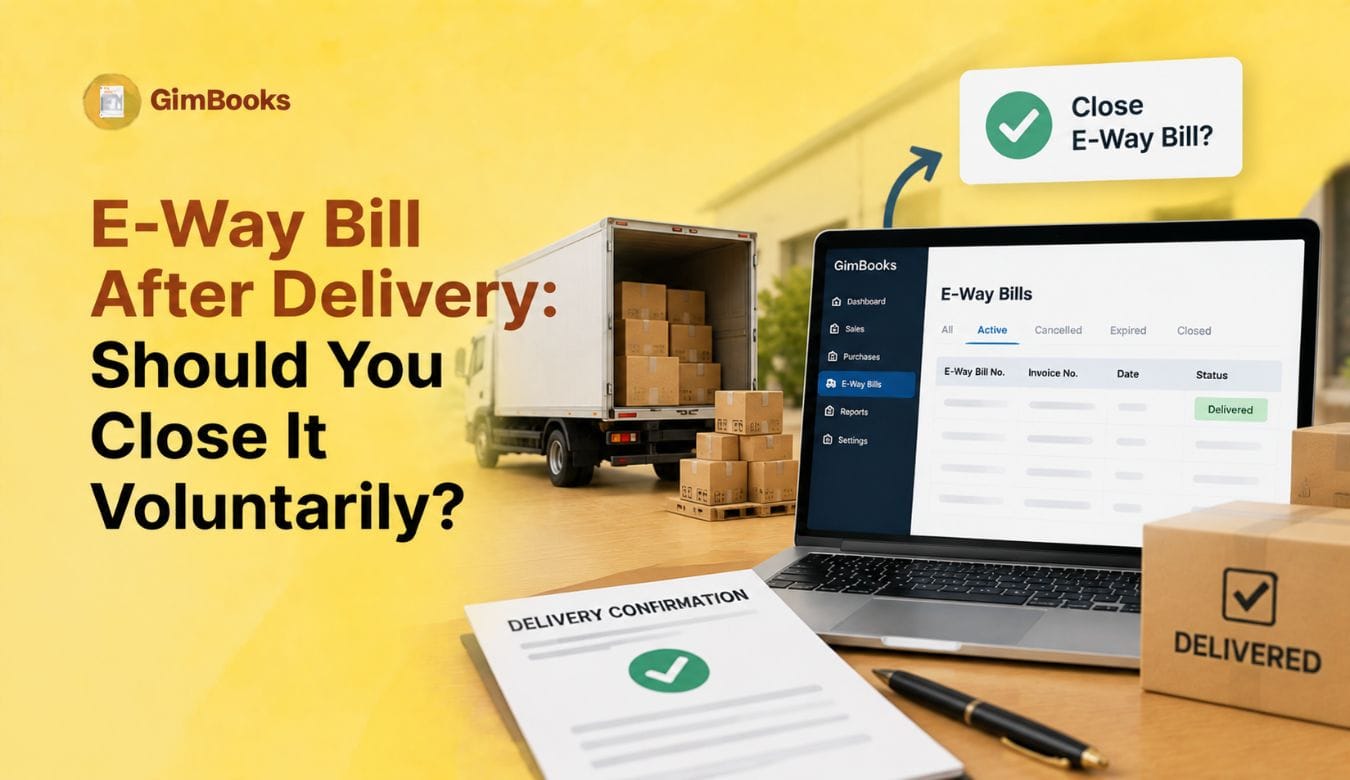
Once goods are delivered, most businesses assume the e-way bill process is complete. The goods have reached the buyer, the transporter has finished the movement, and the e-way bill will expire based on its validity period.
But with the proposed voluntary e-way bill closure facility, businesses started asking an important question: after delivery, should you close the e-way bill voluntarily?
The simple answer is: yes, it can be a useful control if the closure facility is available and your delivery is complete, but it is not mandatory.
However, there is an important latest update. GSTN had proposed the voluntary e-way bill closure facility as part of the 2026 e-way bill enhancements. Later reports stated that the proposed changes scheduled for 1 August 2026 were put on hold until further notice after industry feedback. So businesses should treat voluntary e-way bill closure as a readiness and process-control topic, not as a compulsory active requirement everywhere unless the facility is available on the portal or through their software.
This guide explains what voluntary EWB closure means, when it makes sense to close an e-way bill after delivery, when not to close it, what teams should check before closure and how businesses can manage e-way bill status more cleanly.
What Is Voluntary E-Way Bill Closure?
Voluntary e-way bill closure is a proposed facility that allows an eligible user to mark an e-way bill as closed after the delivery of goods is completed.
Earlier, an e-way bill generally remained active until its validity expired. There was no separate system action to confirm that the goods had actually reached the destination. The closure facility was proposed to record completion of goods movement in the system.
In simple terms:
Voluntary closure is different from e-way bill cancellation. Cancellation is used when the e-way bill should not continue because the movement did not happen or the details are wrong. Closure is used after delivery is completed.
For businesses managing dispatches regularly, this can improve e-way bill status management and reconciliation.
Is Closing an E-Way Bill After Delivery Mandatory?
No. The proposed facility is voluntary in nature.
That means businesses are not required to close every e-way bill after delivery just because the goods have reached the buyer. If the closure feature is available, it can be used as a good operational practice to record that movement is completed.
The decision should depend on your business process, delivery volume, transporter coordination and reconciliation needs.
The most practical approach is to close only those e-way bills where delivery is confirmed, documents are matched and there is no pending movement issue.
Latest 2026 Update: Current Status of Voluntary EWB Closure
GSTN issued advisory material in 2026 around two proposed e-way bill changes:
- Mandatory capture of Ship-to GSTIN in Bill-to/Ship-to transactions
- Voluntary closure of e-way bills after delivery
The voluntary closure feature was described as a system facility to record completion of movement after delivery. It was also described as voluntary, not mandatory.
However, later reports stated that the proposed e-way bill enhancements scheduled for 1 August 2026 were put on hold until further notice after industry feedback. This means businesses should check the current portal/software availability before changing their live process.
For now, the best approach is:
- Do not treat closure as compulsory unless officially enabled in your workflow.
- Prepare your internal SOP for future rollout.
- Keep delivery proof and e-way bill reconciliation clean.
- Train dispatch, accounts and logistics teams on when closure should happen.
- Configure billing or ERP systems only after confirming final implementation.
This helps businesses stay ready without creating unnecessary operational confusion.
E-Way Bill Closure vs Expiry vs Cancellation
A lot of confusion happens because teams use the words closure, expiry and cancellation interchangeably. They are not the same.
If goods are delivered successfully, voluntary closure may be useful. If goods did not move or the e-way bill has wrong details, cancellation or correction workflow may be more appropriate. If goods are delayed due to breakdown or route issues, validity extension may be needed instead of closure.
For delay-related cases, read GimBooks’ E-Way Bill Validity Extension for Vehicle Breakdown and Delivery Delays.
Should You Close an E-Way Bill After Delivery?
You should consider closing an e-way bill after delivery when the shipment is complete and your business wants a cleaner record of delivery completion.
Voluntary closure can be useful when:
The safest rule is simple: close only after actual delivery is confirmed and there is no pending movement issue.
Who Can Close an E-Way Bill?
As per the proposed voluntary closure guidance, closure may be done by parties involved in the movement, such as:
- Supplier
- Recipient
- Transporter
- Driver or authorised person, where a mobile number is provided for closure
For businesses, this means ownership should be clearly defined. If multiple people can close the e-way bill, there should be a rule on who is responsible.
Recommended ownership:
Without ownership, the same e-way bill may remain open because everyone assumes someone else will close it.
When Can an E-Way Bill Be Closed?
Under the proposed guidance, an e-way bill may be closed after delivery is completed. Closure is advised on the date of delivery or on the immediately succeeding day.
The closure facility was also described as available up to one day after the expiry of e-way bill validity, provided the closure date falls between the date of generation and the validity period.
Example:
This is why delivery date tracking becomes important. If the closure date is wrong, your movement record may not reflect the actual delivery.
What to Check Before Closing an E-Way Bill
Before closing an e-way bill after delivery, check whether the delivery is actually complete.
Use this checklist:
- Goods have reached the destination.
- Recipient or authorised person has confirmed receipt.
- Invoice or delivery challan details match the shipment.
- E-way bill number matches the goods movement.
- Vehicle or transporter details are correct.
- Quantity delivered matches the document.
- No short delivery is pending.
- No return-to-origin situation exists.
- No goods are still in transit.
- No e-way bill correction or cancellation issue is pending.
- Delivery proof is saved.
For goods movement documents, refer to GimBooks’ Delivery Challan Format and E-Way Bill Format.
Practical E-Way Bill Closure Workflow After Delivery
A simple closure workflow can help dispatch and finance teams avoid confusion.
Step 1: Confirm Delivery
The transporter, driver, warehouse or recipient should confirm that goods have reached the destination.
Delivery confirmation can come from:
- Goods receipt note
- Delivery acknowledgement
- Transporter proof
- Buyer confirmation
- Warehouse inward record
- Driver delivery update
- POD copy
Step 2: Match EWB with Invoice or Delivery Challan
Before closure, match the e-way bill with the source document.
Check:
If the movement was based on a delivery challan, ensure the challan is also closed or reconciled internally.
Step 3: Check Whether Any Issue Is Pending
Do not close the e-way bill if there is an unresolved issue.
Do not close if:
- Goods are damaged and return is expected.
- Quantity is short.
- Buyer has rejected delivery.
- Goods are unloaded at the wrong location.
- Transporter changed delivery status incorrectly.
- Invoice was cancelled.
- E-way bill details are incorrect.
- Movement did not actually happen.
In these cases, the accounts or logistics team should first decide whether cancellation, extension, credit note, debit note, delivery correction or return workflow is needed.
Step 4: Close EWB in Portal or Software
If closure is available and all checks are clear, close the e-way bill through the portal or supported software workflow.
The closure record should include:
- E-way bill number
- Closure date
- Delivery date
- Closure remarks
- User who closed it
- Transporter or driver confirmation, if applicable
- Internal reference document
If your system supports API-based closure, your software team should ensure that EWB number, closure date and remarks are passed correctly.
Step 5: Save Closure Record for Reconciliation
After closure, save the status in your internal system.
Maintain:
- Invoice number
- E-way bill number
- EWB generation date
- Delivery date
- Closure date
- Transporter name
- Vehicle number
- POD status
- Closure remarks
- User who closed
- Final status
This helps during audits, customer disputes, goods movement checks and reconciliation.
When You Should Not Close EWB After Delivery
Even if the feature is available, closing an e-way bill should not be automatic in every case.
Avoid closure when:
Closing too early can create a false record that delivery is complete when it is not.
E-Way Bill Closure for Partially Delivered Goods
Partial delivery cases need special care.
For example, if the e-way bill covers 100 units but only 80 units are delivered, the team should not close the EWB without reviewing the remaining 20 units.
Check:
- Was short delivery accepted by buyer?
- Will the balance goods be sent later?
- Is a separate document needed?
- Is there a return or damage case?
- Is transporter proof available?
- Does the invoice need correction?
- Should a credit note or debit note be issued?
Closure should happen only when the movement linked to that e-way bill is complete and the records are aligned.
E-Way Bill Closure for Returned Goods
If goods are returned after delivery, closure alone may not be enough.
Possible scenarios:
For invoice adjustment workflows, use GimBooks’ Credit Note Format and Debit Note Format, where relevant.
E-Way Bill Closure vs E-Way Bill Extension
If goods are delayed, closure is not the right action. You may need extension.
For delay cases, use GimBooks’ guide on E-Way Bill Validity Extension for Vehicle Breakdown and Delivery Delays.
E-Way Bill Closure in Bill-to/Ship-to Transactions
Bill-to/Ship-to transactions need extra care because the buyer and delivery party may be different.
Before closing the e-way bill, check:
- Bill-to GSTIN is correct.
- Ship-to GSTIN or URP is correct.
- Delivery happened at the actual Ship-to address.
- Transporter delivered goods to the correct consignee.
- Ship-to state and PIN code are correct.
- Delivery proof is available from the receiving location.
If your team faces Ship-to GSTIN issues, read GimBooks’ E-Way Bill Ship-to GSTIN Error: Causes and Fixes and How to Enter URP in Ship-to GSTIN for Unregistered Consignees.
E-Way Bill Closure for Consolidated E-Way Bills
If a transporter uses consolidated e-way bills, closure should be handled carefully.
The team should check:
- Which individual e-way bills are part of the consolidated movement?
- Have all consignments been delivered?
- Are some consignments still in transit?
- Is delivery completed for only one consignee or all consignments?
- Who is responsible for closure: transporter, supplier or recipient?
- Is date-wise closure safe for this batch?
For multiple consignments, refer to GimBooks’ How to Generate a Consolidated E-Way Bill for Multiple Consignments.
Benefits of Closing EWB After Delivery
Voluntary closure can help businesses maintain cleaner movement records.
For businesses generating many e-way bills daily, closure can become a useful status-management step.
Risks of Closing EWB Too Early
Closure should be controlled because early closure can create problems.
That is why businesses should close only after delivery is confirmed and supported by proper records.
E-Way Bill Status Management Report
Businesses should maintain an e-way bill status management report, especially if closure becomes part of the internal SOP.
This report can be reviewed daily by dispatch and weekly by finance.
How GimBooks Helps with E-Way Bill Status Management
E-way bill status management becomes difficult when dispatch teams use manual registers, transporter calls, WhatsApp updates and separate spreadsheets.
With GimBooks E-Way Bills, businesses can manage e-way bill workflows more systematically and reduce manual data-entry issues. GimBooks helps businesses keep billing, delivery documents and GST-ready records better organised.
With GimBooks GST billing software, businesses can manage invoices, customers, inventory, payments and GST records from one place.
This gives finance and dispatch teams better visibility over e-way bill generation, delivery status, movement records and reconciliation.
Practical Checklist: Should You Close EWB After Delivery?
Use this checklist before closing an e-way bill voluntarily:
- Confirm the voluntary closure facility is available in your portal/software.
- Confirm the goods have been delivered.
- Verify recipient or authorised person confirmation.
- Match invoice or delivery challan with the e-way bill.
- Check quantity, item and delivery address.
- Confirm there is no short delivery.
- Confirm there is no buyer rejection.
- Confirm there is no return movement pending.
- Check transporter/driver delivery proof.
- Enter the correct closure date.
- Add clear closure remarks.
- Save closure status in internal records.
- Reconcile EWB, invoice and delivery proof.
Conclusion
Closing an e-way bill after delivery can be a useful practice, but it should be done carefully and only when the voluntary closure facility is available and the goods have actually been delivered.
As per the proposed 2026 update, voluntary EWB closure was intended to record completion of goods movement after delivery. However, the proposed 1 August 2026 e-way bill enhancements were later put on hold until further notice. Businesses should therefore prepare their SOPs and software workflows, but avoid treating closure as a mandatory live requirement unless the facility is officially available in their system.
The best approach is to maintain clean e-way bill status management: generate the EWB correctly, track movement, confirm delivery, save proof, close voluntarily where appropriate, and reconcile records with invoices and delivery documents.
For traders, wholesalers, manufacturers, distributors and logistics teams, the goal is simple: every e-way bill should have a clear final status, whether delivered, closed, expired, cancelled, extended or under review.
FAQs
Should I close an e-way bill after delivery?
If the voluntary closure facility is available and goods are fully delivered, closing the e-way bill can be useful for status management and audit trail. However, closure is voluntary and should not be done before delivery is confirmed.
Is voluntary e-way bill closure mandatory?
No. The proposed e-way bill closure facility is voluntary. It is meant to record completion of goods movement after delivery.
Is the 2026 e-way bill closure facility live?
GSTN had proposed the voluntary e-way bill closure facility as part of the 2026 changes, but later reports said the proposed 1 August 2026 enhancements were put on hold until further notice. Businesses should check current portal/software availability before using it.
Who can close an e-way bill after delivery?
Under the proposed guidance, an e-way bill may be closed by the supplier, recipient, transporter or driver/authorised person whose mobile number is provided for closure.
When should an e-way bill be closed?
It should be closed only after delivery of goods is completed. The proposed guidance advised closure on the date of delivery or the immediately succeeding day.
Can I close an e-way bill if goods are partially delivered?
It is better not to close until the movement linked to that e-way bill is fully resolved. Partial delivery should be reviewed before closure.
What is the difference between EWB closure and EWB cancellation?
Closure records that delivery is complete. Cancellation is used when the e-way bill is wrong, movement did not happen or the document should not remain active.
Can an expired e-way bill be closed?
Under the proposed FAQ example, closure functionality was described as available up to one day after expiry, provided the closure date falls within the generation-to-validity period. Businesses should verify final portal behaviour once the facility is live.
How can billing software help with EWB status management?
Billing software can help by tracking e-way bill numbers, delivery status, validity, transporter details, closure status, exceptions and reconciliation with invoices or delivery challans.