
E-Invoice HSN Error Checklist for Product Masters
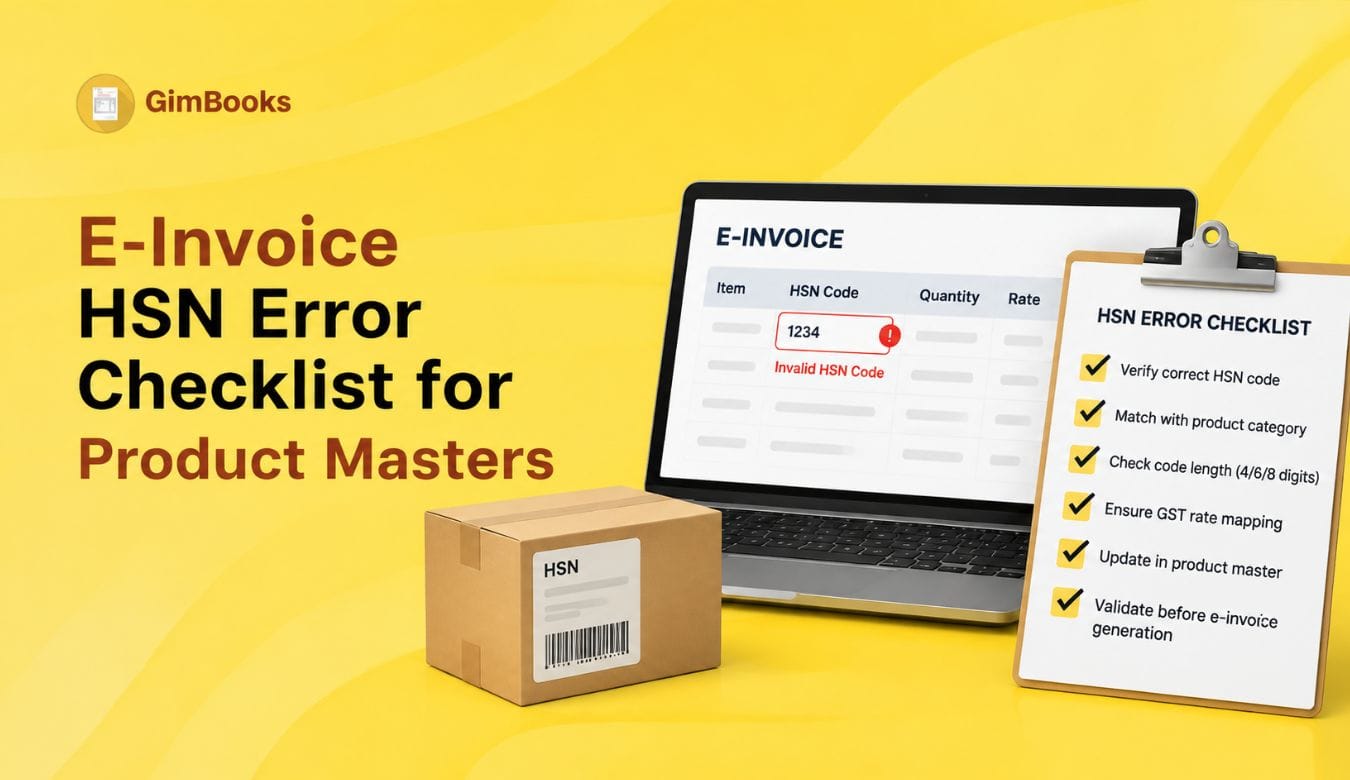
E-invoice HSN errors usually appear at the time of IRN generation, but the problem often starts much earlier inside the product master. If the item master has the wrong HSN, incomplete HSN, wrong SAC, incorrect GST rate or invalid unit code, the Invoice Registration Portal may reject the e-invoice.
For businesses that create invoices in bulk, sell many SKUs or manage products across branches, one wrong product master entry can create repeated e-invoice failures. This can delay IRN generation, dispatch, e-way bill creation, customer billing and GST reporting.
That is why every business should maintain an e-invoice HSN error checklist for product masters. Instead of fixing the same error again and again at invoice level, finance teams should fix the source data inside the product master.
This guide explains how to fix e-invoice HSN errors, what product master fields to check, how to handle HSN/SAC mismatch, and how billing software can reduce IRP validation errors before invoices are reported.
What Is an E-Invoice HSN Error?
An e-invoice HSN error occurs when the HSN or SAC code passed in the e-invoice data is incorrect, invalid, incomplete or not aligned with the item type.
In simple terms, the IRP is saying:
“The HSN or SAC code used in this invoice line item is not valid or does not match the expected master data. Please correct the item details before generating IRN.”
This error can appear for goods, services, stock items, service items, product groups, imported items, newly added SKUs or bulk-uploaded invoice data.
Common error scenarios include:
- Invalid HSN code
- Missing HSN/SAC code
- Four-digit HSN used where six-digit HSN is required
- HSN entered for a service item instead of SAC
- SAC entered for a goods item
- Wrong HSN mapped to product group
- Product master has old or inactive HSN
- Wrong GST rate mapped with the HSN
- Incorrect UQC or unit code used with the item
- Bulk import file contains incomplete HSN data
For a broader list of IRP rejection messages, refer to GimBooks’ E-Invoice Error Codes and Fixes.
Why Product Masters Cause E-Invoice HSN Errors
Most businesses focus on the invoice screen when an e-invoice fails. But in many cases, the invoice is only pulling data from the product master.
If the product master is wrong, every invoice using that product can fail.
For example:
A clean product master helps the billing team generate invoices faster and reduces repeated IRP validation errors.
Maintaining accurate product and invoice details is also important because GST invoices must contain all mandatory information required for compliance. Businesses can review the GST invoice mandatory fields checklist to ensure invoice data is complete before reporting it through the IRP.
Common E-Invoice HSN Errors and Quick Fixes
Product Master Fields to Check Before IRN Generation
A product master should not only store item name and price. For e-invoicing, it should contain complete GST and classification details.
A product master with these fields is easier to validate before invoices reach the IRP.
HSN vs SAC: The Most Common Product Master Mistake
One of the most common causes of e-invoice HSN errors is confusing HSN and SAC.
HSN is used for goods. SAC is used for services.
If a service item is created as a stock item and an HSN is used incorrectly, the invoice may fail validation or create GST reporting issues. Similarly, a goods item should not be mapped using a SAC code just because the internal product description says “service kit” or “support item.”
For mandatory invoice field checks, refer to GimBooks’ GST Invoice Mandatory Fields Audit Checklist.
HSN Digit Requirement to Check in Product Masters
Businesses should also check whether the product master has the correct number of HSN/SAC digits.
For GST taxpayers with turnover above ₹5 crore in the preceding financial year, six-digit HSN/SAC reporting is mandatory on invoices. Taxpayers up to ₹5 crore are required to furnish four-digit HSN on B2B invoices.
For e-invoicing, businesses above the applicable threshold should avoid keeping only short or incomplete HSN codes in their product master. If a valid six-digit HSN is not available for a product, businesses should use a valid eight-digit code instead of artificially creating a six-digit code.
This is especially important for manufacturers, wholesalers and distributors with large SKU lists.
Step 1: Identify the Failed Product Line
When an e-invoice fails due to HSN, do not only check the invoice header. Open the failed invoice and identify the exact line item causing the error.
Check:
- Invoice number
- Failed line item
- Product name
- Product code/SKU
- HSN/SAC passed to IRP
- Item type: goods or service
- GST rate
- Quantity and UQC
- Product group/category
- Whether the item came from manual entry or product master
This helps the team fix the product master instead of only editing one invoice.
Step 2: Check Whether the Item Is Goods or Service
Before changing the HSN/SAC code, confirm the item type.
Ask:
- Is this a physical product?
- Is this a service?
- Is it a repair/service charge?
- Is it a software or subscription service?
- Is it an accessory or spare part?
- Is it part of a bundled product?
- Is it wrongly created as stock item or service item?
A wrong item type can lead to repeated HSN/SAC errors.
For example:
Step 3: Validate HSN/SAC Before Updating the Product Master
Once you identify the product line, verify the correct HSN or SAC. Do not guess based on similar items.
Check:
- Product description
- Product category
- Supplier invoice HSN
- Previous GST returns
- GST rate schedule
- Internal tax team or CA review
- Valid HSN/SAC master
- Whether the code is goods HSN or service SAC
After confirmation, update the product master and regenerate the e-invoice.
Step 4: Check GST Rate Along with HSN
Fixing only the HSN is not enough. The GST rate mapped with the product should also be reviewed.
Wrong HSN can lead to wrong GST rate, and wrong GST rate can cause invoice-level validation or reconciliation issues.
For GST calculation and invoice field checks, businesses can also use GimBooks GST billing software to manage product and invoice data in a more structured way.
Step 5: Review UQC and Unit Mapping
HSN errors are often found together with unit code errors. If the product master uses internal units such as “packet,” “box,” “bundle” or “piece,” the billing software should map them correctly to valid UQC values used in e-invoice reporting.
Incorrect unit mapping may create a separate IRP validation error even after the HSN is fixed.
Step 6: Clean Product Groups and Item-Level Overrides
Many billing systems allow HSN and GST rate to be set at the product group level. This is useful, but it can cause errors if all items in the group do not share the same HSN or tax rate.
For example, a group named “Electrical Items” may contain wires, switches, lighting fixtures, LED products and spare parts. These may not always share the same HSN.
Check whether:
- Product group HSN is applied automatically
- Item-level HSN is blank
- Item-level HSN overrides group HSN
- Old group HSN is copied to new products
- GST rate is inherited incorrectly
- Different products are grouped too broadly
A safer structure is:
Step 7: Fix Bulk Import and API Mapping Errors
If your business imports products through Excel, CSV or API, HSN errors can happen during upload.
Common import mistakes include:
- HSN column left blank
- HSN stored as number and leading zeros removed
- HSN copied incorrectly
- SAC entered in HSN column
- GST rate column does not match HSN
- Item type column missing
- Old item master overwritten
- Product category mapped wrongly
- UQC column missing
- Import file has duplicate items with different HSNs
Before importing product masters, check this table:
For bulk invoice workflows, refer to Month-End Bulk E-Invoice Generation Without Missing the 30-Day Limit.
Step 8: Create a Product Master HSN Review Process
A one-time cleanup is not enough. Product masters should be reviewed regularly, especially when new items are added.
Create a simple review workflow:
- Sales or purchase team requests a new product item.
- Product details are added with SKU, category and description.
- Accounts team adds HSN/SAC and GST rate.
- Tax reviewer checks classification for high-value or complex products.
- Item is approved for billing.
- Product is locked for invoice use.
- HSN/SAC changes are tracked in an audit log.
This prevents random users from creating products with incomplete HSN details.
Step 9: Maintain an HSN Error Register
Finance teams should maintain a small HSN error register to identify repeated product master issues.
This helps manufacturers, wholesalers and distributors reduce recurring HSN validation IRP errors.
Step 10: Validate Product Master Before IRN Generation
The best time to catch an HSN error is before the invoice reaches the IRP.
Before generating IRN, run a product master validation check:
This pre-check can reduce invoice rejections and save time during dispatch or month-end reporting.
Product Master HSN Error Checklist
Use this checklist when reviewing product masters for e-invoice readiness:
- Check all active products have valid HSN or SAC.
- Confirm goods are mapped with HSN and services with SAC.
- Maintain minimum six-digit HSN/SAC where applicable.
- Use valid eight-digit HSN where a valid six-digit code is not available.
- Do not artificially create HSN codes.
- Review GST rate mapped with each product.
- Check UQC or unit mapping for every item.
- Avoid broad product groups with one HSN for different products.
- Review imported product master files before upload.
- Check whether leading zeros are getting removed in Excel.
- Maintain separate records for taxable, exempt and nil-rated items.
- Keep an approval workflow for new product creation.
- Track HSN changes in an audit log.
- Review failed invoices and correct the product master.
- Validate product data before IRN generation.
How GimBooks Helps Reduce E-Invoice HSN Errors
Manual product master management can become difficult when a business handles hundreds or thousands of items. One wrong product entry can create repeated e-invoice errors across multiple invoices.
With GimBooks e-invoicing software, businesses can manage GST invoices and e-invoice workflows in a more organised way. GimBooks helps teams maintain better invoice records, validate billing information and reduce manual correction work before IRN generation.
Businesses can also improve invoice accuracy by understanding how GST billing software helps businesses manage billing data, tax calculations and compliance requirements.
Businesses can also use GimBooks GST billing software to manage products, customers, invoices, inventory, payments and GST reports from one place.
For product-based businesses, clean product masters help improve invoice accuracy, reduce HSN code invoice errors and make GST reporting smoother.
Related Internal Resources
To improve e-invoice accuracy further, read these related guides:
- E-Invoice Error Codes and Fixes
- GST Invoice Mandatory Fields Audit Checklist
- How to Fix E-Invoice PIN Code and State Code Validation Errors
- E-Invoice Cut-Off Control Sheet for ₹10 Crore+ Businesses
- Month-End Bulk E-Invoice Generation Without Missing the 30-Day Limit
Conclusion
E-invoice HSN errors are usually not just invoice-level mistakes. They are often product master issues. If the item master contains wrong HSN, wrong SAC, incorrect GST rate, invalid UQC or broad product group mapping, the same error can keep appearing in multiple invoices.
To fix e-invoice HSN errors, businesses should identify the failed product line, confirm whether the item is goods or service, validate HSN/SAC, update the product master, review GST rate and UQC mapping, and add a product master approval process.
A clean product master reduces IRP validation errors, improves billing accuracy and helps finance teams generate e-invoices without repeated manual corrections.
FAQs
What is an e-invoice HSN error?
An e-invoice HSN error occurs when the HSN or SAC code passed in the e-invoice data is invalid, missing, incomplete or not aligned with the item type.
What is error code 2176 in e-invoicing?
Error code 2176 means the HSN code passed in the e-invoice data is invalid. The business should check the HSN code and correct the product master before retrying IRN generation.
Why does an invalid HSN error happen?
Invalid HSN errors happen because of wrong HSN entry, incomplete HSN, wrong item type, outdated product master, SAC used for goods, HSN used for services or incorrect bulk upload data.
How do I fix an HSN error in e-invoice?
Identify the failed line item, verify the correct HSN or SAC, update the product master, check GST rate and UQC, and then regenerate the e-invoice.
Is six-digit HSN mandatory for e-invoices?
Businesses with turnover above ₹5 crore should maintain minimum six-digit valid HSN/SAC on invoices. For e-invoicing, such businesses should avoid short or incomplete HSN codes in their product master.
What is the difference between HSN and SAC?
HSN is used for goods. SAC is used for services. A goods item should use HSN, while a service item should use SAC.
Can product master mistakes cause repeated e-invoice errors?
Yes. If the wrong HSN or GST rate is saved in the product master, every invoice using that product may fail until the master data is corrected.
How can billing software prevent HSN errors?
Billing software can prevent HSN errors by validating product master fields, item type, HSN/SAC, GST rate, UQC and tax settings before sending invoice data to the IRP.