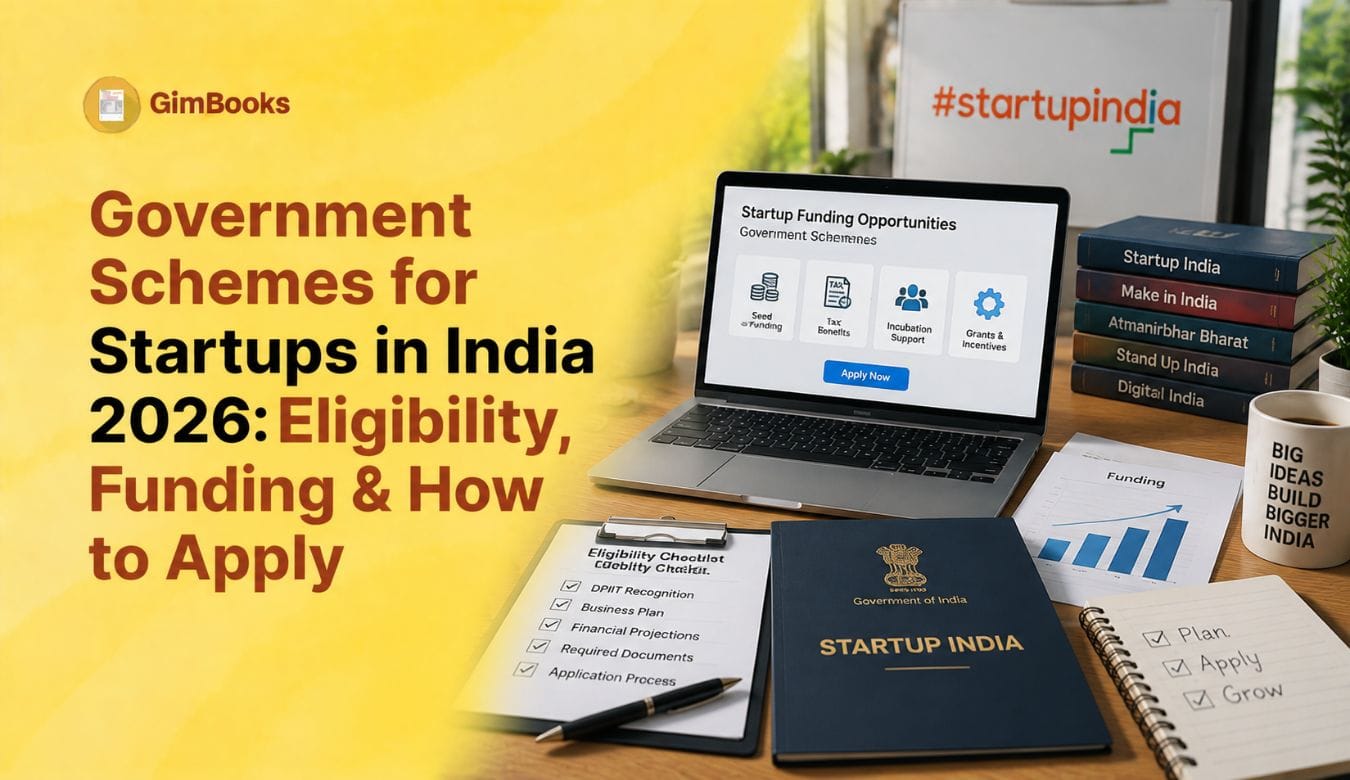
Government Schemes for Startups in India 2026: Eligibility, Funding & How to Apply
Starting a business in India involves more than developing a product or finding customers. Startups may need funding for product development, working capital, technology, hiring, intellectual property, market expansion and other business requirements.
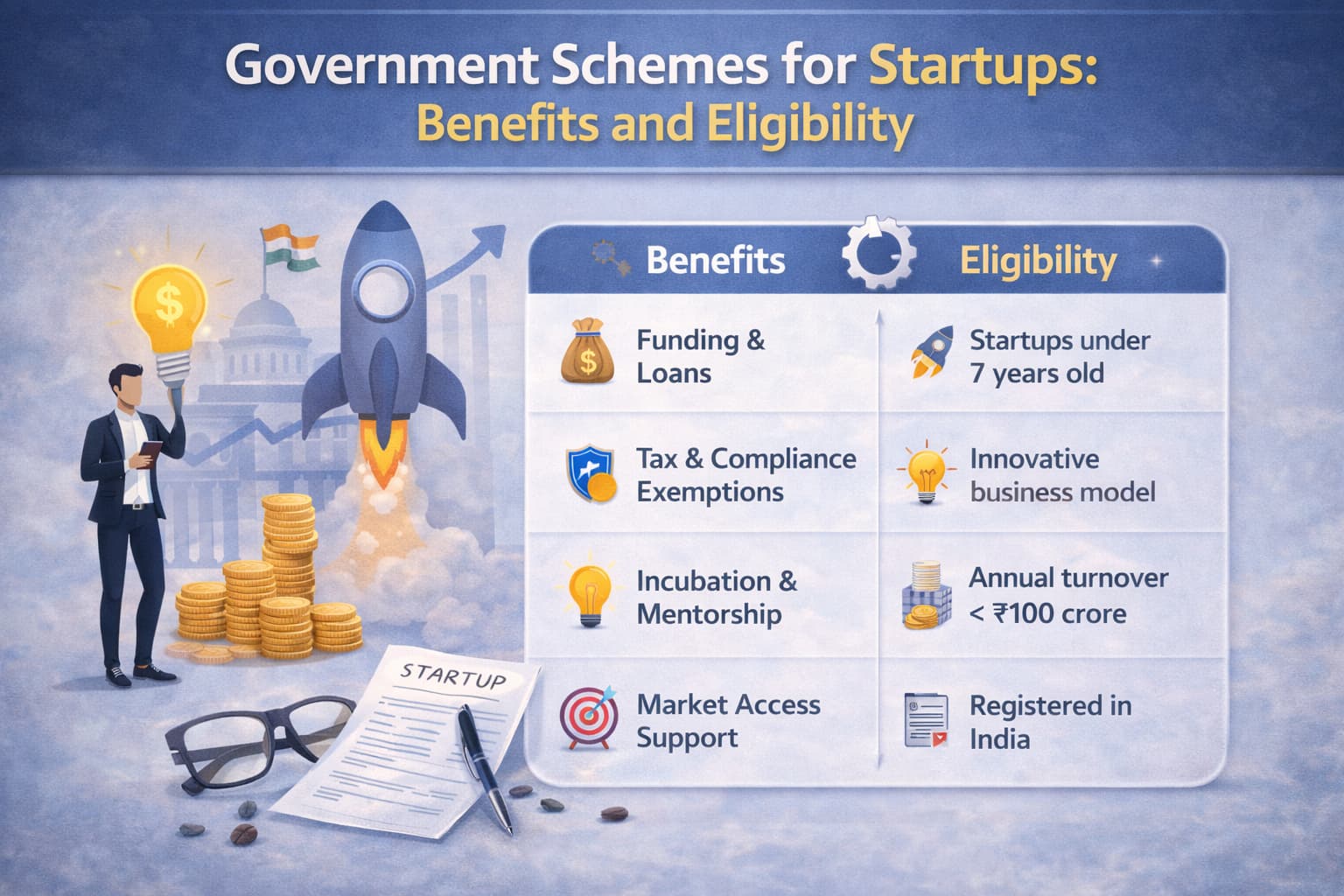
The Government of India and state governments offer different schemes and support programs for startups, entrepreneurs and eligible small businesses. Depending on the program, support may be available through seed funding, loans, credit guarantees, tax benefits, incubation, intellectual-property assistance, market access or sector-specific programs.
However, not every scheme is designed for every startup. Eligibility can depend on factors such as the age and legal structure of the business, DPIIT recognition, industry, location, stage of development and the purpose for which funding or support is required.
In this guide, we cover important government schemes and startup-support programs relevant to businesses in India in 2026, along with the type of support they provide, who they may be suitable for, the documents generally required and how to identify the right scheme for your business.
Because government schemes and eligibility conditions can change, always verify the latest requirements on the relevant official government portal before applying.
What Are Government Schemes for Startups?
Government startup schemes are programs introduced by central or state government bodies to support entrepreneurship, innovation, business development and access to finance.
Depending on the program, support can include:
- Seed funding or grants
- Loans and credit support
- Credit guarantees
- Equity-investment support
- Tax benefits
- Incubation and mentoring
- Intellectual-property support
- Technology development
- Government procurement and market access
- Sector-specific assistance
A startup should not assume that every government scheme provides direct cash funding. Some programs provide funding through incubators, lenders or investment funds, while others provide tax, credit, technology or market-access support.
For example, Startup India Fund of Funds 2.0 works through venture funds rather than providing direct investment to individual startups. The 2026 program has a ₹10,000 crore corpus and focuses on channeling capital into venture funds supporting startups.
Government Schemes for Startups in India: Quick Comparison
The exact eligibility, funding structure and application process differ by scheme. Always check the current scheme guidelines before applying.
Central Government Schemes for Startups: Key Programs You Should Know
The central government schemes for startups are available across India. Different ministries and departments manage these. Let us look at some important ones.
Major Government Schemes for Startups in India
Different government programs address different startup needs. Instead of looking only at the funding amount, founders should first identify whether they need seed capital, debt, equity investment, tax support, incubation, technology assistance or market access.
1. Startup India and DPIIT Recognition
Startup India is a broader government initiative that provides a framework for supporting eligible startups through recognition, policy benefits and access to various programs.
DPIIT recognition is important because several startup-specific benefits and schemes have their own eligibility requirements linked to recognised startups.
For a detailed explanation of Startup India, its recognition process, benefits and eligibility, see the dedicated Startup India Scheme guide.
Do not treat DPIIT recognition as the same thing as company incorporation. A business can first be legally incorporated and may then need to apply separately for DPIIT recognition if it wants to access benefits for which recognition is required.
2. Startup India Seed Fund Scheme
The Startup India Seed Fund Scheme is designed to support eligible early-stage startups during activities such as proof of concept, prototype development, product trials and market entry.
The important questions for founders are:
- Is the startup eligible?
- Is the business at the right stage?
- What type of expenditure can the support be used for?
- Which incubator handles the application?
- What documents are required?
Rather than treating seed funding as a generic startup loan, founders should understand the specific structure and conditions of the scheme before applying.
3. Startup India Fund of Funds 2.0
Startup India Fund of Funds 2.0 is different from a conventional government grant.
The government channels capital into venture funds, which can then invest in eligible startups. The 2026 Startup India playbook states that the program has a ₹10,000 crore corpus and is intended to increase investment into emerging businesses, including priority areas such as deep technology and innovative manufacturing.
For founders, the important distinction is:
You do not apply to the government for a direct Fund of Funds 2.0 payout.
The investment route works through participating investment funds.
4. Credit Guarantee Scheme for Startups
The Credit Guarantee Scheme for Startups supports access to debt by providing guarantee coverage to eligible lenders for qualifying loans to eligible startups.
This is different from a grant because the startup still has a borrowing and repayment obligation.
The scheme can be relevant for businesses that have moved beyond the initial idea stage and require debt financing for activities such as working capital or expansion, subject to the applicable eligibility and lending conditions.
Before applying, check:
- Startup eligibility
- Eligible lending institutions
- Debt limits
- Guarantee coverage
- Borrower contribution requirements
- Repayment terms
5. Section 80-IAC Tax Benefit
Eligible startups may be able to claim a deduction under Section 80-IAC, subject to the applicable requirements.
This should not be presented as an automatic tax exemption for every startup.
Eligibility depends on conditions such as the entity's recognition status, incorporation period, business activity and other requirements applicable to the deduction.
Founders should verify their eligibility and the current tax rules before claiming the benefit.
6. Startup Intellectual Property Support
Startups developing proprietary technology, products or processes may also find government support related to intellectual property.
The Startup India ecosystem includes programs such as the Startup Intellectual Property Protection (SIPP) framework, which is intended to make patent and trademark processes more accessible to eligible startups.
This can be particularly relevant for technology, deep-tech, manufacturing and product startups.
Which Government Scheme Is Right for Your Startup?
The right government program depends on what your business needs rather than simply which scheme offers the highest funding amount.
If You Need Seed Funding
Look at early-stage programs such as the Startup India Seed Fund Scheme and relevant incubation programs.
If You Need a Business Loan
Explore startup credit support and broader MSME financing options.
If your business is classified as an MSME, you can also explore the MSME business loan for an overview of business-loan requirements, documentation and financing options.
If You Need Venture Capital
Programs such as Startup India Fund of Funds 2.0 work through investment funds rather than providing a direct government loan.
If You Need Tax Benefits
Check whether your startup meets the conditions for benefits such as the Section 80-IAC deduction.
If You Need Incubation or Mentoring
Look at government-supported incubators and programs designed around innovation, product development and entrepreneurship.
If You Need Intellectual-Property Support
Explore programs that assist eligible startups with patent and trademark processes.
If You Need Sector-Specific Support
Look for programs focused on areas such as biotechnology, agriculture, defence, manufacturing, deep technology and other priority sectors.
Government Schemes Based on Your Startup Stage
Not every startup needs the same type of government support. Your stage of development can help narrow down the programs worth investigating.
Idea Stage
At the idea stage, founders may benefit more from:
- Incubation
- Mentoring
- Innovation programs
- Prototype-development support
Prototype or Proof-of-Concept Stage
At this stage, look for programs that support:
- Prototype development
- Product validation
- Technology development
- Testing and trials
Early Revenue Stage
Once the business has customers and revenue, relevant requirements may shift toward:
- Working capital
- Business loans
- Credit guarantees
- Market access
- Business expansion
Growth Stage
Growth-stage startups may explore:
- Equity investment
- Venture capital
- Fund-based investment
- Expansion financing
- Government procurement opportunities
The most suitable option depends on the startup's eligibility, sector, financial position and intended use of funds.
Government Support for Different Types of Startups
Government support is also available through programs aimed at specific industries and innovation areas.
Deep-Tech Startups
Deep-tech businesses should look for programs supporting technology development, research, innovation and venture investment. Startup India Fund of Funds 2.0 specifically identifies deep technology among its priority areas.
Manufacturing Startups
Manufacturing startups may need a combination of technology, capital, market-access and innovation support. Check central and state programs applicable to your industry and location.
Agritech Startups
Agritech businesses can explore agriculture-focused startup programs and funding initiatives alongside general startup-support schemes.
Biotechnology Startups
Biotech businesses should examine programs operated through organisations such as BIRAC, particularly where funding or incubation is linked to technology development.
Defence Startups
Defence and dual-use technology businesses can investigate innovation programs such as iDEX and related government initiatives.
Women-Led Startups
Women entrepreneurs should check both startup-specific programs and broader entrepreneurship or MSME schemes that have dedicated provisions for women-owned businesses.
Eligibility varies significantly between programs, so founders should verify the current scheme guidelines rather than assuming that a business qualifies solely because it belongs to a particular category.
State Government Schemes for Startups in India
Central government programs are only one part of India's startup-support ecosystem. Individual states and union territories may have their own startup policies, incentives, incubators and entrepreneurship programs.
Depending on the state, support may include:
- Incubation
- Grants or financial assistance
- Patent-cost support
- Mentoring
- Infrastructure support
- Startup events and market access
- Sector-specific incentives
Before applying for a state startup benefit, check:
- Whether the startup must be incorporated in the state.
- Whether the founder must be a resident of the state.
- Whether DPIIT recognition is required.
- Whether the scheme has a specific sector requirement.
- Whether applications are currently open.
- Which government department or portal accepts applications.
Startup India also maintains information on startup policies across states and union territories.
Examples of State Startup Ecosystems
Maharashtra: Check the current state startup policy and programs for innovation, incubation and entrepreneurship.
Karnataka: Review the current state programs for technology, innovation and startup development.
Telangana: Check state-backed startup and innovation initiatives and their current eligibility.
Gujarat: Review current state startup and entrepreneurship programs.
Tamil Nadu: Check the state's current startup policy and support programs.
Kerala: Review programs operated through the state's startup ecosystem.
Because state policies can be revised independently, avoid relying on old funding amounts or application deadlines. Always verify the current notification before applying.
Government Grant vs Loan vs Equity Funding: What's the Difference?
The term "government funding" can refer to several different forms of financial support.
Understanding this difference is important before applying. A startup looking for a grant should not automatically apply for a loan scheme, and an established business seeking working capital may have different financing requirements from a startup developing a prototype.
Government Schemes for Business Startup: Common Benefits
Across different programs, most government schemes for business startups offer similar types of support.
Here are the common benefits:
1. Tax Benefits
Recognized startups can apply for tax exemption for three consecutive years under certain conditions.
2. Easier Compliance
Startups can self-certify under some labor and environmental laws. This reduces paperwork and saves time.
3. Funding and Grants
Many schemes provide grants, seed funding, and loan support.
4. Patent and IPR Support
Startups get fast-track patent examination and reduced filing fees.
5. Incubation and Mentorship
Government-supported incubators help startups with:
- Office space
- Mentoring
- Networking
- Market access
All Government Startup Schemes for Eligibility Criteria
Understanding all government startup schemes' eligibility criteria is very important before applying.
Though each scheme is different, most require:
- Legal registration as a company, LLP, or partnership.
- Business age is less than 10 years.
- Turnover below the prescribed limit.
- Focus on innovation or improvement.
- Not formed by splitting an existing business.
For funding schemes, you may also need:
- Business plan.
- Prototype or proof of concept.
- Recommendation from an incubator.
Always check the official scheme guidelines before applying.
Upcoming Government Schemes for Startups: What to Expect
The government keeps updating policies and launching upcoming government schemes for startups. These may include:
- More sector-focused funding.
- Green and climate-focused startup support.
- Digital and AI-based startup programs.
- Special schemes for women and rural entrepreneurs.
Keeping track of new announcements can help you apply early and gain an advantage.
How to Apply for Government Schemes for Startups
The application process depends on the individual scheme, but founders can use the following framework to identify and prepare for the right program.
Step 1: Identify Your Business Stage
Determine whether your startup is at the idea, prototype, early-revenue or growth stage.
Step 2: Check the Eligibility Criteria
Review the scheme's requirements for:
- Entity type
- Incorporation date
- Turnover
- Sector
- Location
- DPIIT recognition
- Founder eligibility
- Intended use of funds
Step 3: Identify the Type of Support You Need
Decide whether you need:
- Grant or seed support
- Loan
- Credit guarantee
- Equity investment
- Tax benefit
- Incubation
- IP support
Step 4: Prepare Your Business Information
Keep your incorporation documents, business information, financial records and supporting documents organised.
Step 5: Prepare the Required Proposal
Depending on the scheme, this may include a business plan, pitch deck, project report, prototype information, financial projections or other supporting documents.
Step 6: Apply Through the Correct Portal or Institution
Some programs accept applications through government portals, while others operate through incubators, lenders, investment funds or designated institutions.
Step 7: Track the Application
Keep a record of your application, submitted documents and any follow-up requirements.
Do not assume that applying to one government program automatically makes a startup eligible for another. Each scheme has its own rules and approval process.
Documents Required for Government Startup Schemes
The exact document list varies by scheme, but founders should generally keep the following information organised:
- Certificate of incorporation or business registration
- PAN
- Business address proof
- Bank account details
- DPIIT recognition certificate, where required
- GST registration details, where applicable
- Business plan
- Pitch deck
- Project report
- Financial statements, where applicable
- Income and expense records
- Bank statements
- Founder or promoter KYC documents
- Proof of intellectual property, where relevant
- Technology or prototype information, where relevant
Before submitting an application, compare your documents against the latest checklist published by the scheme's official authority.
Keeping invoices, expenses and business transactions organised can also make it easier to prepare financial information when it is required for business planning or documentation.
Common Mistakes to Avoid
- Applying without eligibility check
- Poor financial documentation
- Weak business plan
- Missing deadlines
- Not tracking application status
How GimBooks Can Help Startups Maintain Business Records
Government schemes have their own eligibility and approval processes, but startups still need organised business information for day-to-day financial management and, where applicable, documentation.
GimBooks can help small businesses manage key records through:
- GST-ready invoicing
- Income and expense tracking
- Business transaction records
- Payment tracking
- Accounting and bookkeeping workflows
- Inventory records
- Digital business documents
For a startup preparing financial information, maintaining accurate records from the beginning can make routine business administration more organised.
For example, businesses can use GimBooks to manage their business expenses, maintain inventory records and create GST-compliant invoices.
GimBooks does not determine eligibility or approval for government schemes. Founders should always follow the requirements and application process specified by the relevant government authority.
Conclusion
Government support for startups in India is not limited to direct funding. Depending on the business stage and eligibility, startups may find support through seed funding, loans, credit guarantees, tax benefits, incubation, intellectual-property assistance, venture investment and sector-specific programs.
The right scheme depends on factors such as:
- Business stage
- Entity structure
- Incorporation date
- Turnover
- Industry
- Location
- DPIIT recognition
- Funding requirement
- Intended use of funds
Before applying, verify the latest eligibility criteria, funding structure, documents, application process and deadlines through the official scheme authority.
Startups should also maintain organised business records from the beginning. Accurate invoices, expenses, payments, inventory and accounting information can make everyday financial management easier and help businesses keep their documentation in order.
For businesses looking to streamline these processes, GimBooks provides tools for GST invoicing, bookkeeping, accounting, expenses, payments and inventory management.
Explore More
How to Start an Export Business in India
How to Start a Pharmaceutical Company
Frequently Asked Questions
What are the government schemes available for startups in India?
Government startup-support programs cover several areas, including seed funding, loans, credit guarantees, tax benefits, incubation, intellectual-property support, technology development and market access. Eligibility depends on the individual scheme.
Which government scheme provides funding for startups?
Different programs provide different forms of financial support. Early-stage startups can explore seed-funding programs, while businesses seeking debt or venture investment may need to consider credit or investment-oriented programs.
Do I need DPIIT recognition to apply for government startup schemes?
Not necessarily. DPIIT recognition is relevant to several startup-specific benefits and programs, but eligibility requirements differ between schemes. Always check the specific scheme guidelines.
What is the Startup India Seed Fund Scheme?
The Startup India Seed Fund Scheme is an early-stage support program designed to help eligible startups with activities such as proof of concept, prototype development, product trials and market entry.
What is Startup India Fund of Funds 2.0?
Startup India Fund of Funds 2.0 is an investment-support mechanism in which government capital is channelled through venture funds. It is different from a direct government grant or startup loan. The 2026 program has a ₹10,000 crore corpus.
What is the Credit Guarantee Scheme for Startups?
The Credit Guarantee Scheme for Startups provides guarantee support for qualifying debt provided to eligible startups through participating lenders. The startup remains responsible for repaying the loan according to the lending terms.
Can startups get government loans?
Eligible businesses may be able to access government-supported credit programs, but the exact eligibility, lender requirements and loan terms vary by scheme. MSMEs can also explore broader government-backed financing programs.
Are there government schemes for women entrepreneurs?
Yes. There are government and institutional programs that provide financing, entrepreneurship support and other assistance for eligible women entrepreneurs. The applicable criteria vary by program.
Are there state government startup schemes?
Yes. States and union territories may have their own startup policies and support programs. Eligibility can depend on incorporation, location, sector and other state-specific conditions.
What documents are required to apply for a government startup scheme?
The requirements depend on the scheme. Common documents may include business registration details, PAN, bank information, financial records, business plans, pitch decks, DPIIT recognition and other supporting documents.
Does using billing or accounting software guarantee approval for a government scheme?
No. Government scheme eligibility and approval are determined by the relevant authority according to the applicable scheme rules. Accounting or billing software can help businesses maintain organised records but does not guarantee approval.