E-Way Bill Workflow for Multi-Branch Businesses
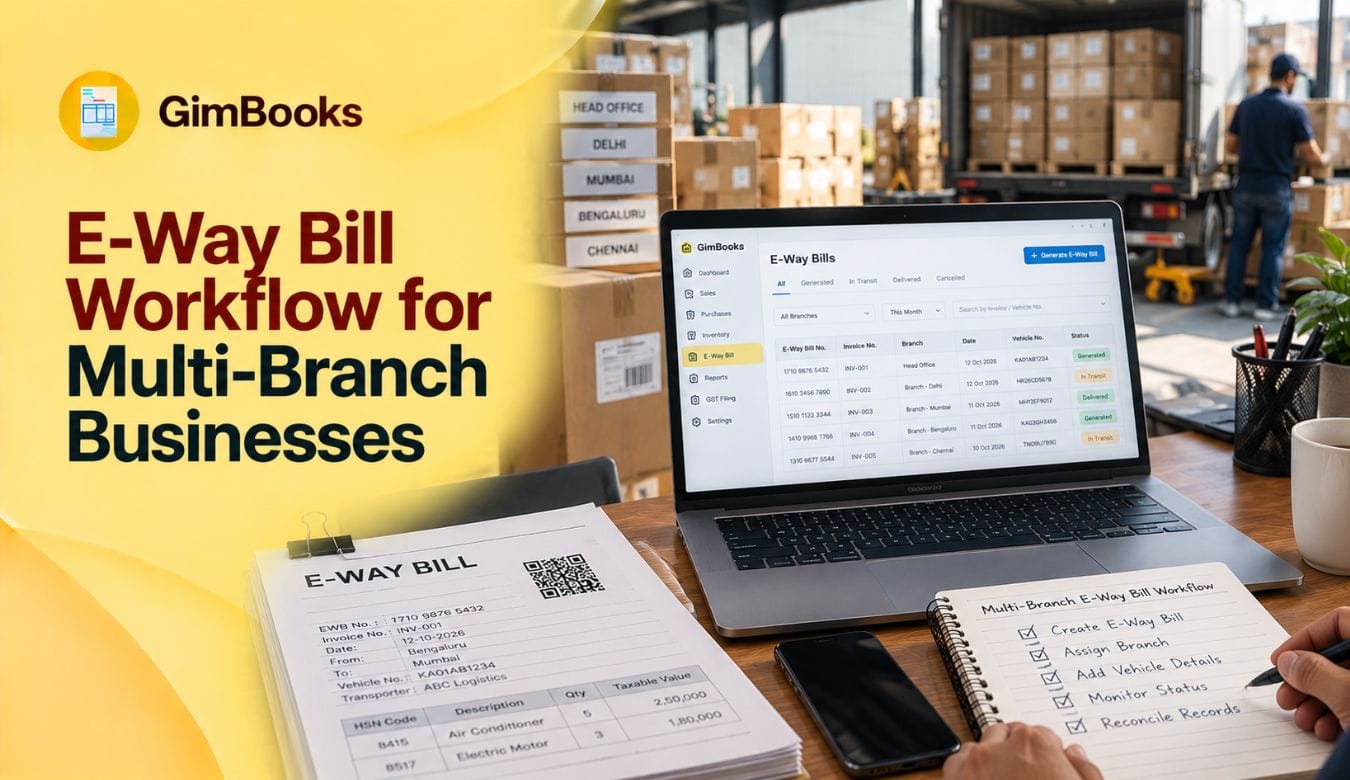
Managing e-way bills becomes more complex when a business operates from multiple branches, warehouses, distribution centres, or locations across different states. Every goods movement may involve a different GSTIN, dispatch address, receiving branch, transporter, and supporting document. Without a standardised process, businesses can face incorrect e-way bills, stock discrepancies, delivery delays, and compliance issues.
An organised e way bill multi branch workflow helps businesses manage goods movement across locations while ensuring that invoices, delivery challans, e-way bills, transporter details, and inventory records remain consistent.
For wholesalers, distributors, manufacturers, and retailers operating across multiple locations, the challenge is not limited to generating e-way bills. It also involves coordinating branch operations, maintaining accurate documentation, tracking shipments, and reconciling records centrally.
This guide explains how to establish an efficient multi-branch e-way bill process, assign responsibilities, manage inter-branch stock transfers, and reduce documentation errors.
What Is an E-Way Bill Workflow for Multi-Branch Businesses?
An e-way bill workflow for multi-branch businesses is a structured process for managing e-way bill generation, goods dispatch, transportation, receiving confirmation, and documentation across different business locations.
It typically involves:
- Identifying the branch initiating the goods movement
- Verifying supplier and recipient GSTINs
- Preparing invoices or delivery challans
- Generating applicable e-way bills
- Assigning transporters and vehicles
- Monitoring goods movement
- Confirming delivery at the receiving branch
- Reconciling dispatch documents and inventory records
Under GST, an e-way bill is generally required for specified movements of goods where the consignment value exceeds ₹50,000, subject to exemptions, special rules, and applicable state requirements.
When a business operates across several branches, centralized e-way bill management can help maintain consistent records while allowing individual locations to manage their daily dispatch activities.
Why Multi-Branch Businesses Need a Standard E-Way Bill Process
Businesses operating across multiple locations face operational challenges that are less common in single-branch operations.
Multiple GST Registrations Across States
A company may have separate GST registrations for its offices or warehouses in Delhi, Maharashtra, Karnataka, and Gujarat.
When goods move between separately registered locations, businesses must determine the correct documentation and GST treatment for e-way bill branch transfers between GSTINs.
Using an incorrect GSTIN may create mismatches between e-way bills, tax invoices, and accounting records.
Different Billing and Dispatch Locations
In some transactions, the head office raises the invoice while goods are physically dispatched from a warehouse in another location.
For example, a Delhi office may issue an invoice for goods dispatched from a Gurugram warehouse.
The business must correctly record the billing party, actual dispatch location, recipient, and delivery address using the appropriate transaction type.
Decentralised Dispatch Activities
Branches may independently generate invoices, coordinate transporters, and dispatch goods.
Without common procedures, this can result in:
- Duplicate document creation
- Incorrect branch selection
- Missing e-way bill references
- Incomplete transport information
- Delayed delivery confirmation
- Unreconciled stock movements
Lack of Central Shipment Visibility
When branches maintain separate spreadsheets, the head office may struggle to determine which consignments have been dispatched, delivered, cancelled, or delayed.
An integrated e-way bill management for multiple branches process creates better visibility across business locations.
Step-by-Step E-Way Bill Workflow for Multi-Branch Businesses
A practical workflow should connect branch requests, documentation, transportation, and receiving confirmation.
Step 1: Maintain a Centralised Branch and GSTIN Database
Start by creating a master database containing details of every branch, warehouse, and distribution centre.
For example, a business may use DEL-01 for its Delhi branch, MUM-01 for Mumbai, and BLR-01 for Bengaluru.
Each branch should be mapped to the appropriate GSTIN and physical location.
Centralised master data reduces the risk of employees selecting incorrect billing or dispatch details.
Step 2: Identify the Goods Movement Type
Before generating an e-way bill, the dispatch team must identify the purpose of the movement.
Common movement types include:
- Sale to a customer
- Branch-to-branch stock transfer
- Warehouse-to-warehouse transfer
- Goods sent for job work
- Goods sent for repair
- Goods returned to suppliers
- Movement of samples
- Customer returns
The supporting document depends on whether the transaction represents a taxable supply or another permitted category of goods movement.
For example, an inter-branch stock transfer under GST between separate GST registrations may be treated as a supply between distinct persons even when the branches belong to the same company.
However, a movement between warehouses covered by the same GSTIN may be an internal stock movement rather than a separate taxable supply.
For non-supply movements, businesses should understand the difference between an e-way bill and delivery challan before selecting the document used for dispatch.
Step 3: Prepare the Correct Invoice or Delivery Challan
After identifying the movement type, the branch should prepare the appropriate source document.
A standard dispatch process should verify:
- Document number and date
- Supplier GSTIN
- Recipient GSTIN, where applicable
- Product description
- HSN code
- Quantity
- Goods value
- Applicable GST details
- Dispatch and delivery addresses
A common challenge is maintaining consistency between the source document and the transport record. Businesses can reduce these errors by correctly linking delivery challans, invoices, and e-way bills for goods movement.
For movements where a delivery challan is required, the dispatch team should also follow the applicable delivery challan format and issuing procedure to ensure that necessary transaction details are documented.
Step 4: Verify Branch GSTIN and Transaction Details
Accurate GSTIN mapping is essential for branch-wise e-way bill generation.
Multi-location businesses commonly handle three transaction arrangements.
Regular Dispatch
A registered branch sells and dispatches goods directly to a customer.
The e-way bill should reflect the appropriate supplier, recipient, and actual movement details.
Bill From – Dispatch From
The invoice is raised by one registered location, while goods are dispatched from another physical location.
For example, a Mumbai office raises an invoice while goods are dispatched from a Pune warehouse.
The correct billing and dispatch information must be entered using the applicable transaction type.
Bill To – Ship To
The invoice is raised to one recipient, but goods are delivered to another location.
For example, a customer registered in Delhi asks the supplier to deliver goods to its warehouse in Jaipur.
The business must correctly distinguish the billed recipient from the actual delivery destination.
Some transactions combine different billing, dispatch, and delivery parties and require the applicable combined transaction option.
Before finalising the document, verify the legal nature of the supply and the applicable place-of-supply treatment.
Step 5: Generate the E-Way Bill Before Goods Movement
Once the documents are verified, the responsible branch or authorised user can generate the e-way bill where required.
The generation process should include:
- Selecting the applicable transaction and supply type
- Entering the correct invoice or challan details
- Verifying consignor and consignee information
- Confirming dispatch and delivery locations
- Entering product descriptions, HSN, quantities, and values
- Providing transportation details
- Completing the required e-way bill information before movement
Part A captures the transaction and consignment details, while Part B contains the relevant transport information.
For businesses handling high daily dispatch volumes, e-way bill automation can help reduce repetitive data entry and support consistent document preparation.
However, automated data entry still requires appropriate checks for GST treatment, applicability, and transaction accuracy.
Step 6: Coordinate Transporters and Vehicle Information
Once the e-way bill is generated, the dispatch branch must coordinate with the transporter.
This becomes especially important when different branches use shared transporters or the same vehicle handles repeated movements.
The dispatch team should verify:
- Transporter ID
- Vehicle registration number
- Transport mode
- Dispatch location
- Delivery location
- Relevant transport document number
- E-way bill validity
- Vehicle changes during transportation
Maintaining accurate e-way bill vehicle details for repeated movements helps businesses reduce transport discrepancies when the same trucks or delivery vans are used across warehouses.
If a vehicle breaks down or goods are transferred to another vehicle, the authorised user or transporter should make the appropriate updates.
Businesses should ensure that the required e-way bill vehicle number updates are completed when transport circumstances change.
Step 7: Manage Multiple Consignments and Delivery Locations
Multi-branch businesses often consolidate shipments to reduce transportation costs.
For example, a distributor may load goods for three regional branches into a single truck.
Each consignment must be supported by the appropriate documents and individual e-way bill wherever required.
When multiple consignments are transported together, a consolidated e-way bill for multiple consignments may be generated by combining the relevant individual e-way bill references.
A consolidated e-way bill does not replace the underlying individual e-way bills.
For routes serving several branches or customers, businesses should also organise e-way bills for multi-stop deliveries according to the actual consignment documents and delivery points.
Each receiving location should be able to identify which goods and documents belong to its shipment.
Step 8: Track E-Way Bill Status Across Branches
After dispatch, the business should monitor shipments centrally.
An internal tracking system can classify shipments by operational stage.
These are internal operational stages, not necessarily official e-way bill portal statuses.
The finance team should also periodically review active, cancelled, expired, and closed e-way bill records to identify movements requiring additional investigation.
For example, a branch may report that goods were delivered while its internal tracking register still shows the shipment as in transit.
Matching transport records with delivery confirmations can help resolve such inconsistencies.
Step 9: Handle Vehicle Breakdowns and Shipment Delays
Interstate shipments and long-distance stock transfers can experience unexpected delays due to vehicle breakdowns, traffic restrictions, or operational disruptions.
The logistics team should regularly check whether the applicable e-way bill remains valid.
Where the rules permit, a transporter may request an e-way bill validity extension for vehicle breakdowns and delivery delays within the prescribed window.
Businesses should document the reason for delay, transporter communication, and corrective action.
An internal escalation process can help ensure that branch employees contact the responsible transport or compliance team when a shipment may exceed its permitted validity.
Step 10: Confirm Delivery and Reconcile Branch Records
The final step is confirming that goods have reached the receiving branch and reconciling the relevant documents.
The receiving team should verify:
- Invoice or challan number
- E-way bill reference
- Item description
- Quantity received
- Condition of goods
- Delivery date
- Inventory inward entry
- Shortages or damaged goods
For example, if a warehouse dispatches 500 units to a regional branch but the branch receives only 495 units, the discrepancy should be recorded.
The finance team should then compare the dispatch register, receiving records, and inventory ledger.
A central e-way bill reconciliation process helps ensure that the business maintains consistent documentation across locations.
Centralised vs Branch-Wise E-Way Bill Management
Businesses can organise e-way bill responsibilities through different operating models.
Centralised Management
Head office controls document review, e-way bill coordination, and reporting.
This provides consistency but may create bottlenecks if every dispatch requires central approval.
Branch-Wise Management
Each branch manages local transactions and transportation.
This allows greater operational independence but requires consistent user training and documentation standards.
Hybrid Management
Branches handle daily dispatch activities while head office oversees reconciliation, exceptions, and reporting.
For businesses operating across several states and warehouses, this often provides a practical balance between flexibility and control.
Example of an E-Way Bill Workflow Across Multiple Branches
Consider a distributor operating through four locations:
The company receives two stock transfer requests.
- Gurugram to Jaipur: Goods worth ₹1,50,000
- Gurugram to Lucknow: Goods worth ₹90,000
Stage 1: Branch Request
The receiving branches create internal stock requests specifying the products and quantities required.
Stage 2: Document Preparation
The dispatch team verifies the relevant GST registrations, nature of movement, and appropriate tax invoice or delivery challan.
Stage 3: E-Way Bill Generation
Applicable e-way bills are generated for the respective consignments, using correct GSTINs and dispatch details.
Stage 4: Transport Coordination
Both consignments may move through the same transporter. If they travel in one vehicle and satisfy the applicable conditions, a consolidated e-way bill can be used.
Stage 5: Delivery Confirmation
Jaipur and Lucknow independently verify the received goods and record any shortages.
Stage 6: Central Reconciliation
The head office compares the stock transfer requests, source documents, e-way bills, dispatch records, and inventory entries.
This process enables better multi-location e-way bill tracking without requiring every branch to maintain an entirely separate documentation system.
Common E-Way Bill Challenges for Multi-Branch Businesses
Incorrect GSTIN Mapping
Using the wrong branch GSTIN can create inconsistent transaction records.
Solution: Maintain an approved branch-GSTIN master and validate it before document generation.
Duplicate E-Way Bill Generation
The same dispatch may be processed by both the warehouse and the head office.
Solution: Assign generation responsibility clearly and use unique document references.
Missing Dispatch Information
The invoice may contain the billing address instead of the actual dispatch location.
Solution: Confirm physical dispatch details before selecting the transaction type.
Transporter Coordination Issues
Vehicle information may change without timely communication to the responsible user.
Solution: Establish transporter communication and vehicle-update responsibilities.
Delayed Receiving Confirmation
The destination branch may fail to record the delivery on time.
Solution: Make receiving confirmation part of the stock transfer closure procedure.
Unreconciled Inventory Transfers
Goods may be removed from one branch's inventory without corresponding receipt at the destination.
Solution: Reconcile stock outward and inward entries against the relevant dispatch documents.
How to Improve Multi-Branch E-Way Bill Compliance
Effective e-way bill compliance for businesses requires clear responsibility, consistent documentation, and regular monitoring.
Assign Ownership for Every Activity
Introduce Pre-Dispatch Validation
Before goods leave the warehouse, the responsible team should verify source documents, GSTINs, movement details, transporter information, and applicable e-way bill requirements.
Maintain a Central Exception Register
Record unresolved issues such as:
- Incorrect GSTIN
- Wrong dispatch address
- Missing e-way bill
- Document mismatch
- Vehicle update pending
- Delayed delivery
- Quantity shortage
- Stock transfer not reconciled
Review Branch Reports Regularly
Head office can maintain monthly reports covering e-way bills generated, shipments dispatched, pending receipts, and unresolved exceptions.
Consistent branch-level reporting helps identify recurring errors and improve operational controls.
How E-Way Bill Software Helps Multi-Branch Businesses
Managing large numbers of invoices, delivery challans, dispatches, and stock transfers manually can become time-consuming.
E-way bill software for multiple branches can help businesses organise movement-related information and minimise repetitive data entry.
Useful capabilities to evaluate include:
- GST invoice generation
- Delivery challan preparation
- Customer and supplier information
- Item and HSN details
- E-way bill creation
- Inventory records
- Transaction reports
- Document history
- Branch-wise access and reporting, where supported
GimBooks provides GST billing, inventory, and related business-management tools that can support the organisation of invoices and e-way bill documentation.
Businesses considering GST billing and e-way bill software should verify the available multi-location and multi-GSTIN features against their operational requirements.
Software can simplify record management, but businesses must still review applicable GST obligations and maintain accurate transaction data.
Monthly E-Way Bill Checklist for Multi-Branch Businesses
Use this checklist to review branch-wise goods movement.
Branch and GSTIN Records
- All branch GSTINs are correctly mapped.
- Dispatch addresses are updated.
- Warehouse PIN codes are verified.
- Responsible branch users are identified.
Invoice and E-Way Bill Documentation
- Appropriate invoices or challans are prepared.
- E-way bills are generated where required.
- Document details match the relevant e-way bills.
- Billing and delivery locations are accurate.
- Duplicate and cancelled documents are reviewed.
Transportation
- Transporter details are correct.
- Vehicle numbers are verified.
- Vehicle changes are recorded appropriately.
- Delayed shipments are reviewed.
- E-way bill validity is monitored.
Receiving and Reconciliation
- Destination branches confirm goods receipt.
- Inventory inward and outward records match.
- Quantity differences are documented.
- Unmatched movements are investigated.
- Outstanding exceptions are assigned for resolution.
Frequently Asked Questions
How do you manage e-way bills across multiple branches?
Businesses can manage e-way bills across multiple branches by maintaining accurate GSTIN records, standardising invoices and challans, assigning generation responsibilities, coordinating transporters, and reconciling dispatch and receiving information centrally.
Can a business generate e-way bills for multiple GSTINs?
A business with multiple GST registrations can manage transactions across those registrations, but each relevant movement must use the appropriate GSTIN and authorised system access. One registration should not be substituted for another.
Is an e-way bill required for inter-branch stock transfers?
An e-way bill may be required for applicable inter-branch stock transfers based on consignment value, movement type, exceptions, and relevant state rules. The fact that goods move between locations belonging to the same business does not automatically remove the requirement.
What is the difference between centralised and branch-wise e-way bill generation?
Centralised management places greater responsibility with head office, while branch-wise management gives individual locations control over their own dispatch documentation. A hybrid model combines branch execution with central oversight.
Can one e-way bill cover multiple branch deliveries?
A single e-way bill does not automatically cover multiple independent consignments going to different branches. Each applicable consignment requires the correct documentation and e-way bill. A consolidated e-way bill may be generated for eligible consignments transported together.
How can businesses avoid duplicate e-way bills?
Businesses can reduce duplicate generation by assigning clear responsibilities, using unique document numbers, maintaining shared transaction records, and checking existing e-way bill references before creating new ones.
How should e-way bills be reconciled across warehouses?
Compare the applicable invoices or challans, e-way bill numbers, dispatch records, transporter information, goods receipt confirmations, and inventory entries. Investigate missing or mismatched movements before closing the reconciliation period.
Can billing software simplify multi-branch e-way bill management?
Yes. Suitable billing and business-management software can help organise invoices, transport documentation, inventory information, and reports. Businesses should verify whether the selected solution supports their required GSTIN, location, and approval workflows.
Conclusion
An organised e way bill multi branch workflow helps businesses manage goods movement across warehouses, offices, and distribution centres with greater consistency.
From GSTIN verification and document preparation to transporter coordination, receiving confirmation, and e-way bill reconciliation, every stage should follow a clearly defined process.
For growing businesses, combining branch-level operations with centralised monitoring can reduce documentation errors and improve visibility over stock transfers.
Using suitable GST billing and e-way bill tools can further simplify record management while allowing businesses to maintain control over their GST documentation and compliance responsibilities.