
GST Export Refunds 2026: How Billing Software Helps Exporters Get Faster GST Refunds
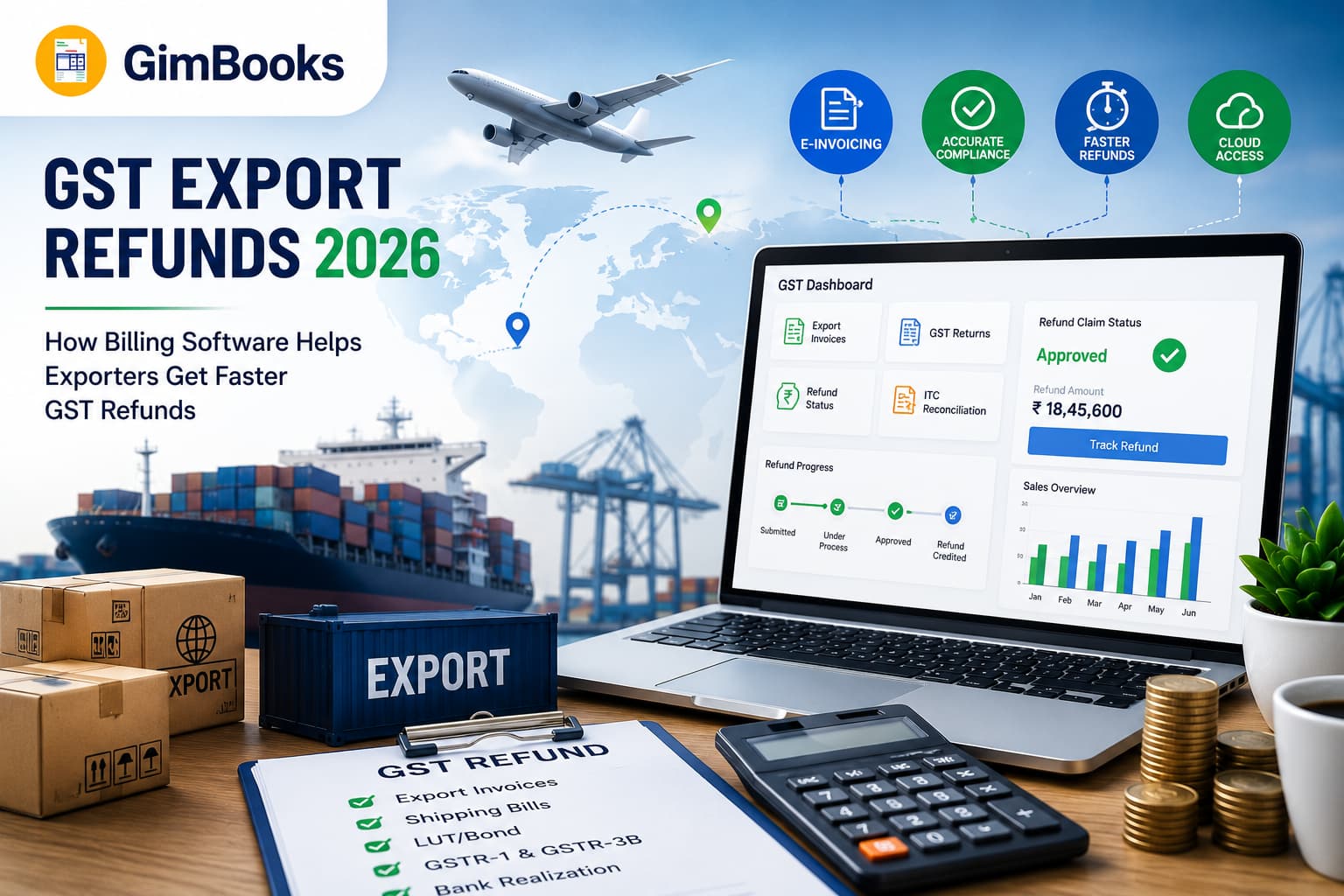
Export businesses in India depend heavily on timely GST refunds to maintain healthy cash flow. However, refund delays caused by invoice mismatches, filing errors, missing documents, and GST compliance issues continue to affect exporters in 2026.
This is where modern GST billing software plays a major role. Instead of managing invoices, shipping records, GST returns, and refund documentation manually, exporters are now using automated billing and compliance platforms to reduce errors and speed up refund processing.
For exporters, wholesalers, manufacturers, and MSMEs, choosing the right GST billing software is no longer only about invoicing. It has become a critical tool for faster GST export refund claims, smoother compliance, and better working capital management.
Key Takeaways
- GST refunds are essential for exporter cash flow management
- Invoice mismatches are one of the biggest reasons for refund delays
- GST billing software helps automate refund-related documentation
- Exporters using automated GST tools face fewer compliance errors
- Real-time reconciliation improves refund approval speed
- E-invoicing and GST return sync reduce rejection risks
- Cloud billing software improves tracking and audit readiness
Why GST Refund Delays Are a Big Problem for Exporters
Exporters usually operate on thin margins and large working capital cycles. When GST refunds get delayed, businesses often struggle with:
- Inventory purchase cycles
- Vendor payments
- Logistics expenses
- Export operations
- Production planning
Many exporters still use spreadsheets or disconnected accounting systems. This creates inconsistencies between invoices, GST returns, shipping documents, and refund applications.
Even a small mismatch in GSTR-1, shipping bill details, or invoice values can delay refunds for weeks or months.
Common Reasons for GST Refund Delays
What Is GST Export Refund Under GST?
Under GST law, exports are treated as zero-rated supplies. Exporters can claim GST refunds through two methods:
Both methods require accurate invoicing, GST return filing, and proper documentation.
This makes billing and compliance software extremely important for exporters in 2026.
How GST Billing Software Helps Exporters
Modern GST software does much more than invoice generation. It connects billing, inventory, GST returns, e-invoicing, reconciliation, and refund workflows into one system.
For exporters, this significantly reduces refund processing issues.
Automated GST-Compliant Invoicing
Export invoices must include specific GST details such as:
- LUT reference
- Export invoice format
- Shipping details
- HSN/SAC codes
- GSTIN information
- Currency details
Manual invoice creation often leads to formatting or tax calculation mistakes.
GST billing software automatically generates compliant export invoices and reduces documentation errors.
Example
A textile exporter creating 300 export invoices monthly manually may accidentally mismatch invoice numbers in GSTR-1 filings. Automated software syncs invoices directly with GST returns, reducing such risks.
Real-Time GST Return Reconciliation
One of the biggest reasons for refund delays is mismatch between:
- GSTR-1
- GSTR-3B
- Shipping bills
- E-invoice records
Billing software automatically reconciles sales data and highlights mismatches before filing returns.
Benefits of Automated Reconciliation
Faster Refund Documentation Management
GST refund claims require multiple supporting documents, including:
- Export invoices
- Shipping bills
- LUT copies
- Bank realization certificates
- GST returns
- E-way bills
Managing these manually becomes difficult for exporters handling high transaction volumes.
Cloud billing software stores all documents centrally and makes retrieval easier during refund filing or GST scrutiny.
Role of E-Invoicing in GST Export Refunds
In 2026, e-invoicing compliance continues to expand across businesses. Exporters using e-invoice-enabled billing software gain several advantages.
How E-Invoicing Helps
- Reduces fake invoice risks
- Creates standardized invoice records
- Improves GST verification
- Minimizes data mismatches
- Speeds up automated validations
This directly supports faster GST refund processing.
Inventory Integration Improves Refund Accuracy
Exporters dealing with inventory-heavy operations often struggle with ITC calculations and stock reconciliation.
Inventory-connected billing software helps track:
- Purchase entries
- Input tax credit
- Export stock movement
- Warehouse inventory
- Batch-wise sales
This creates more accurate GST reporting and reduces refund disputes.
GST Refund Workflow with Billing Software
Traditional Manual Process vs Software-Driven Process
Best Features Exporters Should Look for in GST Billing Software
Exporters should choose software that supports both GST compliance and operational efficiency.
Important Features
- GST-compliant invoicing
- Export invoice support
- LUT management
- E-invoicing integration
- Inventory management
- Return reconciliation
- Cloud access
- Multi-user access
- Refund-ready reporting
- Document management
Why GimBooks Fits Export Businesses
GimBooks for GST Export Compliance
For Indian exporters, distributors, manufacturers, and wholesalers, GimBooks offers features that directly support GST refund readiness and compliance workflows.
Key Export-Friendly Features
- GST-compliant invoicing
- Inventory tracking
- E-invoice support
- Cloud billing access
- Multi-device usage
- Payment tracking
- Business reporting
- Automated billing workflows
GimBooks is especially useful for:
- MSME exporters
- Traders
- Distributors
- Manufacturers
- Mobile-first businesses
- Multi-location operations
Unlike traditional accounting systems that require complex setups, GimBooks focuses on simplicity and day-to-day operational efficiency.
Common GST Refund Mistakes Exporters Must Avoid
Even with software, businesses must follow proper compliance practices.
Common Errors
How Exporters Can Speed Up GST Refund Processing
Practical Tips
- File GSTR-1 and GSTR-3B on time
- Use GST-compliant billing software
- Reconcile invoices monthly
- Maintain proper export documentation
- Verify LUT validity
- Track refund applications regularly
- Use inventory-linked accounting systems
Also check - Export Promotion Capital Goods (EPCG) Scheme: Benefits for Exporters
Future of GST Refund Processing in India
GST refund systems are becoming more automated in 2026. Authorities increasingly rely on:
- E-invoice validation
- Automated reconciliation
- AI-based mismatch detection
- Real-time GST analytics
Businesses using manual accounting methods may face higher compliance risks in the coming years.
Exporters adopting cloud GST software early will likely experience:
- Faster refunds
- Better compliance
- Lower notice risk
- Improved cash flow management
Why Software-Led GST Compliance Matters in 2026
GST compliance is no longer only a finance task. It directly affects:
- Working capital
- Export operations
- Vendor relationships
- Cash flow
- Business scalability
Businesses using disconnected systems often spend excessive time fixing compliance errors instead of focusing on growth.
Modern GST billing software helps exporters build a faster, cleaner, and more audit-ready refund process.
Learn - How to Start an Export Business in India - A Complete Startup Guide
Simplify GST Export Compliance with GimBooks
Manage GST Billing, Invoicing & Export Workflows in One Place
GimBooks helps exporters, wholesalers, and MSMEs simplify GST billing and improve refund readiness through automated invoicing, inventory tracking, GST reporting, and cloud-based business management.
With GimBooks, businesses can:
- Create GST-ready export invoices
- Track inventory and sales together
- Reduce invoice mismatches
- Improve GST filing accuracy
- Manage multiple business operations
- Access billing from mobile and desktop
Whether you run a manufacturing export unit, wholesale distribution business, or growing MSME, GimBooks helps reduce manual compliance work and supports smoother GST operations.
Start simplifying export billing and GST compliance with GimBooks.
Conclusion
GST export refunds remain one of the most important financial processes for exporters in India. In 2026, businesses that continue relying on manual workflows face higher risks of delays, mismatches, and compliance issues.
Modern GST billing software helps exporters automate invoicing, improve reconciliation, organize refund documents, and reduce filing errors. This leads to faster refund processing and better operational efficiency.
For exporters, manufacturers, traders, and distributors, adopting the right billing system is becoming a practical business necessity rather than just an accounting upgrade.
Related - GST Refund Process for Exporters in 2026: Rules, Steps & Tips
FAQs
What is GST export refund?
GST export refund is the refund claimed by exporters on input tax credit or IGST paid on exported goods and services because exports are treated as zero-rated supplies under GST.
How does billing software help with GST refunds?
Billing software helps by automating GST invoices, reconciling returns, organizing refund documents, reducing mismatches, and improving filing accuracy.
Why do GST export refunds get delayed?
Common reasons include invoice mismatches, incorrect GST returns, missing documents, LUT errors, and ITC discrepancies.
Is e-invoicing important for exporters in 2026?
Yes. E-invoicing improves invoice accuracy, supports GST verification, reduces mismatch risk, and helps speed up refund processing.
Which businesses benefit most from GST billing software?
Exporters, manufacturers, wholesalers, traders, distributors, and MSMEs handling large invoice volumes benefit significantly from GST billing software.
Can GST billing software reduce refund rejection risk?
Yes. Automated reconciliation and compliance checks reduce filing mistakes that commonly lead to refund rejection or scrutiny.
What features should exporters look for in GST software?
Exporters should prioritize GST invoicing, inventory integration, e-invoicing, reconciliation tools, cloud access, and document management.
Is cloud billing software better for exporters?
Cloud billing software provides better accessibility, centralized records, real-time reporting, and easier multi-location management for export businesses.
Disclaimer
This blog is intended for informational purposes only and should not be considered legal, tax, or financial advice. GST rules and refund procedures may change based on government notifications and regulatory updates. Businesses should consult qualified tax professionals or GST practitioners for case-specific guidance.