
GST Filing Mistakes Businesses Must Avoid in 2026
Key Takeaways
- Incorrect GST returns can lead to notices, penalties, ITC blockage, and refund delays.
- Invoice mismatches remain one of the biggest GST compliance issues in 2026.
- Businesses must verify GSTR-1, GSTR-3B, e-invoices, and ITC claims regularly.
- Delayed filing can result in late fees, interest, and compliance risks.
- Small businesses should automate GST billing and reconciliation wherever possible.
- Proper invoice management and vendor compliance checks help reduce GST errors.
Introduction
GST compliance has become more technology-driven and data-focused in 2026. With stricter return validations, e-invoicing expansion, automated reconciliations, and AI-based scrutiny by tax authorities, even small filing mistakes can create serious compliance problems for businesses.
Many businesses still rely on manual spreadsheets, disconnected billing systems, or delayed reconciliations. These gaps often lead to incorrect GST returns, blocked Input Tax Credit (ITC), late fees, notices, and refund delays.
This guide explains the most common GST filing mistakes businesses must avoid in 2026, along with practical examples, compliance tips, and preventive measures for Indian businesses, accountants, startups, wholesalers, agencies, and MSMEs.
What Are GST Filing Mistakes?
GST filing mistakes are errors made while preparing invoices, filing GST returns, claiming ITC, generating e-invoices, or reconciling tax data under GST compliance rules.
These mistakes may seem small initially but can create:
- GST notices
- Interest liability
- Penalties
- ITC reversals
- Refund rejection
- Vendor disputes
- Compliance scrutiny
Common Causes of GST Errors
Why GST Filing Accuracy Matters More in 2026
GST compliance in 2026 is increasingly automated. The GST portal now relies heavily on invoice-level matching, e-invoice integration, and real-time validation.
Businesses can no longer depend on year-end corrections alone. Errors are identified much faster through:
- E-invoice data sync
- GSTR-1 and GSTR-3B comparison
- Vendor ITC matching
- AI-driven GST scrutiny systems
- E-way bill validations
Even small mismatches can trigger compliance alerts.
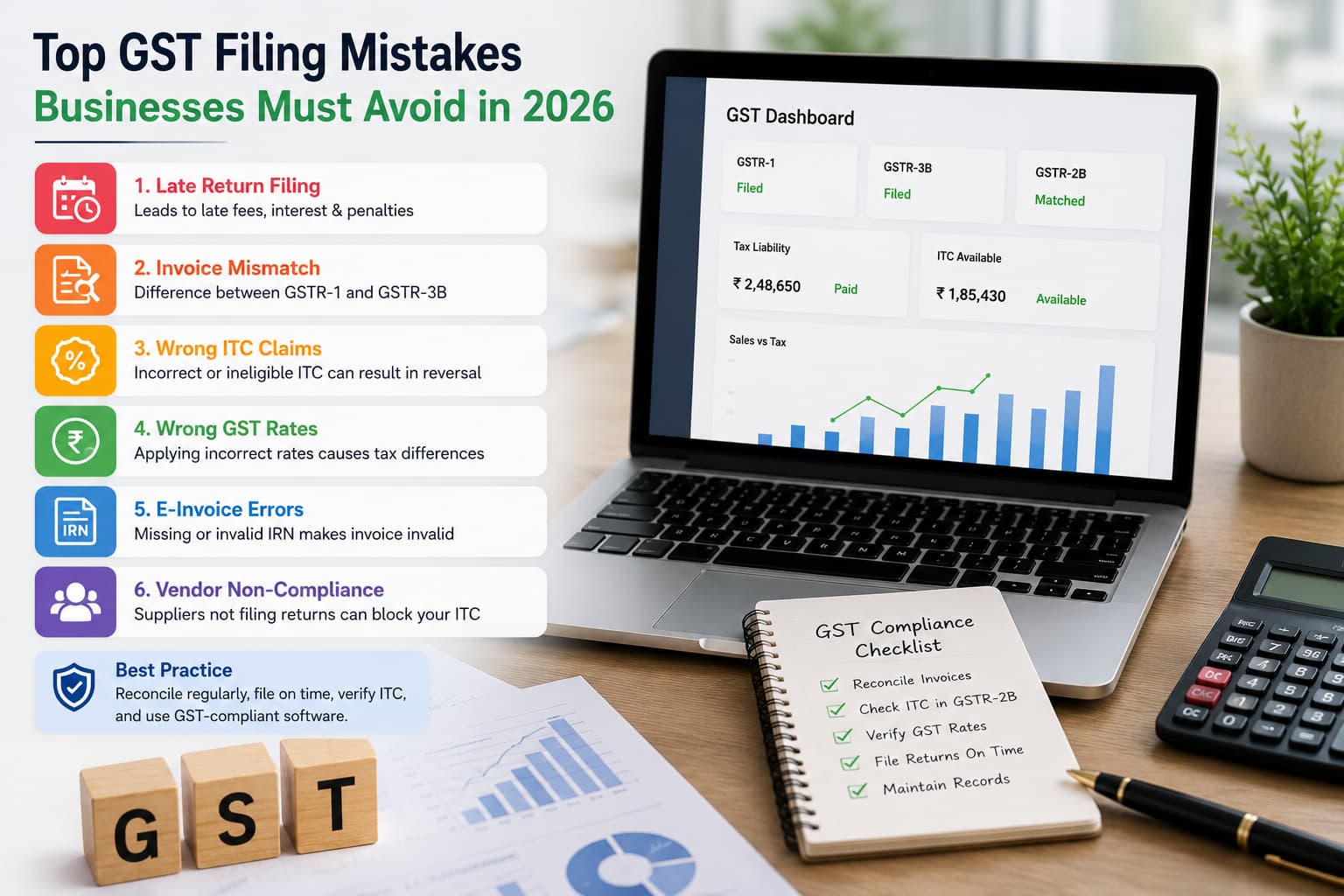
Top GST Filing Mistakes Businesses Must Avoid in 2026
1. Filing GSTR-3B Without Reconciling GSTR-1
Many businesses file GSTR-3B quickly without checking whether sales data matches GSTR-1.
This creates major mismatches between outward supplies and tax liability.
Why It Matters
Mismatch between returns may trigger:
- GST notices
- Tax demand
- Interest liability
- Audit scrutiny
Example
A distributor reports ₹12 lakh sales in GSTR-1 but only ₹10 lakh in GSTR-3B. The difference may attract tax demand and interest.
Best Practice
- Reconcile sales before filing
- Match invoices with accounting software
- Review tax liability monthly
2. Incorrect Input Tax Credit (ITC) Claims
Wrong ITC claims remain one of the most common GST filing mistakes businesses must avoid in 2026.
Businesses often claim ITC:
- On blocked credits
- From non-compliant vendors
- Without valid invoices
- Before supplier filing
Common ITC Errors
Practical Tip
Always reconcile purchase data with GSTR-2B before claiming ITC.
3. Delayed GST Return Filing
Late GST filing leads to unnecessary financial burden and compliance risk.
Late Filing Consequences
Interest Liability
Businesses may also pay:
- 18% interest on late tax payment
- Additional compliance penalties
Example
A business delays GSTR-3B filing by 25 days.
Potential cost:
- Late fee
- Interest on tax due
- ITC flow disruption
4. Wrong GST Rates on Invoices
Applying incorrect GST rates creates tax mismatch and accounting problems.
This is common in:
- Wholesale businesses
- Multi-product traders
- Service agencies
- FMCG distributors
Why It Happens
- Incorrect HSN classification
- Outdated GST rate usage
- Manual billing errors
Best Practice
Use GST-ready billing software with updated tax configurations.
5. Missing E-Invoice Compliance
The expansion of e-invoicing rules in recent years has increased compliance responsibility for businesses.
Eligible businesses must generate valid IRN-enabled invoices before issuing invoices.
Risks of Non-Generation of IRN
Example
A business dispatches goods without valid IRN generation. The invoice may become invalid under GST law.
6. Ignoring Vendor Compliance Checks
Your GST compliance also depends on supplier compliance.
If vendors fail to upload invoices properly, buyers may lose ITC eligibility.
Vendor Verification Checklist
- GSTIN validity
- Filing status
- Invoice matching
- GSTR-2B reflection
- E-invoice compliance
Why This Matters
Businesses with large vendor networks face major ITC risks due to supplier negligence.
7. Using Wrong HSN or SAC Codes
Incorrect HSN/SAC codes can create classification disputes and wrong GST rates.
This problem is common among:
- Manufacturers
- Traders
- Agencies
- Exporters
Possible Consequences
- GST notices
- Short tax payment
- Wrong compliance reporting
Best Practice
Regularly verify HSN classification updates issued under GST notifications.
8. Not Reconciling E-Way Bills
Many businesses generate e-way bills separately from invoicing systems, creating inconsistencies.
Common Problems
- Invoice mismatch
- Quantity mismatch
- Wrong transporter details
- Expired e-way bills
Why Reconciliation Matters
GST authorities can cross-check:
- E-way bill data
- E-invoice data
- GST returns
9. Filing Returns With Incorrect Invoice Details
Even minor invoice errors may create GST mismatches.
Common Invoice Errors
Best Practice
Review invoice data before filing returns.
10. Depending Entirely on Manual GST Processes
Businesses using spreadsheets for GST compliance face higher risk of:
- Human errors
- Duplicate entries
- Missed reconciliations
- Filing delays
Manual compliance becomes difficult as business volume grows.
Businesses Most Affected
- Wholesalers
- Manufacturers
- Agencies
- Multi-branch businesses
- Distributors
GST Filing Mistakes vs Their Impact
How Businesses Can Avoid GST Filing Mistakes in 2026
Build a Monthly GST Reconciliation Process
Businesses should reconcile:
- Sales invoices
- Purchase invoices
- GSTR-1
- GSTR-3B
- GSTR-2B
- E-way bills
Monthly reviews reduce year-end compliance stress.
Use Automated GST Billing Software
Modern GST software helps businesses:
- Generate GST invoices
- Reconcile returns
- Track ITC
- Generate e-invoices
- Reduce manual work
Automation significantly lowers filing mistakes.
Why GimBooks Helps Businesses Reduce GST Filing Errors
Businesses handling GST manually often struggle with invoice mismatches, delayed filings, and ITC reconciliation issues. This becomes more difficult for growing MSMEs, distributors, agencies, wholesalers, and service businesses managing multiple invoices daily.
Simplify GST Compliance with GimBooks
GimBooks helps businesses streamline GST billing, invoicing, inventory tracking, and compliance workflows through a simple cloud-based platform built for Indian businesses.
Key Benefits for GST Compliance
- GST-compliant invoice generation
- Automated tax calculations
- Inventory-linked billing
- E-invoice support
- Real-time business reports
- Payment tracking & reminders
- Multi-device billing access
- Faster reconciliation workflows
Best Fit For
- Small businesses
- MSMEs
- Agencies
- Traders
- Wholesalers
- Distributors
- Service businesses
Businesses looking to reduce GST filing mistakes and improve compliance efficiency can use GimBooks GST Billing Software for smoother invoicing and return preparation.
Common GST Compliance Checklist for 2026
Monthly GST Checklist
- Verify all GST invoices
- Reconcile GSTR-1 and GSTR-3B
- Match ITC with GSTR-2B
- Review vendor filing status
- Check e-invoice compliance
- Validate HSN/SAC codes
- File returns before due dates
- Maintain proper documentation
Future GST Compliance Trends in 2026
GST compliance is moving toward greater automation and digital validation.
Key Trends
Businesses adopting automated GST systems early will face fewer compliance risks.
Conclusion
GST filing accuracy has become critical for businesses in 2026. Even small mistakes in invoices, ITC claims, return filing, or e-invoicing can lead to penalties, blocked credits, compliance notices, and operational delays.
Businesses should move beyond manual filing methods and adopt structured GST reconciliation and billing practices. Regular reviews, timely filings, vendor checks, and automated invoicing systems can significantly reduce compliance risks.
Companies that prioritize accurate GST compliance today will save time, reduce penalties, and improve financial efficiency in the long run.
Recommended read - GST Billing Software for Agencies in India
FAQs
What are the most common GST filing mistakes in 2026?
The most common GST filing mistakes include incorrect ITC claims, delayed GSTR-3B filing, invoice mismatches, wrong GST rates, vendor reconciliation issues, and e-invoice non-compliance.
What happens if GST returns are filed late?
Late GST filing can result in late fees, interest liability, blocked ITC, and compliance notices. Businesses may also face difficulty during audits and refund claims.
How can businesses avoid GST penalties?
Businesses can avoid GST penalties by filing returns on time, reconciling invoices monthly, verifying ITC eligibility, checking vendor compliance, and using GST-compliant billing software.
Why is GSTR-2B reconciliation important?
GSTR-2B reconciliation helps businesses verify eligible ITC based on supplier filings. Without reconciliation, businesses may claim incorrect credits and face ITC reversal.
Is e-invoicing mandatory in 2026?
E-invoicing applicability depends on turnover thresholds notified under GST regulations. Eligible businesses must generate IRN-enabled invoices to remain compliant.
What is the penalty for incorrect GST invoices?
Incorrect GST invoices may lead to tax notices, ITC denial, penalties, and compliance scrutiny depending on the nature of the error.
Why do GST refunds get delayed?
GST refunds may get delayed due to invoice mismatches, incorrect filings, missing documents, ITC discrepancies, or pending compliance verification.
Can GST filing mistakes be corrected later?
Yes, certain GST filing mistakes can be corrected through amendments or revised reporting within prescribed timelines. However, repeated errors may still attract notices or penalties.