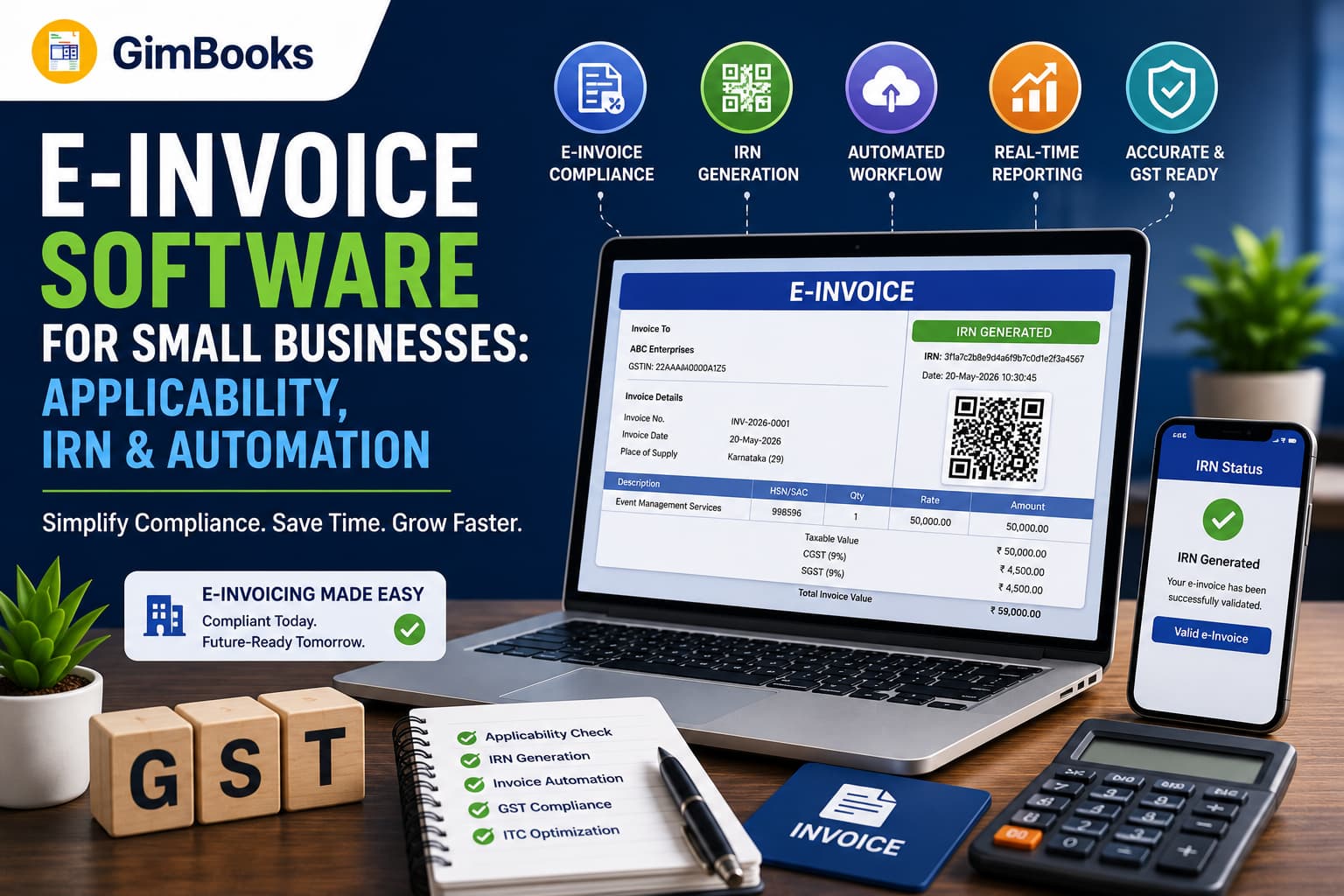
E-Invoice Software for Small Businesses: Applicability, IRN & Automation Guide (2026)
Key Takeaways
- E-Invoicing is mandatory only for businesses crossing the prescribed GST turnover threshold notified by the government.
- Every e-Invoice requires a valid Invoice Reference Number (IRN) generated through the Invoice Registration Portal (IRP).
- Manual invoice management increases the risk of IRN rejection, compliance errors, and GST mismatches.
- E-Invoice software automates invoice validation, IRN generation, QR code creation, and GST reporting.
- Small businesses adopting automation early can improve compliance, reduce administrative workload, and prepare for future GST digitization initiatives.
- Modern billing software helps integrate invoicing, accounting, inventory management, and GST compliance into one system.
Introduction
India's GST ecosystem continues to become more digital every year. From e-Way Bills and online GST returns to e-Invoicing, businesses are increasingly expected to maintain accurate, real-time transaction records.
For many small businesses, understanding e-Invoicing can seem complicated. Questions around applicability, IRN generation, invoice validation, compliance requirements, and software selection often create confusion. As GST compliance requirements continue evolving in 2026, businesses need reliable systems that simplify invoice management and reduce compliance risks.
This guide explains everything small business owners need to know about e-Invoice software, including applicability rules, the IRN generation process, automation benefits, compliance requirements, and how modern billing solutions help businesses stay GST-ready.
What Is E-Invoicing Under GST?
Before selecting e-Invoice software, it's important to understand what e-Invoicing actually means.
E-Invoicing does not mean creating invoices on a government portal. Businesses continue generating invoices through their ERP, billing software, or accounting system. The invoice data is then electronically reported to the Invoice Registration Portal (IRP), which validates the information and generates an Invoice Reference Number (IRN).
Once validated, the invoice receives:
- Unique IRN
- Digitally signed response
- QR Code
- Invoice authentication
The validated invoice becomes an officially recognized GST e-Invoice.
Why E-Invoicing Matters for Small Businesses
Many small businesses assume e-Invoicing only affects large enterprises. However, GST digitization is expanding, and businesses that adopt automated invoicing systems early often gain operational advantages.
Key Benefits
- Improved GST compliance
- Reduced invoice errors
- Faster reconciliation
- Better audit readiness
- Automated reporting
- Improved customer confidence
- Reduced manual work
As businesses grow, invoice volumes increase. Managing compliance manually becomes difficult and time-consuming.
E-Invoice Applicability for Small Businesses in 2026
One of the most common questions businesses ask is whether e-Invoicing is mandatory for them.
GST e-Invoicing applicability depends primarily on annual aggregate turnover as notified by the government from time to time.
Understanding Applicability
Businesses should regularly monitor:
- Aggregate turnover
- GST notifications
- Industry-specific requirements
- Future threshold revisions
Applicability Overview
Businesses should verify the latest GST notifications before implementing compliance processes.
What Is an IRN (Invoice Reference Number)?
The IRN is the foundation of India's e-Invoicing system.
It acts as a unique identifier for every registered e-Invoice and ensures invoice authenticity within the GST ecosystem.
Why IRN Is Important
Without a valid IRN:
- The invoice may not qualify as a valid e-Invoice.
- Compliance risks increase.
- GST reporting issues may arise.
- Input Tax Credit reconciliation may be affected.
For applicable taxpayers, IRN generation is a critical compliance requirement.
How IRN Generation Works
Many businesses understand the concept of IRN but are unfamiliar with the actual process.
The workflow is largely automated when using e-Invoice software.
Step-by-Step IRN Process
Step 1: Create Invoice
The invoice is generated in billing software or ERP.
Step 2: Validate Data
The software checks:
- GSTIN
- Invoice number
- Tax values
- HSN codes
- Customer information
Step 3: Submit to IRP
Invoice data is transmitted to the Invoice Registration Portal.
Step 4: IRN Generation
The portal validates the information and generates an IRN.
Step 5: QR Code Creation
A digitally signed QR code is generated.
Step 6: Invoice Authentication
The validated invoice is returned to the business system.
E-Invoice Workflow Explained
Understanding the complete workflow helps businesses identify where automation can create efficiencies.
Automation significantly reduces manual intervention across these stages.
Challenges of Manual E-Invoice Management
Many businesses initially attempt to manage e-Invoicing manually.
While possible for very low invoice volumes, this approach becomes difficult as operations grow.
Common Challenges
Data Entry Errors
Incorrect GSTINs, invoice values, or HSN codes can lead to rejection.
Duplicate Invoices
Repeated invoice numbers often trigger validation failures.
Compliance Delays
Manual processes increase reporting delays.
Reconciliation Issues
Tracking invoices across multiple systems becomes difficult.
Audit Risks
Incomplete documentation creates compliance challenges during audits.
These issues are one reason businesses increasingly adopt e-Invoice software.
How E-Invoice Software Simplifies Compliance
Modern e-Invoice software automates much of the compliance workload.
Instead of manually interacting with multiple systems, businesses can manage invoicing through a centralized platform.
Key Automation Benefits
Automation improves both accuracy and efficiency.
Essential Features to Look for in E-Invoice Software
Not every billing solution is built for GST compliance.
Businesses should evaluate software carefully before implementation.
Must-Have Features
GST-Compliant Invoicing
Supports GST calculations and tax rules.
Automated IRN Generation
Reduces compliance workload.
QR Code Integration
Ensures valid invoice authentication.
Inventory Management
Tracks stock alongside billing.
Accounting Integration
Improves financial reporting.
Cloud Accessibility
Enables access from multiple locations.
Reporting Dashboard
Provides real-time compliance insights.
E-Invoice Software vs Traditional Billing Systems
Many businesses continue using traditional invoice processes that were designed before GST digitization.
Comparison Table
The gap between traditional and automated systems continues to grow.
Common IRN Generation Errors and Solutions
Businesses frequently encounter avoidable IRN issues.
Frequent Errors
Automated validation helps prevent many of these problems before submission.
How Small Businesses Can Prepare for E-Invoicing
Even if a business is not currently covered under mandatory e-Invoicing requirements, preparation is beneficial.
Recommended Steps
- Adopt GST-compliant billing software
- Standardize invoice formats
- Maintain accurate customer data
- Improve inventory management
- Train finance teams
- Automate reconciliation processes
Early adoption reduces disruption when compliance requirements expand.
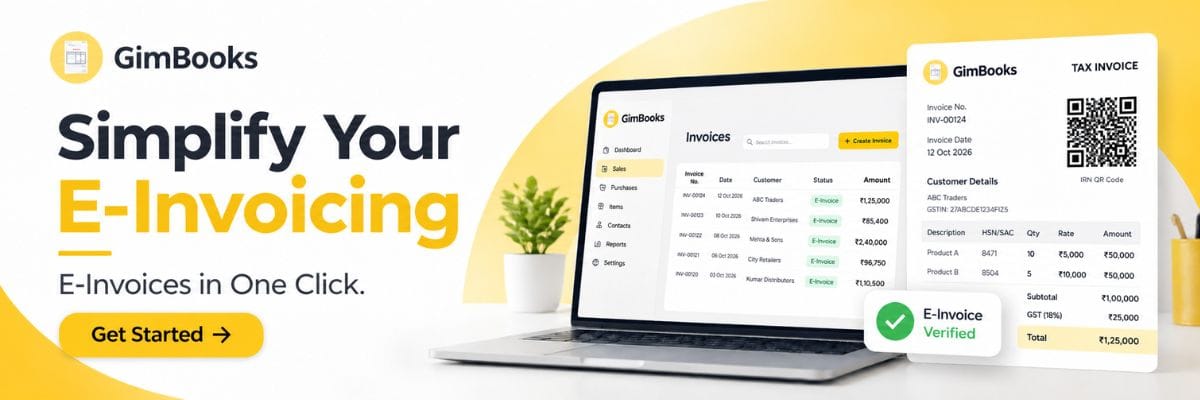
Why GimBooks Can Help Businesses Manage E-Invoicing
Smart GST Billing and Business Automation
As GST compliance becomes increasingly digital, businesses need software that goes beyond basic invoice creation.
GimBooks helps businesses streamline:
- GST-compliant invoicing
- Inventory management
- Customer management
- Expense tracking
- Business reporting
- Payment reminders
- Multi-device access
- Cloud-based billing operations
For traders, retailers, distributors, agencies, and growing MSMEs, a centralized billing system can reduce compliance complexity while improving operational efficiency.
Ideal For
- Small businesses
- Retailers
- Traders
- Agencies
- Service providers
- Distributors
- Growing MSMEs
Using a modern billing platform allows businesses to spend less time on compliance administration and more time on growth.
Future of E-Invoicing in India
India's GST ecosystem continues moving toward greater automation and real-time compliance.
Future developments may include:
- AI-driven invoice validation
- Real-time compliance monitoring
- Automated GST reconciliation
- Predictive compliance alerts
- Enhanced ERP integration
- Expanded e-Invoice coverage
Businesses that invest in digital invoicing systems today will be better prepared for future regulatory changes.
Conclusion
E-Invoicing has become a key part of India's GST compliance framework. While applicability currently depends on turnover thresholds and government notifications, businesses of all sizes can benefit from adopting automated invoicing systems.
The combination of automated IRN generation, GST validation, QR code creation, and compliance reporting helps reduce errors, improve efficiency, and strengthen audit readiness. For growing businesses, modern e-Invoice software is no longer just a compliance tool—it is becoming an essential part of financial operations.
Organizations that embrace automation early will be better positioned to manage compliance requirements, improve productivity, and adapt to future GST digitization initiatives.
Simplify E-Invoicing and GST Compliance with GimBooks
Managing invoices manually can create compliance risks, operational inefficiencies, and unnecessary administrative work. A modern billing platform helps businesses automate invoicing, track transactions, maintain accurate records, and stay GST-ready.
GimBooks provides GST-compliant billing, inventory management, expense tracking, business reporting, and cloud-based accessibility designed for Indian businesses. Whether you're preparing for e-Invoicing requirements or looking to streamline daily operations, the right software can make compliance significantly easier.
FAQs
What is e-Invoicing under GST?
E-Invoicing is a system where invoice data is electronically reported to the Invoice Registration Portal (IRP) for validation. After successful validation, an Invoice Reference Number (IRN) and QR code are generated.
Is e-Invoicing mandatory for all small businesses?
No. E-Invoicing applicability depends on turnover thresholds and GST notifications issued by the government. Businesses should verify the latest requirements regularly.
What is an IRN in GST e-Invoicing?
IRN stands for Invoice Reference Number. It is a unique identifier generated by the Invoice Registration Portal after invoice validation.
Can e-Invoice software generate IRN automatically?
Yes. Modern e-Invoice software can automate IRN generation, QR code creation, and invoice validation through integration with the GST ecosystem.
What happens if an applicable business does not generate IRN?
Failure to comply with e-Invoicing requirements can lead to compliance issues, penalties, and potential GST reporting complications.
Does e-Invoicing apply to export invoices?
Yes. Export invoices are generally covered under e-Invoicing requirements where the taxpayer falls within the prescribed applicability criteria.
How does automation improve e-Invoicing compliance?
Automation reduces manual errors, speeds up invoice processing, improves validation accuracy, and simplifies GST reporting and reconciliation.
Which businesses benefit most from e-Invoice software?
Retailers, traders, distributors, service providers, agencies, manufacturers, and MSMEs handling regular invoice volumes benefit significantly from automation.