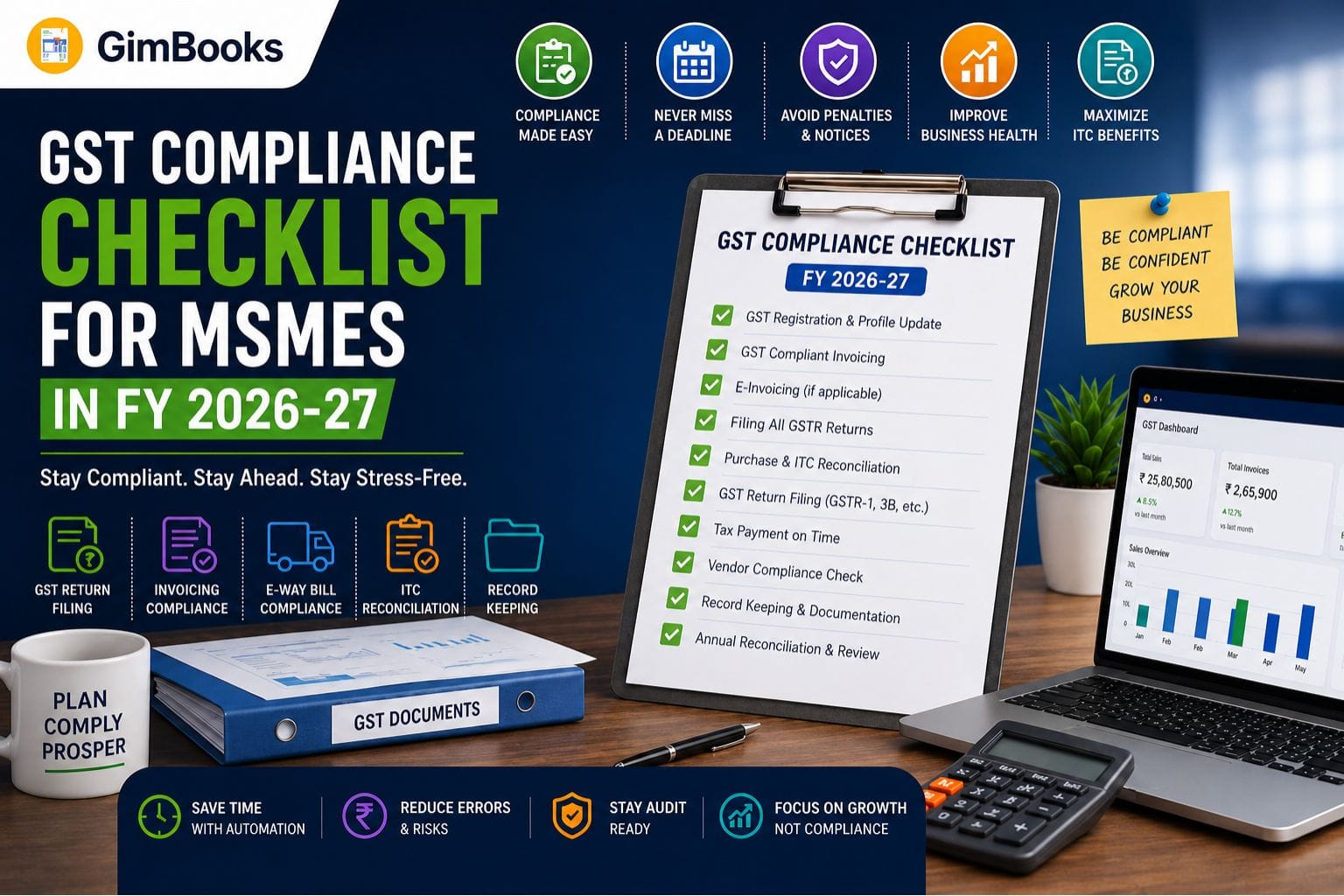
GST Compliance Checklist for MSMEs in FY 2026-27: Complete Guide
Key Takeaways
- GST compliance is no longer limited to filing returns; it includes invoicing, reconciliation, e-Way Bills, ITC management, and record maintenance.
- MSMEs that follow a structured GST compliance checklist can reduce penalties, notices, and cash flow disruptions.
- Monthly and quarterly GST obligations should be tracked using a compliance calendar.
- Proper invoice management and reconciliation improve Input Tax Credit (ITC) accuracy.
- Billing software can automate many GST compliance activities and reduce manual effort.
- Regular GST reviews help businesses stay prepared for audits and regulatory changes.
Introduction
For MSMEs, GST compliance has become a critical part of day-to-day business operations. Beyond tax payments and return filing, businesses must ensure accurate invoicing, Input Tax Credit (ITC) reconciliation, e-Way Bill generation, record maintenance, and timely reporting. Missing even a small compliance requirement can lead to penalties, blocked ITC claims, delayed refunds, or GST notices.
As GST systems become increasingly digitized in FY 2026-27, small businesses, startups, traders, manufacturers, distributors, service providers, and growing enterprises need a clear compliance framework. A structured GST compliance checklist helps MSMEs stay organized, avoid costly mistakes, and focus on business growth.
This guide provides a practical GST compliance checklist for FY 2026-27, covering monthly, quarterly, annual, and ongoing compliance responsibilities.
Why GST Compliance Is Important for MSMEs
Many small businesses view GST compliance as a periodic filing activity. In reality, GST compliance directly impacts cash flow, vendor relationships, audit readiness, and business credibility.
A disciplined compliance process can help businesses:
- Avoid interest and penalties
- Claim eligible ITC correctly
- Improve financial accuracy
- Reduce audit risks
- Maintain smooth business operations
- Improve vendor and customer confidence
With increasing automation in GST systems, compliance errors are becoming easier for authorities to detect.
GST Compliance Calendar for FY 2026-27
Before reviewing individual compliance tasks, MSMEs should understand the key compliance areas they must monitor throughout the year.
Core GST Compliance Activities
Maintaining a compliance calendar significantly reduces missed deadlines.
GST Registration Compliance Checklist
The first step toward GST compliance is ensuring registration details remain accurate and up to date.
Verify GST Registration Details
Businesses should periodically review:
- Legal business name
- GSTIN
- Business address
- Contact details
- Authorized signatory information
- Principal place of business
Incorrect registration details can create return filing and invoice-related issues.
GST Invoice Compliance Checklist
Invoice-related errors remain one of the most common reasons for GST notices and reconciliation problems.
Businesses should establish a standard invoicing process.
Ensure Every GST Invoice Includes
- Invoice number
- Invoice date
- Supplier GSTIN
- Customer GSTIN (where applicable)
- HSN/SAC code
- Product or service description
- Taxable value
- GST rate
- CGST, SGST, IGST breakup
- Place of supply
- Authorized signature
GST Invoice Verification Table
Proper invoicing helps prevent ITC mismatches later.
Input Tax Credit (ITC) Compliance Checklist
Input Tax Credit is one of the biggest financial benefits under GST. However, many MSMEs lose eligible credits due to poor reconciliation practices.
Monthly ITC Review Checklist
Match Purchase Records
Compare purchase invoices with supplier submissions.
Verify Vendor GST Compliance
Ensure vendors file returns on time.
Review Missing Credits
Identify invoices not reflecting in GST records.
Remove Ineligible ITC
Avoid claiming restricted credits.
Monitor Vendor Mismatches
Follow up with suppliers for corrections.
Why ITC Reconciliation Matters
Regular reconciliation helps:
- Prevent blocked credits
- Improve cash flow
- Reduce notices
- Strengthen audit preparedness
Monthly reviews are easier than correcting issues at year-end.
GST Return Filing Checklist
GST return filing remains one of the most important compliance responsibilities for MSMEs.
Businesses should maintain proper records before filing returns.
Before Filing GST Returns
- Verify sales invoices
- Verify purchase invoices
- Check GST liability
- Reconcile ITC claims
- Review credit notes
- Verify debit notes
- Confirm tax payments
GST Return Preparation Checklist
Preparing returns carefully reduces future corrections.
E-Way Bill Compliance Checklist
Businesses involved in goods movement must comply with e-Way Bill requirements.
This applies particularly to:
- Manufacturers
- Traders
- Distributors
- Wholesalers
- Logistics companies
Verify Before Generating E-Way Bills
- Correct invoice details
- Accurate vehicle information
- Proper transporter details
- Correct distance information
- Matching GST details
Common E-Way Bill Errors
- Wrong GSTIN
- Incorrect invoice numbers
- Invalid vehicle details
- Distance mismatches
- Expired e-Way Bills
Regular reviews help avoid transportation disruptions.
E-Invoicing Compliance Checklist
Although e-Invoicing applicability depends on turnover thresholds notified by the government, eligible businesses must ensure compliance.
E-Invoicing Readiness Checklist
- ERP integration configured
- GSTIN validation completed
- Invoice numbering standardized
- HSN codes updated
- Tax rates reviewed
- IRN generation tested
Businesses nearing turnover thresholds should prepare in advance.
Vendor Compliance Monitoring Checklist
Your GST compliance depends partly on your vendors' compliance.
Many ITC issues arise due to supplier filing delays.
Review Vendors Regularly
- GST registration status
- Return filing behavior
- Invoice accuracy
- Credit note issuance
- GSTIN validity
Vendor monitoring protects eligible tax credits.
Record-Keeping Checklist Under GST
GST law requires businesses to maintain proper records for specified periods.
Organized records simplify audits and compliance reviews.
Documents MSMEs Should Maintain
Sales Records
- Tax invoices
- Credit notes
- Debit notes
Purchase Records
- Vendor invoices
- Import documents
GST Records
- Return filings
- Payment challans
- Reconciliation reports
Inventory Records
- Stock registers
- Movement records
Monthly GST Compliance Checklist for MSMEs
A monthly review process keeps compliance manageable.
Monthly Checklist
Sales Review
Ensure all invoices are recorded.
Purchase Review
Confirm all supplier invoices are captured.
ITC Reconciliation
Match available credits.
GST Liability Review
Verify tax payable.
Vendor Compliance Review
Check key supplier filings.
Return Filing Preparation
Prepare required GST returns.
Quarterly GST Compliance Checklist
Businesses under QRMP and other applicable schemes should perform additional quarterly reviews.
Quarterly Tasks
- Compliance review meeting
- Vendor risk assessment
- ITC validation
- Tax liability analysis
- Business growth review
- GST process improvements
Quarterly reviews help identify recurring compliance gaps.
Annual GST Compliance Checklist
Year-end GST reviews help businesses close compliance gaps before audits.
Annual Review Areas
GST Return Reconciliation
Match annual turnover with filed returns.
Financial Statement Matching
Verify GST records align with books of accounts.
ITC Review
Check pending and reversed credits.
Vendor Verification
Review high-value vendor transactions.
Compliance Documentation
Organize audit-ready records.
Common GST Compliance Mistakes MSMEs Must Avoid
Many compliance issues occur due to routine operational mistakes.
Missing Filing Deadlines
Late filing attracts interest and penalties.
Incorrect GST Rates
Wrong tax rates affect return accuracy.
Poor ITC Reconciliation
May result in blocked credits.
Invoice Errors
Incorrect GSTINs create matching issues.
Vendor Negligence
Non-compliant suppliers can impact your credits.
Manual Record Management
Increases risk of errors and missing data.
How GST Billing Software Improves MSME Compliance
Manual compliance management becomes increasingly difficult as businesses grow.
Modern GST billing software can automate:
- GST invoicing
- Tax calculations
- Invoice numbering
- E-Way Bill preparation
- Inventory updates
- Customer management
- Business reporting
- Compliance tracking
Automation reduces manual errors and improves overall compliance efficiency.
Why GimBooks Can Help MSMEs Stay GST-Compliant
For MSMEs looking to simplify compliance management, GimBooks provides features designed around day-to-day business operations.
Key capabilities include:
- GST-compliant invoicing
- Inventory tracking
- Business reporting
- Multi-business management
- Payment reminders
- Customer and supplier management
- Mobile billing
- Cloud access
- E-Invoice readiness
- E-Way Bill support
For growing businesses, these tools help reduce compliance workload while improving operational visibility.
Conclusion
GST compliance in FY 2026-27 requires much more than filing returns on time. MSMEs must manage invoicing, ITC reconciliation, vendor compliance, e-Way Bills, record maintenance, and tax reporting throughout the year.
By following a structured GST compliance checklist, businesses can reduce compliance risks, avoid penalties, protect eligible tax credits, and improve financial control. The most successful MSMEs treat GST compliance as an ongoing business process rather than a monthly task.
Investing in organized workflows, regular reviews, and automation tools can significantly improve compliance efficiency and support long-term business growth.
FAQs
What is the most important GST compliance requirement for MSMEs?
Timely return filing, accurate invoicing, and regular ITC reconciliation are among the most important GST compliance responsibilities.
How often should MSMEs perform GST reconciliation?
Monthly reconciliation is recommended to identify mismatches early and protect Input Tax Credit claims.
Can GST compliance mistakes lead to penalties?
Yes. Delayed filing, incorrect reporting, invoice errors, and non-payment of taxes can result in interest, penalties, and notices.
Is GST billing software necessary for MSMEs?
While not mandatory, GST billing software helps automate compliance tasks and significantly reduces manual errors.
How long should GST records be maintained?
Businesses should retain GST-related records for the prescribed period under GST regulations and applicable laws.
What is the biggest GST compliance risk for small businesses?
Poor ITC reconciliation and invoice mismatches are among the most common compliance risks.