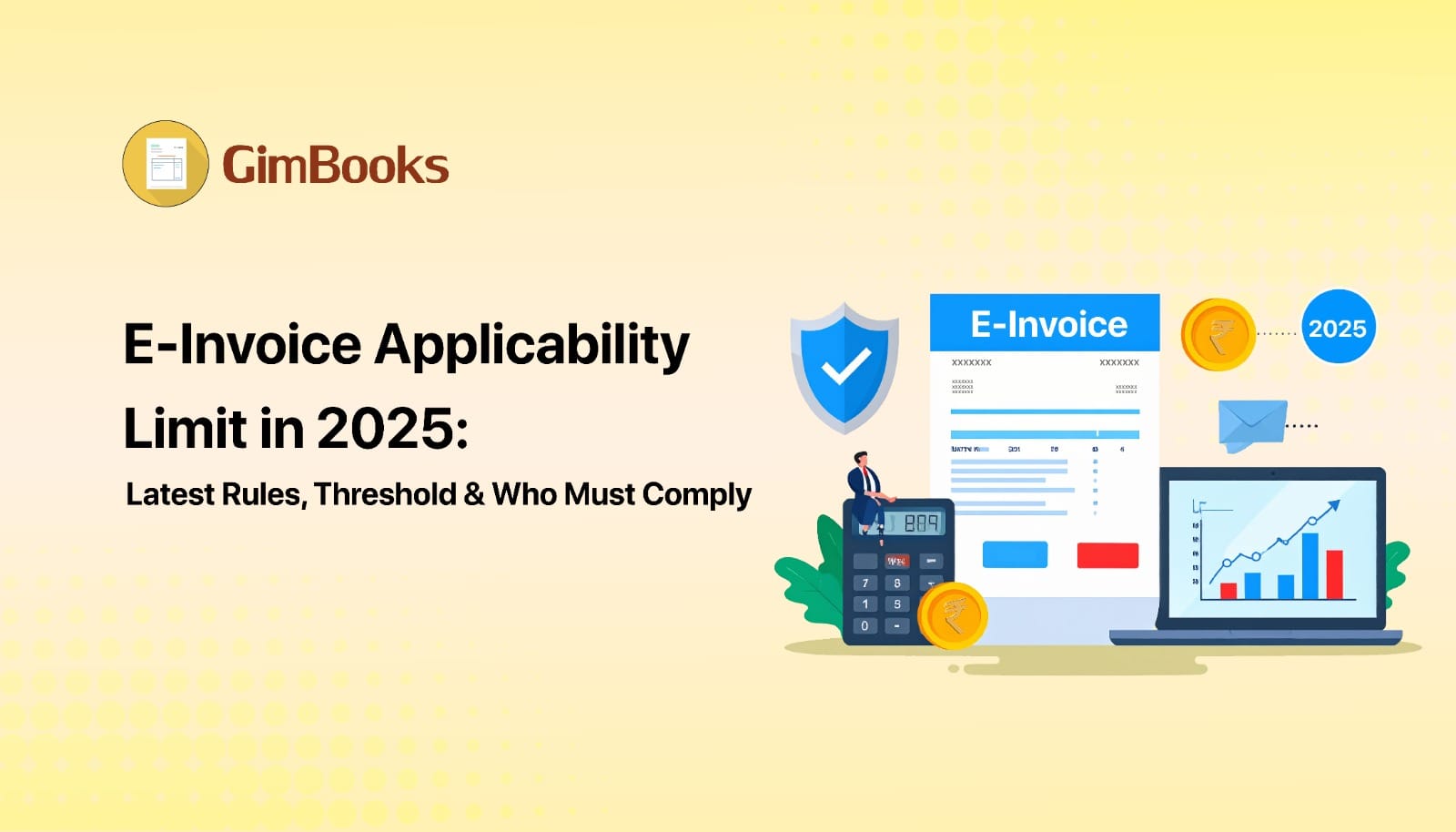
E-Invoice Applicability Limit in 2025-26: Latest Rules, Threshold & Who Must Comply
See if your business is required to issue e-invoices under GST in 2025. Understand the ₹5 crore limit, rules, and penalties.

Getting the hang of e-invoicing is becoming a must for small businesses in India. In 2026, it's more important than ever for these businesses to know the latest rules, what the new e-invoice applicability limits and thresholds are, and who needs to follow them. This isn't just about following the law; it's about making your invoicing work better.
In this blog, we will explain the e-invoice applicability limit for the financial year 2025-26. We will also guide small businesses on who must comply and how to stay GST-compliant.
What Exactly Is E-Invoicing?
So let’s break this down step by step. What is e-invoicing? How does the turnover threshold work? Who is exempt? And most importantly, how do you stay compliant without disrupting your business?
Understanding E-Invoicing
A lot of business owners hear “e-invoicing” and think that it means creating invoices on the GST portal. That’s not correct.
E-invoicing simply means that every invoice you generate through your own billing or accounting software must be reported to the Invoice Registration Portal (IRP). Once reported, the invoice gets a unique Invoice Reference Number (IRN) and a QR code.
That IRN makes the invoice valid under the GST law. Without it, the invoice is treated as invalid, no matter how professional or correct it looks.
The E-Invoice Applicability Limit in 2026
The government has been lowering the GST e-invoicing threshold gradually. In 2026, the limit is ₹5 crore.
That means if your aggregate turnover in any financial year since 2017-18 is ₹5 crore or more, you need to issue e-invoices for B2B transactions, exports, and certain government supplies.
How the E-invoicing Turnover Limit Changed Over Time
- October 2020: Started at ₹500+ crore
- January 2021: Reduced to ₹100 crore
- April 2022: Reduced to ₹20 crore
- October 2022: Reduced to ₹10 crore
- August 2023: Reduced to ₹5 crore (still applicable in 2026)
So, if you crossed ₹5 crore turnover at any point after 2017-18, the e-invoice mandatory limit applies to you now.
Who Must Comply With GST E-Invoicing Rules in 2026
Wondering who must comply with e-invoicing 2026? Here’s a clear guide for small and medium businesses.
You are required to issue e-invoices if:
- Your turnover exceeded ₹5 crore in any financial year from 2017–18 onwards
- You conduct B2B sales to other registered businesses
- You export goods or services
- You supply goods or services to government departments (B2G transactions)
Note on “aggregate turnover”: This refers to the total value of sales, including exports and exempt sales, across all GSTINs under your PAN. Businesses meeting these criteria are the ones who must comply with e-invoicing 2026
Who is Exempt From E-Invoicing
Not everyone with a turnover above ₹5 crore is required to comply. The following businesses are exempt from e-invoicing:
Banks, NBFCs, and insurance companies
- SEZ units (but not developers)
- Goods transport agencies (GTA)
- Passenger transport services
- Cinema ticket sellers
So even if these businesses cross the e-invoice turnover limit, they don’t need to issue e-invoices.
Why Does the Government Want E-Invoicing?
The idea is simple: make GST compliance smoother, reduce fake invoicing, and create a real-time flow of data into the GST system.
Here’s How The E-invoicing Limit Can Help You:
- Input Tax Credit (ITC) claim becomes easier as the buyers can claim ITC without disputes.
- GST return filing gets easier since data is already shared with the GST system.
- Reduced fraud as the fake invoices are harder to generate.
How to Check If You Are E-invoicing Compliant
Many businesses are unsure whether they’re required to issue e-invoices. Use this simple check:
-
Add up your total turnover (taxable, exempt, exports—everything).
-
Include turnover from all branches/GSTINs under your PAN.
-
See if it crossed ₹5 crore in any financial year since 2017–18.
If your turnover has crossed ₹5 crore in any year since 2017–18, you must comply with the GST e-invoice rules (e-invoicing limit applicable in 2026).
What Happens If You Ignore the E-Invoice Rules?
This is where the rules get strict. If you don’t generate an e-invoice when required, the following issues affect your business:
- Your invoice becomes invalid under the GST law
- Your customer can’t claim ITC
- You may face penalties up to ₹25,000 per invoice
- Your reputation with clients may take a hit
So, ignoring the e-invoice applicability limit is not really an option.
Check - Top 6 GST Rules From 1 January 2026
How to Get Started With E-Invoicing
If you’ve confirmed you’re required to comply, here’s what to do next:
Update your billing software – It should support e-invoice generation and IRP integration.
- Register on the Invoice Registration Portal (IRP)—usually handled by your software provider.
- Train your team—they need to know how to generate and validate invoices.
- Test the system—run trial invoices before going live.
With GimBooks, e-invoicing is easy!
All you need to do is click on an invoice.
Then click on the e-invoice option below the invoice; that will convert the invoice to an e-invoice quickly!!
From this point, every eligible invoice will have an Invoice Reference Number (IRN) and QR code.
E-Invoicing for Service Providers vs Traders
Many service providers assume e-invoicing doesn’t apply to them. That’s not true.
If you’re in consulting, IT, logistics, or any service sector and your turnover is above ₹5 crore, you must issue e-invoices for your B2B clients. The GST e-invoice turnover limit applies equally to traders and service providers.
To know more, explore GimBook’s blog for small businesses!
Explore latest update - Complete Guide to E-Invoice Updates in India by 2026: Rules, Deadlines, and Compliance
Avoid Common e-Invoicing Mistakes by Small Businesses
-Believing the e-invoice rule applies only to the current year (it applies to any year since 2017-18)
-Skipping e-invoicing for branches with smaller turnovers (it applies to all GSTINs under your PAN)
-Issuing invoices without IRN and QR code (these are invalid)
-Forgetting to check exemption lists.
Avoiding these mistakes can save you both money and trouble.
Read more about e-invoicing
The Bottom Line
The e-invoice applicability limit in 2026 is ₹5 crore, and if your business crosses that line, e-invoicing is no longer optional. It’s the law.
Yes, it requires some adjustment, but once you set it up, it can actually simplify your billing and reduce errors. This makes your compliance quick, easy, and free from penalties.
Explore more - E-Invoice Limit in India: Updated Guide for Businesses
E-invoice software to create e invoice in minutes
FAQs on GST E-Invoicing Limit 2026
What is the e-invoice limit under GST in 2026?
The GST e-invoice limit in 2026 remains ₹5 crore. Any business with an Aggregate Annual Turnover (AATO) exceeding ₹5 crore in any financial year from 2017-18 onwards must generate e-invoices.
Is e-invoicing mandatory for ₹5 crore turnover in 2026?
Yes. If your turnover is ₹5 crore or more, e-invoicing is mandatory. Additionally, as of April 1, 2025, businesses with a turnover of ₹10 crore or more must report invoices to the portal within a strict 30-day window. If you cross ₹10 crore, you cannot generate an e-invoice for a bill older than 30 days.
Who is exempt from e-invoicing in 2026?
E-invoicing does not apply to Special Economic Zone (SEZ) Units, Insurers, Banking companies, NBFCs, Goods Transport Agencies (GTA), Passenger Transport Services, or Multiplex Cinema admissions.
Pro Tip: In 2026, exempt businesses should use the "E-invoice Exemption Declaration" functionality on the GST portal to avoid automated notices.
How can I determine whether an electronic invoice is required for my business in 2026?
Calculate your Aggregate Annual Turnover (AATO) by adding the turnover of all GSTINs under your PAN for any year since 2017-18. You can also log in to the e-invoice portal and use the "Check Enablement Status" tool with your GSTIN to see if the system has already flagged you for mandatory compliance.
What happens if I fail to issue electronic invoices when required in 2026?
If you fail to issue a valid e-invoice (with a signed IRN and QR Code):
- Invalid Document: The invoice is legally void, and goods can be seized in transit.
- ITC Denial: Your clients will see a "flag" in their Invoice Management System (IMS) and will be unable to claim Input Tax Credit (ITC).
- Penalties: You face a penalty of 100% of the tax due or ₹10,000 per invoice (whichever is higher) for non-issuance, and up to ₹25,000 for incorrect invoicing.