Best Billing Software for Multi-Business Owners in India (2026)
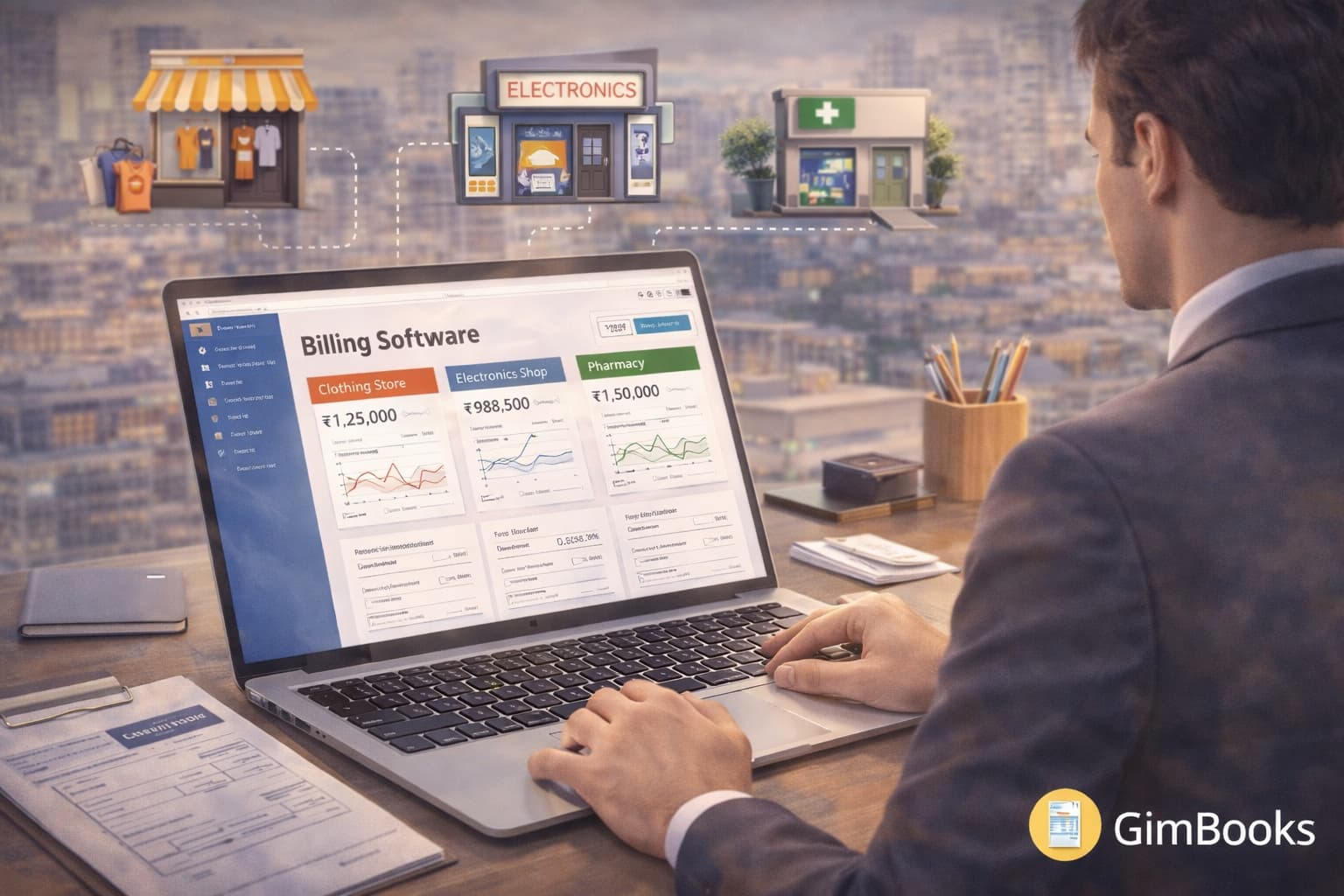
Running one business is already demanding. Managing two or more businesses simultaneously adds another layer of complexity. Entrepreneurs who operate multiple stores, branches, or different types of businesses often struggle with managing billing, inventory, and financial records separately.
Without the right tools, owners may end up using different billing systems for each business, which creates confusion and makes it difficult to track overall financial performance.
This is where multi business billing software becomes essential. Instead of juggling multiple tools, business owners can manage everything from a single platform.
In this guide, we will explain what billing software for multiple businesses is, why multi-business owners need it, the essential features to look for, and how cloud-based solutions like GimBooks help entrepreneurs manage multiple businesses efficiently.
What Is Multi-Business Billing Software?
Multi-business billing software allows an owner to manage two or more businesses, firms or business entities from one software platform while keeping each business's transactions and records separate.
Instead of maintaining different billing accounts for every venture, owners can use one login to switch between businesses, create invoices, monitor sales and review business-level reports.
A useful system should support:
- Separate business profiles and financial records
- Separate GSTIN and tax information where applicable
- Business-specific invoice numbering
- A centralized dashboard
- Quick switching between businesses
- Separate or business-level inventory records
- Multi-user access and permissions
- Business-wise reports
- Mobile and desktop access
This is particularly useful for owners managing different retail shops, trading businesses, service companies or businesses operating under different GST registrations.
Can You Manage Multiple Business Accounts From One Dashboard?
Yes, the right platform can allow you to manage multiple business accounts from one dashboard while keeping each business's invoices, customers, inventory and financial records separate.
For businesses with multiple entities, the important question is not simply whether a platform supports multiple businesses. Check how it separates GST details, invoice series, users, inventory and reports for each business.
Challenges Faced by Multi-Business Owners
Many entrepreneurs run multiple businesses in different industries or locations. While this helps diversify revenue, it also creates operational challenges.
Managing Multiple Billing Systems
Using separate billing tools for each business means more time spent logging into different platforms and reconciling financial records.
Tracking Sales Across Businesses
Without centralized reporting, owners cannot easily compare performance between businesses.
Handling Inventory for Multiple Stores
Businesses with multiple outlets often struggle with inventory tracking, leading to stock mismatches.
Maintaining GST Compliance
Generating GST-compliant invoices across multiple businesses can become complicated when handled manually.
Financial Reporting
Owners need accurate data to understand which business is performing well and which needs improvement.
These challenges highlight the need for billing software that helps manage multiple businesses with billing software from one system.
Multi-Business vs Multi-Branch vs Multi-Store: What Is the Difference?
These terms are related but can describe different operating structures.
If you are comparing multi branch accounting software, check whether it separates branch-level transactions without making it difficult to view the overall business.
For a multi store financial management system in India, inventory and sales synchronization across locations become especially important.
For billing and invoicing software for firms with multiple entities, verify that each entity can maintain its own tax information, invoice records and financial data rather than simply sharing one common profile.
For businesses moving goods between GST registrations, the billing workflow should also connect with the relevant documentation. See GimBooks' guide on e-way bill for branch transfers between GSTINs for the specific GST workflow.
Must-Have Features in Billing Software for Multi-Business Owners
Choosing the right solution requires understanding which features are necessary for managing multiple businesses efficiently.
Multi-Business Dashboard
A centralized dashboard allows users to manage all businesses from a single account.
This makes it easier to switch between companies and monitor operations.
GST-Compliant Invoicing
Businesses in India must generate invoices that comply with GST rules.
A good GST billing software automatically calculates tax rates and produces compliant invoices.
Inventory Management
If your businesses sell physical products, billing and inventory should work together rather than being maintained separately.
A useful system should allow each sale to update the relevant inventory records while keeping stock information organized by business, store or location where applicable.
Look for:
- Real-time stock updates after sales and purchases
- Business- or location-level inventory visibility
- Low-stock alerts
- Product and SKU management
- Purchase tracking
- Stock movement reports
- Multi-store or warehouse support
This is especially important when an owner manages multiple businesses with different product catalogs. The goal is to answer both questions from the same system: what was sold and what stock is available now?
For a deeper look at integrated billing and stock management, see billing software with inventory management.
Real-Time Reports
For multiple businesses, reporting should provide visibility at both the individual-business and overall level.
Useful reports should help owners review:
- Sales by business
- Sales by branch or store
- Expenses by business
- Outstanding customer payments
- Inventory movement
- Profitability
- GST-related transactions
The important distinction is between separate reporting and consolidated visibility.
For example, an owner may want to see the sales of Business A without mixing them with Business B, while also being able to compare their overall performance.
When evaluating a multi-company financial reporting tool in India, check whether reports can be filtered by business, branch, location or other relevant operating unit.
Multi-User Access and Permission Control
Multi user billing software should do more than allow several people to log in.
For businesses with multiple employees, branches or companies, look for:
- Separate user logins
- Role-based permissions
- Business- or branch-level access
- Restrictions on sensitive financial information
- Owner or administrator controls
- Activity visibility where available
For example, a billing employee may only need permission to create invoices, while an owner or accountant may need access to reports, expenses and financial records.
This makes multi-user invoicing tools with permission control more practical for growing businesses and reduces the risk of giving every employee full access to every business record.
Cloud Backup and Security
Cloud-based systems store data securely and provide automatic backups.
This ensures important business records are protected.
Mobile Accessibility
For owners who manage businesses while travelling between stores, offices or locations, mobile access can be an important selection factor.
The best option for businesses that mostly use mobile phones should make it possible to perform essential tasks such as:
- Create or review invoices
- Check sales
- View outstanding payments
- Review inventory
- Check business reports
- Switch between supported business profiles
However, mobile access should not come at the expense of proper web or desktop functionality. Multi-business owners should check whether data remains synchronized across supported devices so the owner and staff are working from the same records.
Should Billing, Accounting and Inventory Be in One System?
For owners managing multiple businesses, using separate tools for billing, inventory and accounting can create duplicate data entry and reconciliation work.
An integrated system can connect:
Billing → Inventory → Payments → Accounting → Reports
This means an invoice can update the relevant sales record, inventory can reflect the transaction, payment status can be tracked and the resulting information can feed into business reports.
This is particularly useful for businesses comparing multi-user accounting software in India, because the software needs to support both daily billing tasks and broader financial visibility.
Before choosing a platform, check whether billing, accounting and inventory are genuinely connected or simply offered as separate modules.
Billing Software vs Accounting Software for Multiple Businesses
Billing software primarily focuses on invoicing, sales and transaction management.
Accounting software provides broader financial functions such as ledgers, expenses, financial reports and accounting records.
For a multi-business owner, the better option may be a platform that connects both workflows so invoices, payments, inventory and financial records do not have to be maintained separately.
How to Choose the Best Billing Software for Multiple Businesses
When comparing the best billing software in India, multi-business owners should evaluate more than invoice creation.
Use these checks before selecting a platform:
What to Check Before Comparing Prices
The multi-user accounting software pricing you see advertised may not be the final cost for a multi-business operation.
Check whether the plan includes:
- Multiple businesses
- Additional users
- Additional devices
- Inventory
- Advanced reports
- E-invoicing
- E-way bills
- Data export
- Customer support
Compare the plan that matches your actual requirements rather than comparing only the lowest advertised price.
A Simple Buying Checklist
Before choosing billing and invoicing software for firms with multiple entities, confirm:
- Can I manage all required businesses from one account?
- Does each business retain separate records?
- Can I maintain the correct GST information for each business?
- Can employees have different permissions?
- Can I track inventory separately?
- Can I compare business performance?
- Can I access the system from mobile and desktop?
- Can I export my data?
- Can the software support additional businesses as I grow?
How to Choose the Best Billing Software for Multiple Businesses
Selecting the right billing software for multiple businesses requires careful evaluation.
Ease of Use
The interface should be simple enough for business owners and staff to use without extensive training.
Multi-Business Capability
The software should support multiple businesses under one account with clear separation of financial records.
GST Compliance
Indian businesses must follow GST regulations, so the software should generate GST-compliant invoices automatically.
Inventory Integration
Inventory tracking is important for retailers and wholesalers managing multiple stores.
Scalability
As businesses grow, the software should be able to support additional users, locations, or products.
Mobile Accessibility
Mobile access allows owners to manage operations remotely.
Reliable Customer Support
Technical support ensures businesses can resolve issues quickly and maintain uninterrupted operations.
Why GimBooks is a Good Choice for Multi-Business Owners
For entrepreneurs searching for the best billing software for multi business owners, GimBooks offers features designed specifically for small businesses.
Manage Multiple Businesses in One Account
GimBooks allows business owners to manage multiple businesses from one platform while maintaining separate business records.
This can help owners reduce the need to switch between different billing systems when managing multiple ventures. It also provides a central place to handle billing and review business information.
GST-Ready Invoices
The platform generates GST-compliant invoices automatically, ensuring accurate tax calculations.
Sales, Expense, and Inventory Tracking
Instead of managing invoices, stock registers, customer balances and financial records separately, GimBooks helps connect billing, purchases, inventory, payments and reports in one practical system.
For a multi-business owner, this can make it easier to review business activity while keeping day-to-day billing and inventory workflows organized.
Real-Time Business Insights
Built-in reports provide detailed insights into business performance.
Mobile and Desktop Access
Because the system is cloud-based, owners can manage their businesses from anywhere using mobile or desktop devices.
Entrepreneurs interested in simplifying their operations can explore the platform here:
Conclusion
Managing multiple businesses can be challenging without the right tools. Entrepreneurs often struggle with tracking sales, maintaining inventory, and ensuring GST compliance across different businesses.
The right multi business billing software helps centralize operations, improve financial visibility, and simplify everyday tasks.
With features such as centralized dashboards, GST-compliant invoicing, inventory tracking, and real-time reports, modern billing software allows business owners to manage their operations more efficiently.
Solutions like GimBooks make it easier for entrepreneurs to manage multiple businesses with billing software from a single platform, saving time and improving accuracy.
By adopting the right technology, business owners can focus more on growth while keeping their financial and operational processes organized.
Related - How to Select Billing Software That Scales With Your Business (And When It’s Time to Switch)
FAQs
What is the best billing software for multi-business owners?
The best billing software for multi-business owners is a platform that allows users to manage multiple businesses from a single account while keeping financial data separate. Solutions like GimBooks help business owners generate GST invoices, track sales, and manage inventory across different businesses through one dashboard.
Why do entrepreneurs need multi-business billing software?
Entrepreneurs running multiple businesses often face challenges such as managing invoices, tracking sales, and maintaining separate financial records. Multi-business billing software simplifies these tasks by providing centralized management, automated billing, and detailed business reports.
What features should multi-business billing software include?
Multi-business billing software should include features such as:
- Multi-business dashboard
- GST-compliant invoicing
- Inventory management
- Sales and expense tracking
- Real-time reports
- Cloud access and data backup
- Multi-user access
These features help business owners manage operations efficiently across multiple businesses.
Is cloud billing software better for managing multiple businesses?
Yes, cloud billing software is often more effective for multi-business owners because it allows access from anywhere, provides automatic data backups, and enables real-time synchronization across devices. Business owners can monitor sales, invoices, and financial reports even when they are not physically present at their stores.
Can billing software help track sales for multiple branches?
Yes, advanced billing software allows businesses to track sales for different branches or businesses separately. Owners can generate reports for each location and compare performance, helping them make better operational and financial decisions.
Is billing software necessary for small businesses with multiple shops?
Billing software is highly beneficial for businesses operating multiple shops because it automates invoicing, tracks inventory across locations, and generates financial reports. It reduces manual errors and helps business owners maintain accurate records while managing several outlets efficiently.
What is the difference between accounting software and billing software?
Billing software focuses primarily on invoice generation, sales tracking, and GST billing, while accounting software provides broader financial management such as profit and loss reports, balance sheets, and expense tracking. Many modern platforms combine both capabilities to help businesses manage their finances in one place.
Can billing software generate GST invoices automatically?
Yes, most modern GST billing software automatically calculates GST rates and generates compliant invoices. This helps businesses reduce manual work and ensures invoices follow GST regulations, which is especially useful for entrepreneurs managing multiple businesses.
Can I manage multiple businesses with different GST registrations in one billing software?
Yes, some billing platforms support multiple businesses or entities under one account. Before choosing one, check whether each business can maintain its own GST details, invoice records, customers, inventory and reports separately.
What is the difference between multi-business and multi-branch billing software?
Multi-business software is designed for managing separate businesses or entities, while multi-branch software focuses on different locations or branches of a business. The right setup depends on how your businesses are structured and whether they require separate tax and financial records.
Does multi-user billing software provide permission controls?
Some multi-user billing platforms provide role-based permissions that allow owners to control what employees, accountants or managers can view or change. Check whether permissions can be assigned according to your business and user requirements.
Can billing software connect invoicing, accounting and inventory?
Yes, some platforms connect invoicing with inventory, payments, accounting and reporting. This can reduce duplicate data entry and make it easier to maintain consistent business records.