10 Best Accounting & Bookkeeping Software for Sole Traders in 2026
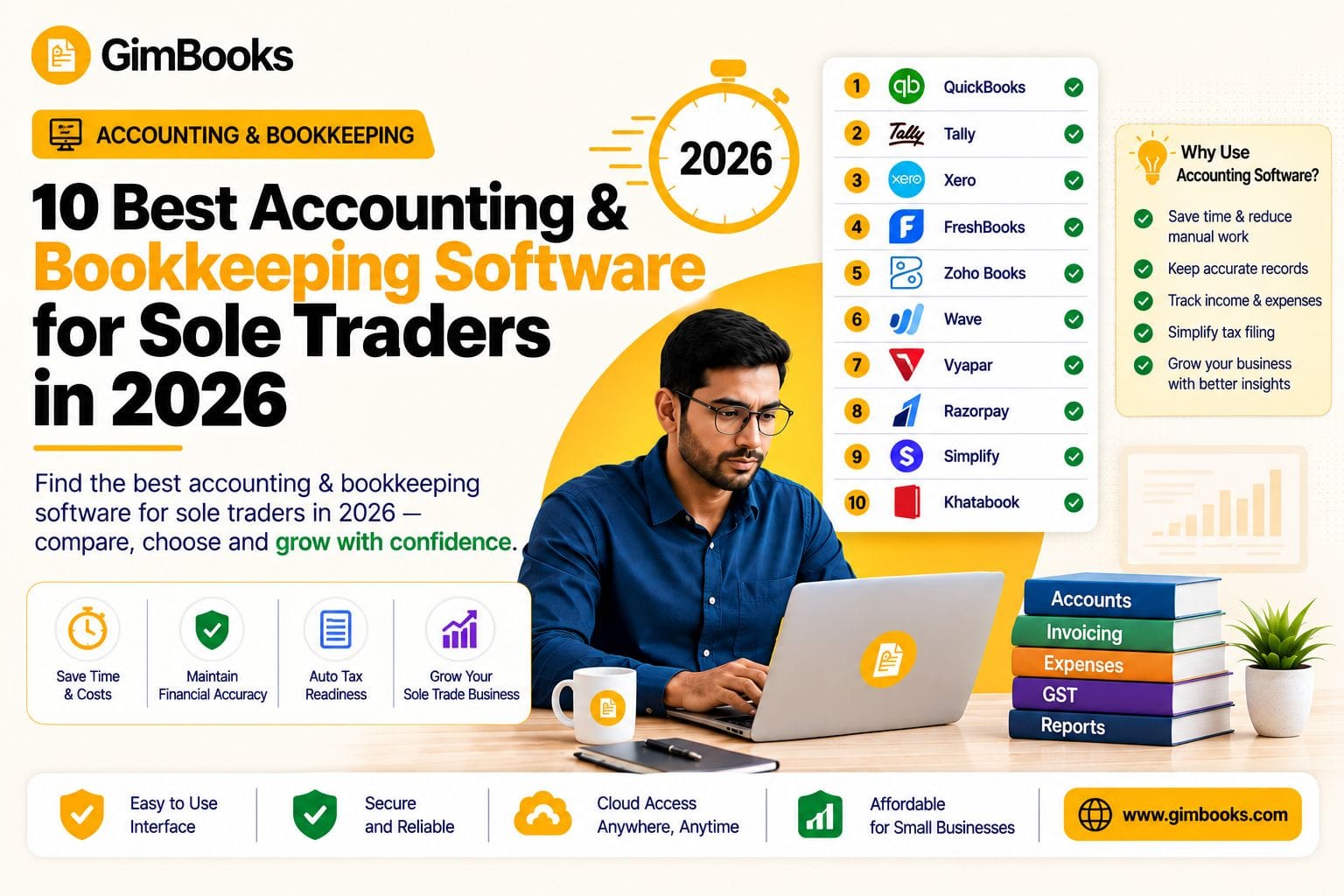
Running a business as a sole trader means managing sales, expenses, payments, invoices and financial records—often without a dedicated accounting team. The right accounting and bookkeeping software for sole traders can reduce manual work and give you a clearer view of your business finances.
For Indian businesses, a sole trader is commonly referred to as a sole proprietor. Along with regular bookkeeping, Indian sole proprietors may also need GST billing software, inventory management, payment tracking, business reports, e-invoicing and e-way bill support.
In this guide, we compare 10 popular bookkeeping and accounting software options for sole traders, sole proprietors, freelancers and self-employed business owners. We look at ease of use, invoicing, expenses, accounting capabilities, mobile access and suitability for Indian businesses.
What Should Sole Traders Look for in Accounting Software?
Good sole trader accounting software should do more than simply record income and expenses. It should reduce repetitive bookkeeping work while making important financial information easy to access.
Before choosing an accounting app or bookkeeping platform, consider these features:
Easy Invoicing
You should be able to create, share and track invoices without maintaining separate spreadsheets or documents.
Income and Expense Tracking
Recording business income and expenses regularly makes it easier to understand profitability and maintain accurate financial records.
Payment and Outstanding Tracking
The software should show which invoices have been paid and which customers still owe money.
Financial and Business Reports
Profit, sales, expenses, party ledgers and other reports help sole traders understand how the business is performing.
Mobile and Cloud Access
A good sole trader accounting app should allow business owners to access important information when they are away from their shop or office.
Inventory Management
For traders, wholesalers and retailers, accounting software with inventory management can help track stock alongside purchases and sales.
Tax and GST Support
Indian sole proprietors should consider whether their software supports GST-compliant invoices, GST reports and other applicable compliance requirements.
The right choice depends on whether you are a freelancer, consultant, retailer, wholesaler, contractor or another type of self-employed business owner.
Top 10 Bookkeeping Software for Sole Traders in 2026
Let’s take a look at the most popular options. We’ve listed other tools for comparison, but you’ll see why GimBooks is the best choice, especially if you're a mobile-first user based in India or the Middle East.
1. GimBooks: Best for Indian Sole Proprietors and Small Businesses
GimBooks is a cloud-based billing, bookkeeping and accounting platform designed primarily for Indian small businesses. It can be accessed through mobile and web applications, making it useful for sole proprietors who manage their business while moving between customers, stores or worksites.
Key Features
- GST-compliant invoicing
- Bookkeeping and accounting
- Expense tracking
- Purchase management
- Customer and supplier ledgers
- Inventory management
- Payment reminders
- Business reports
- E-invoicing
- E-way bill generation
- GST filing support
- Web and mobile access
Best For
GimBooks is particularly relevant for Indian retailers, traders, wholesalers, service businesses and other sole proprietors looking for GST billing software for small businesses that combines billing, bookkeeping, inventory and GST-related workflows in one platform.
Limitation to Consider
Businesses that require highly specialized enterprise accounting, complex international accounting workflows or a large ERP environment may need to compare GimBooks with more advanced accounting systems.
If you're looking for the best bookkeeping software for sole traders in 2026, GimBooks is your answer.
2. QuickBooks: Popular International Accounting Software, but Not Available in India
QuickBooks is one of the most widely recognized accounting platforms globally and offers invoicing, expense tracking, reporting and other small-business accounting tools in supported markets.
However, Indian sole proprietors should be aware that Intuit discontinued QuickBooks Online products and services in India. Therefore, it should not be considered a current India-focused alternative to GimBooks, TallyPrime, Zoho Books, Vyapar or other locally supported platforms.
Best For
Businesses operating in countries where QuickBooks products are currently supported.
Consider Another Option If
You are an Indian sole proprietor who specifically needs local GST billing, GST reporting, e-invoicing or other India-focused workflows.
3. Xero: Good for Tech-Savvy Users
Xero is popular for its cloud features and third-party app support. It works well for those who understand digital tools.
Pros:
- Clean interface
- Good for global users
Cons:
- Expensive for basic needs
- Not beginner-friendly
Why GimBooks is better: Mobile-first, simple design, and tailored to sole traders without needing an accountant.
4. Zoho Books: Good for Cloud Accounting and Automation
Zoho Books is a cloud accounting platform suitable for freelancers, sole traders and small businesses. It provides invoicing, expense management, accounting, reporting and automation features and integrates with other products in the Zoho ecosystem.
Best For
Sole proprietors who want cloud-based accounting and expect to use additional business automation or Zoho applications.
Consider Before Choosing
The broader feature set and configuration options may be more than very small businesses need if their primary requirements are simple billing, GST management and everyday bookkeeping.
5. Wave: Best Free Option (Limited to US/Canada)
Wave offers free bookkeeping software for freelancers and small businesses but only supports payments in the US and Canada.
Pros:
- Free accounting and invoicing
- Simple dashboard
Cons:
- Not available for Indian or Middle Eastern users
- No GST/VAT support
Why GimBooks is better: It fully supports GST and VAT, is made for Indian and Middle Eastern users, and offers local features.
6. FreshBooks: Good for Freelancers
FreshBooks is easy to use and popular among freelancers and small service providers.
Pros:
- Clean and user-friendly
- Good time-tracking features
Cons:
- Not focused on inventory or product businesses
- Higher pricing for more clients
Why GimBooks is better: More features for traders, contractors, shopkeepers, and service providers alike plus more affordable.
7. TallyPrime: Trusted Name in India
TallyPrime is well-known in India and is used mostly by accountants and larger businesses.
Pros:
- Good desktop-based features
- Strong GST support
Cons:
- Less mobile-friendly
- Needs training or accountant help
Why GimBooks is better: Mobile-first, easy for non-accountants, and built with local language and industry options.
8. Sage Accounting: Good for UK and AU Markets
Sage offers robust tools for small businesses, especially in the UK and Australia.
Pros:
- Powerful financial tools
- Multi-currency support
Cons:
- Expensive
- Not tailored for Indian markets
Why GimBooks is better: Perfect for sole traders in India and the Middle East, with better pricing and localized features.
9. Vyapar: Indian Alternative
Vyapar is another local tool offering invoicing and bookkeeping services.
Pros:
- Simple invoice creation
- GST support
Cons:
- Fewer updates
- Basic user experience
Why GimBooks is better: More advanced mobile features, better interface, and smoother user flow.
10. Busy Accounting: Local Desktop Software
Busy is a desktop software used by Indian SMEs. It's strong in accounting but not great for mobile or cloud users.
Pros:
- GST compliance
- Strong backend features
Cons:
- Not mobile-first
- Hard to use without training
Why GimBooks is better: It works from your phone, auto-syncs with the cloud, and fits into your daily work without hassle.
Explore - Top Free Expense Tracking Software for Small Business 2026
Best Accounting & Bookkeeping Software for Sole Traders: Comparison
Note: Features, pricing and regional availability can change. Businesses should check the provider's current plan and local tax support before subscribing.
Sole Trader vs Sole Proprietor: Is There a Difference?
The terms sole trader and sole proprietor generally describe a business owned and operated by one individual, although the terminology commonly used differs by country.
“Sole trader” is frequently used in markets such as the UK and Australia, while Indian businesses more commonly use the term sole proprietorship or sole proprietor.
This distinction is important when choosing accounting software because tax, invoicing and compliance requirements vary by country.
For an Indian sole proprietor, features such as GST invoicing, HSN/SAC support, GST reports, inventory tracking, e-invoicing and e-way bills may be more important than features designed around tax systems in other countries.
How to Choose the Best Accounting Software for a Sole Trader
There is no single accounting app that is best for every sole trader. Start by identifying the tasks you perform most often.
Choose Based on Your Business Type
Freelancers and consultants:Prioritize invoicing, expenses, payment tracking and simple financial reports.
Retailers and shop owners:Look for billing, inventory, barcode support, customer ledgers and GST features.
Wholesalers and traders:Inventory, purchase management, outstanding payments, supplier records and GST reporting become more important.
Growing sole proprietors:Look for software that can continue supporting your business as invoice volume, inventory and transactions increase.
Questions to Ask Before Selecting Software
- Can I create and send invoices quickly?
- Can I track expenses and outstanding payments?
- Does it generate the reports I actually need?
- Can I access it from my phone?
- Does it support my country's tax requirements?
- Can it manage stock if I sell products?
- Can I share financial information with my accountant?
- Will the software still suit the business as transaction volume grows?
Testing shortlisted platforms before committing is usually better than choosing solely on price.
Free Bookkeeping Software for Sole Traders: What Are the Options?
Free accounting software can work for sole traders with very basic requirements, but it is important to distinguish between a completely free product, a limited free plan and a free trial.
Free plans may place restrictions on invoices, reports, users, transactions, integrations or support. Therefore, the cheapest option may not always be the best option once the business starts growing.
GimBooks currently provides a free trial that allows businesses to test its billing and accounting features before choosing a paid plan.
You can review the current GimBooks pricing and plans or compare its free trial vs paid plans before deciding.
During the trial, sole proprietors can evaluate whether features such as invoicing, bookkeeping, expenses, inventory and reports fit their day-to-day workflow.
Why GimBooks Works Well for Indian Sole Proprietors
International accounting platforms can be powerful, but Indian sole proprietors often need a different combination of features: simple billing, GST compliance, payment tracking, inventory and access from a mobile device.
GimBooks combines these everyday business requirements within one platform. Businesses that need a deeper introduction to digital record keeping can also read this guide to online bookkeeping software for small businesses.
Indian sole proprietors can use GimBooks to:
- Create GST-compliant invoices
- Record purchases and expenses
- Maintain customer and supplier ledgers
- Track outstanding payments
- Manage inventory
- Generate business reports
- Create e-invoices and e-way bills where applicable
- Access business information from mobile and web
- Prepare and manage GST-related records
This makes it particularly relevant to retailers, wholesalers, traders, contractors and service providers that need more than a basic invoice generator but do not want unnecessary accounting complexity.
Which Accounting Software Should a Sole Trader Choose?
The best accounting software for a sole trader depends on business type, location and the complexity of day-to-day financial management.
Freelancers may prioritize simple invoicing and expense tracking, while retailers and traders may need inventory, purchase management and payment tracking. Indian sole proprietors should additionally consider GST invoicing, GST reporting, e-invoicing and e-way bill capabilities where relevant.
Platforms such as Xero, FreshBooks, Zoho Books and Sage serve different accounting requirements, while TallyPrime, Vyapar, BUSY and GimBooks provide options relevant to Indian businesses. You can also compare the broader factors involved in choosing accounting software for small businesses in India.
For sole proprietors who want a mobile-friendly platform combining GST billing, bookkeeping, accounting, inventory, expenses and reports, GimBooks is worth evaluating.
Try the platform with your actual business workflow before deciding whether it is the right long-term accounting solution.
Also check - Gimbooks - Billing Software for Mobile Shop
FAQs
What is the best accounting software for a sole trader?
The best accounting software depends on the business. Indian sole proprietors may prioritize GST invoicing, expense tracking, inventory, payment tracking and business reports. GimBooks, Zoho Books, TallyPrime, Vyapar and BUSY are among the options worth comparing for Indian businesses.
What is the best bookkeeping software for sole traders?
Look for bookkeeping software that can manage invoices, income, expenses, payments and financial reports without requiring excessive manual data entry. Businesses selling products should also consider inventory and purchase management.
What is the best accounting app for a sole trader?
A good sole trader accounting app should allow users to create invoices, record expenses, check payments and access reports from a mobile device. Indian businesses should additionally check whether the app supports GST-related requirements.
Do sole traders need accounting software?
Very small businesses can maintain records manually, but accounting software can simplify invoicing, expense tracking, financial records, outstanding payments and reporting as transaction volume grows.
Is there free accounting software for sole traders?
Yes. Some providers offer free plans, while others provide time-limited free trials. Compare the limits on invoices, reports, users, transactions and tax features before selecting a free option.
Is bookkeeping software different from accounting software?
Bookkeeping primarily focuses on recording financial transactions such as income, purchases and expenses. Accounting software generally goes further by providing financial reports, ledgers, reconciliation and other tools for understanding the overall financial position of the business.
Is a sole trader the same as a sole proprietor?
They describe very similar one-owner business structures, but terminology varies by country. “Sole proprietor” and “sole proprietorship” are more commonly used in India, while “sole trader” is widely used in countries such as the UK and Australia.
Can sole trader accounting software manage GST?
Some India-focused accounting platforms support GST-compliant invoices, GST reports and related workflows. Check exactly which GST features are included in the software and subscription you select.
Is QuickBooks available for sole proprietors in India?
QuickBooks remains available in various international markets, but Intuit discontinued QuickBooks Online products and services for customers in India. Indian sole proprietors should therefore compare currently supported local alternatives.
Can GimBooks be used by sole proprietors?
Yes. GimBooks provides billing, bookkeeping, accounting, expense tracking, inventory, reports and GST-related tools designed for Indian small businesses, making it suitable for many sole proprietors.