
TDS Return Due Date FY 2026–27: Payment Dates, Quarterly Filing, Forms & Penalties
Key Takeaways
- TDS payment due date: Usually the 7th of the next month for non-government deductors.
- March TDS payment due date: 30 April 2027 for March 2027 deductions.
- TDS return due dates FY 2026–27: 31 July 2026, 31 October 2026, 31 January 2027 and 31 May 2027.
- New TDS forms from TY 2026–27: Form 138 replaces 24Q, Form 140 replaces 26Q and Form 144 replaces 27Q.
- TCS return form: Form 143 replaces 27EQ for TY 2026–27.
- Late filing fee: ₹200 per day, subject to the applicable TDS amount.
- Important control: Reconcile PAN, challan, deductee and form details before filing.
Protean’s TDS/TCS return utility page confirms TY 2026–27 forms: Form 138 for earlier 24Q, Form 140 for earlier 26Q, Form 144 for earlier 27Q and Form 143 for earlier 27EQ.
TDS Due Dates FY 2026-27: Quick Overview
TDS compliance requires businesses to deposit deducted tax on time and file quarterly TDS returns within the prescribed deadlines. For FY 2026-27, TDS payments are generally due by the 7th of the following month, while quarterly TDS returns must be submitted by the applicable quarterly deadlines.
Introduction
Managing TDS is one of those responsibilities that many small business owners and finance teams underestimate—until penalties start adding up. Keeping track of tds return due dates fy 2026-27 and tds payment due dates fy 2026-27 is not just about compliance; it directly affects your business credibility and cash flow.
In India, TDS rules require you to deduct tax, deposit it on time, and file returns correctly. Missing even one step can lead to interest, penalties, and notices from the tax department. For freelancers, startups, and MSMEs, this often becomes confusing due to multiple deadlines.
This guide simplifies everything. You will learn exactly when to pay TDS, when to file returns, what mistakes to avoid, and how to stay compliant without stress.
What is TDS?
Before understanding deadlines, it’s important to clearly know what TDS actually means in day-to-day business transactions.
TDS (Tax Deducted at Source) is a system where tax is deducted at the time of making payments like salary, rent, commission, or professional fees. The responsibility of deducting and depositing this tax lies with the payer.
Why TDS Matters for You
- Ensures tax is collected in advance
- Helps avoid large tax payments later
- Builds compliance record for your business
Simple example:You pay ₹50,000 to a freelancer → Deduct ₹5,000 (10%) → Pay ₹45,000 → Deposit ₹5,000 to the government.
If you deduct TDS, you must:
- Deposit it on time
- File TDS returns
TDS Payment Due Dates FY 2026-27
Once TDS is deducted, the next step is depositing it with the government. This must be done within strict timelines.
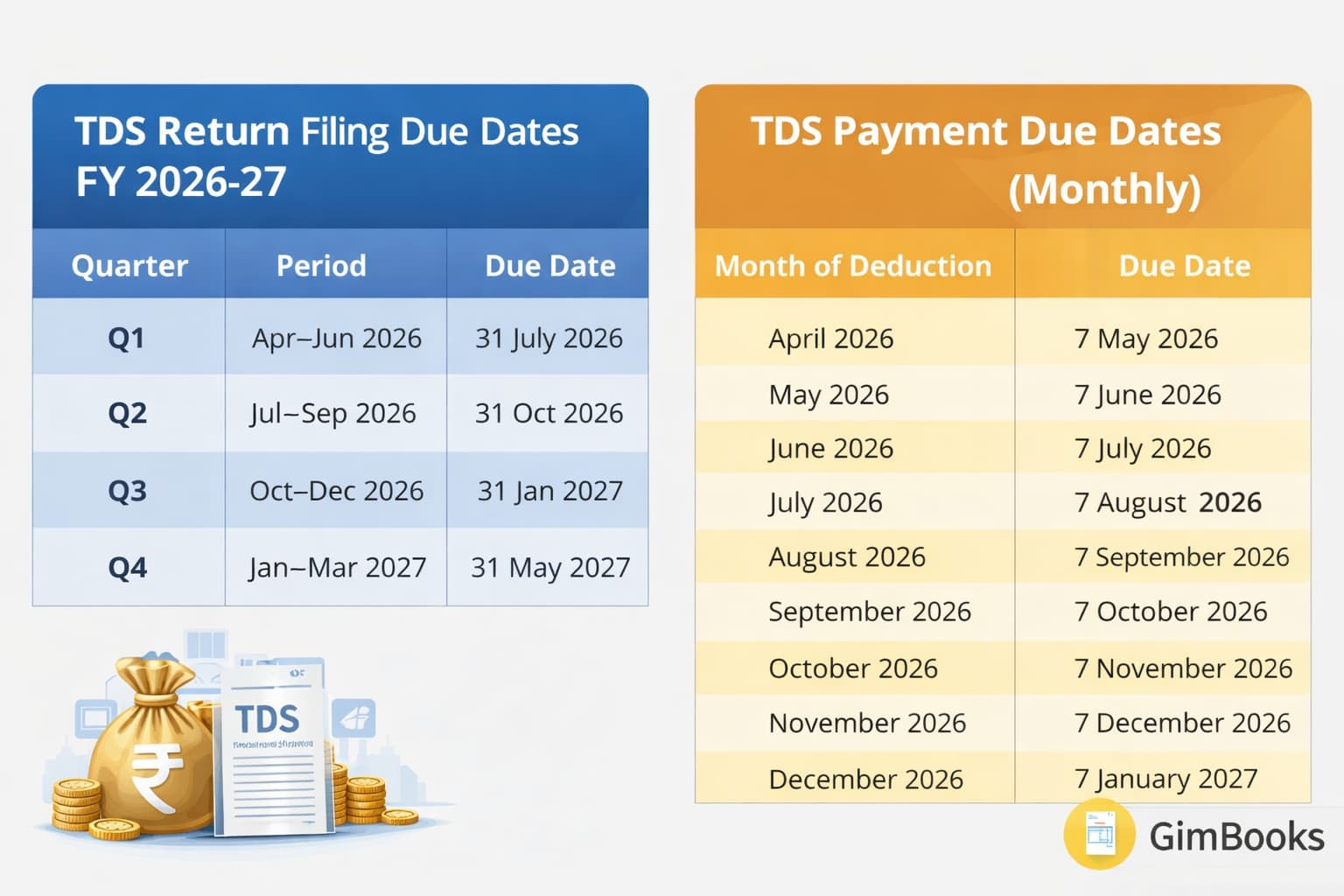
Most businesses follow a monthly TDS deposit system, which means every deduction made in a month must be paid by the 7th of the following month. Missing this deadline results in automatic interest charges.
Upcoming TDS Due Dates: August to October 2026
Note: If you are updating after 7 September, move the first row to September/October focus.
The official transition FAQ confirms that for April 2026 onward, non-government TDS deposit due dates remain the 7th of the next month, and Q2 TY 2026–27 return filing is due by 31 October 2026.
TDS Payment Due Dates (Monthly)
Download TDS Payment & Return Due Date Calendar FY 2026–27
Practical Insights for Businesses
- March has a special extended deadline due to year-end adjustments
- Even a 1-day delay can attract interest
- Always use Challan 281 for payment
- Keep proof of payment (CIN number)
Best practice: Set a reminder for the 5th of every month to avoid last-minute rush.
TDS Return Filing Due Dates (Quarter-wise)
After depositing TDS, you must file returns to report details of deductions. This is where many small businesses face issues due to incorrect filing or missed deadlines.
TDS returns are filed quarterly, not monthly. These returns ensure that the deducted tax is correctly reflected in the recipient’s Form 26AS.
TDS Return Filing Due Dates FY 2026-27
Why Filing Returns is Important
- Ensures vendors/employees get tax credit
- Avoids penalties and notices
Maintains compliance record
Even if TDS is deducted correctly, not filing returns = non-compliance.
What is the due date for TDS return FY 2026-27?
The tds return filing due dates fy 2026-27 follow a quarterly system. For example, the return for April to June must be filed by 31 July 2026, while the last quarter return is due by 31 May 2027.
These timelines are fixed and missing them leads to daily penalties.
Forms for Filing TDS Returns
Many businesses get confused about which form to use. Choosing the correct form is essential for smooth filing.
Each form corresponds to a specific type of payment.
Practical Tip
- Most MSMEs and freelancers use Form 26Q
- Always verify PAN details before filing
- Incorrect form = rejection or correction notice
Penalty for Late Filing
Penalties are one of the biggest risks in TDS compliance. Even small delays can result in noticeable financial impact.
Late Filing Fee (Section 234E)
- ₹200 per day until return is filed
- Cannot exceed total TDS amount
Example: Delay of 20 days = ₹4,000 penalty
Penalty (Section 271H)
- ₹10,000 to ₹1,00,000
- Applicable for serious delays or incorrect filing
What Happens If You Miss TDS Due Dates?
Include:
- Interest on late payment
- Late filing fees
- Impact on compliance records
TDS Return Forms Applicable in FY 2026-27
Business Insight
For small businesses, repeated delays can significantly increase compliance costs and attract scrutiny.
Interest on Late Payment
Interest is charged automatically if TDS is not deducted or deposited on time. This is separate from penalties.
Example
If ₹50,000 TDS is delayed by 2 months: Interest ≈ ₹1,500
This adds up quickly if delays happen frequently.
Prosecution for Non-Compliance
In serious cases, especially when TDS is deducted but not deposited, legal action may be taken.
This includes:
- Heavy penalties
- Possible prosecution
While rare, this applies in cases of intentional non-compliance.
Old TDS Forms vs New TDS Forms for FY 2026–27
Q2 TDS Return Due Date FY 2026–27
For deductions made during July to September 2026, the Q2 TDS return due date is 31 October 2026. Businesses should reconcile TDS challans, deductee PAN, payment entries and form selection before filing.
Use the correct form based on the payment type:
How to File TDS Return (Step-by-Step)
Filing TDS returns becomes easier when you follow a structured process. Most errors happen due to incorrect data or rushed filing.
Steps:
- Prepare return using software
- Verify challan and PAN details
- Login to TRACES portal
- Upload return file
- Validate using DSC/EVC
- Submit and track status
Practical Tip
- Always reconcile data before filing
- Use accounting software to reduce errors
Common Mistakes to Avoid
Many penalties occur due to simple mistakes that can be avoided with proper checks.
Common Errors
- Missing payment or filing deadlines
- Incorrect PAN details
- Wrong challan mapping
- Mismatch between payment and return
Simple solution: Maintain a monthly checklist and review before submission.
How to Pay TDS Online for FY 2026–27
- Visit the Income Tax e-pay tax portal.
- Select TDS/TCS payment.
- Enter TAN and assessment year.
- Select the correct payment type and applicable section/table reference.
- Enter tax, interest, fee, or penalty amount.
- Choose bank/payment mode.
- Submit payment.
- Save challan receipt and CIN.
- Reconcile challan before filing the TDS return.
Warning : For transactions on or after 1 April 2026, use the applicable Income Tax Act, 2025 section/table reference while reporting TDS. Quoting old sections such as 194C or 194J may cause validation errors.
TDS Due Dates Under Income Tax Act, 2025: What Changed from 1 April 2026?
- TDS rates and thresholds are largely retained.
- Reporting references changed under the new Act.
- TDS provisions are consolidated under Section 393.
- TCS provisions are consolidated under Section 394.
- Old section references can create processing errors for post-1 April 2026 transactions.
- Payroll/ERP/accounting systems should be updated.
The Income Tax Department states that rates and thresholds remain the same, but systems must reflect new section numbering, terminology, and reporting requirements under the Income Tax Act, 2025.
TDS Compliance Calendar 2026 (Quick View)
A simple compliance calendar helps you stay organized and avoid missing deadlines.
Compliance Summary
TCS Payment and Return Due Dates FY 2026–27
Businesses that collect Tax Collected at Source must deposit the collected amount with the Central Government and file a quarterly TCS statement within the prescribed deadlines. For FY 2026–27, also referred to as Tax Year 2026–27 under the Income Tax Act, 2025, the TCS return must be filed using the new Form 143 for collections made from 1 April 2026 onward.
TCS Payment Due Dates FY 2026–27
For most non-government collectors, TCS collected during a month must be deposited with the Central Government within seven days from the end of that month. Unlike the special March deadline available for certain TDS deposits, there is no separate extended March deadline for regular TCS payments.
Government offices must generally deposit TCS on the same day when payment is made without an income-tax challan. Where payment is made with a challan, it must generally be deposited within seven days from the end of the month in which the tax was collected.
Explore - Difference between TDS and TCS
TCS Return Filing Due Dates FY 2026–27
TCS returns are filed quarterly. For collections relating to Tax Year 2026–27, the new Form 143 replaces Form 27EQ.
The collector should reconcile all TCS payments, challan details, PAN information and collect-wise transactions before filing the quarterly return. The statement includes details such as the amount received or receivable, applicable TCS rate, tax collected, date of collection and date of deposit.
Form 27EQ and New Income Tax Act Transition
Form 27EQ was the quarterly TCS statement used under the Income Tax Act, 1961. From 1 April 2026, Form 143 is used for TCS statements governed by the Income Tax Act, 2025.
The transition works as follows:
Form 143 is filed under Section 397(3)(b) of the Income Tax Act, 2025 and Rule 219 of the Income Tax Rules, 2026. It covers TCS collected on specified transactions such as scrap, liquor, forest produce, motor vehicles, foreign remittances, overseas tour packages and other prescribed transactions.
After Form 143 is processed, the TCS certificate is issued in Form 133, which replaces Form 27D under the old Act. The certificate should generally be issued to the collectee within 15 days from the due date of filing Form 143.
Important: Form 27EQ should continue to be used for TCS collections relating to periods up to 31 March 2026, including correction statements for those periods. Form 143 should be used for TCS collections from 1 April 2026 onward.
Also check - TDS payment and deduction rules
Simplify TDS Compliance with GimBooks
Managing tds return filing due dates fy 2026-27 and tds payment due dates fy 2026-27 manually can become time-consuming, especially for small businesses and growing teams. Missing even one deadline can lead to penalties, interest, and unnecessary stress.
GimBooks is a practical solution designed for Indian businesses to handle accounting, GST, and TDS-related tasks in one place. It helps reduce manual work and ensures better accuracy in day-to-day compliance.
How GimBooks Helps with TDS Compliance
- Easy invoicing & expense tracking: Keep all financial records organized for accurate TDS calculation
- Automated reports: Generate reports required for TDS filing and reconciliation
- Error reduction: Minimize mistakes in entries, reducing chances of wrong deduction or filing
- Centralized dashboard: Track payments, expenses, and compliance status in one place
- Supports growing businesses: Suitable for freelancers, startups, and MSMEs
For businesses managing multiple payments and vendors, having a system like this can simplify compliance and reduce dependency on manual tracking.
Start managing your accounting and compliance more efficiently with GimBooks.
Explore - GST Penalties and Appeals Explained
Conclusion
Handling tds return filing due dates fy 2026-27 and payment deadlines becomes easy when you follow a structured approach.
Key takeaways:
- Pay TDS on time
- File returns quarterly
- Avoid common mistakes
For small businesses and professionals, staying consistent with compliance not only avoids penalties but also builds a strong financial foundation.
Related - TDS & TCS Rate Chart for FY 2026–27
FAQs on TDS Return and Payment Due Dates FY 2026–27
1. What is the TDS return due date for FY 2026–27?
TDS returns for FY 2026–27 must be filed quarterly. The due dates are 31 July 2026 for Q1, 31 October 2026 for Q2, 31 January 2027 for Q3 and 31 May 2027 for Q4. These deadlines apply to the relevant salary, resident non-salary and non-resident TDS return forms unless the government announces an extension.
2. What is the TDS payment due date for March 2027?
For a non-government deductor, TDS deducted during March 2027 must generally be deposited by 30 April 2027. This is an exception to the normal rule under which TDS is usually deposited by the seventh day of the following month.
3. What is the Q1 TDS return due date for FY 2026–27?
The Q1 TDS return for deductions made from April to June 2026 must be filed by 31 July 2026. Deductors should reconcile the challan, deductee, PAN and TDS payment details before submitting the quarterly statement.
4. What is the Q4 TDS return due date for FY 2026–27?
The Q4 TDS return for deductions made from January to March 2027 must be filed by 31 May 2027. This is also the quarter in which employers provide the complete annual salary and TDS details required in the salary statement.
5. What is the difference between the TDS payment due date and TDS return due date?
The TDS payment due date is the deadline for depositing the tax deducted with the Central Government. The TDS return due date is the deadline for filing a quarterly statement containing deductee-wise, challan-wise and payment-wise details. TDS is generally deposited monthly, while TDS returns are filed quarterly.
6. How do I pay TDS online for FY 2026–27?
Log in to the Income Tax e-filing portal using the organisation’s TAN and go to e-File → e-Pay Tax → New Payment. Select the Income Tax Act, 2025 for Tax Year 2026–27, choose the TDS/TCS payment option, enter the applicable table reference and payment details, select a payment method and complete the payment. Download and retain the challan receipt and CIN for reconciliation and return filing.
7. Which form is used for salary TDS return?
For salary paid during FY 2026–27, employers must file Form 138 under the Income Tax Rules, 2026. Form 138 replaces the earlier Form 24Q and is filed quarterly for TDS deducted from salary under Section 392 of the Income Tax Act, 2025.
8. Which form is used for non-salary TDS return?
For non-salary payments made to resident deductees during FY 2026–27, deductors must use Form 140, which replaces Form 26Q. For payments made to non-residents, Form 144 replaces the earlier Form 27Q.
9. Can a TDS return be revised?
A submitted TDS return cannot normally be edited directly. However, the deductor can file a correction statement after the original statement has been processed by CPC-TDS. The correction may be used to update incorrect PAN details, challan information, deduction amounts, section references or deductee records, subject to the applicable time limit.
10. What happens if TDS is not deposited on time?
If TDS has been deducted but is not deposited by the due date, interest is generally charged at 1.5% per month or part of a month from the date of deduction until the date of actual payment. The deductor may also be treated as an assessee in default and may face recovery proceedings, penalties, prosecution in serious cases and disallowance of part of the related business expenditure, where applicable.
11. What is the late filing fee under Section 234E?
Under Section 234E of the Income-tax Act, 1961, a late filing fee of ₹200 per day applies until the delayed TDS or TCS statement is filed. The total fee cannot exceed the amount of TDS or TCS reported in the statement. For statements governed by the Income Tax Act, 2025, the equivalent late-filing provision is Section 427, which retains the ₹200-per-day fee and the same cap.
12. Are TDS due dates changed under the Income Tax Act, 2025?
No major policy change has been made to the standard TDS payment and quarterly return deadlines under the Income Tax Act, 2025. The payment timelines remain broadly the same, but the section references, challans and return forms have changed. Businesses must use the new Act references and forms for payments or credits made from 1 April 2026 onward.
13. What is the TDS payment due date for August 2026?
For TDS deducted in August 2026, the payment due date is 7 September 2026 for most non-government deductors.
14. What is the Q2 TDS return due date for FY 2026–27?
The Q2 TDS return for July to September 2026 is due on 31 October 2026.
15. Which form replaces Form 26Q from FY 2026–27?
For TY 2026–27, Form 140 replaces the earlier Form 26Q for non-salary TDS payments to resident deductees. The Income Tax Department’s Form 140 manual describes it as the quarterly statement earlier known as Form 26Q.
16. Which forms are used for TDS returns in FY 2026–27?
For TY 2026–27, salary TDS is reported in Form 138, non-salary resident TDS in Form 140 and non-resident TDS in Form 144.
17. Was the Q1 TDS return due date extended?
The standard Q1 TDS return due date for April to June 2026 was 31 July 2026. Unless a separate government extension applies, deductors should follow the prescribed due date.